Brian’s Column: Do jokes have a place in road safety?

Brian’s Column: Do jokes have a place in road safety?

Our regular columnist on all things Africa, Mr Brian Bilal Mwebaze is back with another topical column on jokes in road safety. Is there a place for comedy in road safety messaging? Does it work? Some organizations believe it does and others believe it doesn’t. Here, Brian lays the argument down for you to think about.

Farting in public is commonly seen to be funny , in many African cultures and Kids will not hold their insatiable quest to burst out laughing at it especially if its made by an adult. Upon talking of the innocence of kids, have you signed the #SaveKidsLives campaign yet?

Speaking of (farting), your job will drop having read that an Indian tribe in South America called the Yanomami fart as a greeting, and in China you can actually get a real job as a professional fart-smeller! It gets more interesting because termites are leading criminals in contributing to climate change as they fart more than any other animal producing a record of methane gas. But again, we don’t wanna be professors of farting. I don’t mean to turn this into an article about passing wind but you get my idea; lots of comedy is often based on this form of toilet humour.  We were saying…Yes, Jokes.

A few days after the International Road Federation Conference, Michael (not real names) and I headed to catch a movie in Addis Ababa’s most gliding Cinema Hall, and as we were coming back, we grabbed a taxi driven by what we would later find out, 23 year old Abyi (not real names). Our driver correctly put on his seatbelt and off we drove. We had hardly been 500m’s distance when his mobile went into an awe of ‘Pick-Up-The-Damn-Phone’ ringtone.

WHO notes that distracted driving is a serious and growing threat to road safety. With more and more people owning (sexy) mobile phones, and the rapid introduction of new “invehicle” communication systems, this problem is likely to escalate globally in the coming years. Studies suggest that drivers using a mobile phone are approximately four times more likely to be involved in a crash than when a driver does not use a phone:-and that weren’t prepared for.

Distracted driving takes many forms, read more in the Youth and Road Safety Action Kit.

Being safety freaks (read enthusiasts), we held our breath to see if Abyi would pick it up. In an instant, he reached out to the phone and hit the hands-free mode. On the other line was a ‘Hello Sweetie…’ and well, what? Sorry but the next seemingly 6 words were in a Hebrew of the local language and none of us understood a word apart from ‘Shalom’. While we automatically asked him to stop the car, which he did, our temperatures were infinitely increased by his ‘smart response’. 

“See homies, I am a responsible hi-tech geek who uses a hands free hitech”, there smiling wryly, he said it in a trademark English-Ahmaric accent. According to him, this was supposed to be a joke.

A study by Lewis (2013) on a fresh approach for road safety campaigns through humour revealed that, irrespective of age and gender, humour that was clever, incorporated something unexpected and contrasting with the everyday, was a preferred and relevant approach, thus aligning with incongruity-based theories of humour generation and humour types, such as comic wit and satire. 

As a persuasive function, humorous messages were considered likely to be talked about (and relatively more so than traditional fear-based approaches). Participants also felt that humorous messages would need to be used cautiously as humour that was considered inappropriate and/or associated with serious occurrences, such as a crash, would be unlikely to persuade. Lewis notes that humourous campaigns are not jokes.

Do humour approaches work? Take this example from MAC in Australia.

I am quite sure you have heard about peers, comedians, movie stars and musicians making some road safety messages/programmes a butt of jokes. For a field that is the leading cause of death for young people aged 15-29, contributing 1.3 million deaths annually worldwide, you honestly got the balls to call this a joke? With estimated 50 million injuries documented annually, should we be making fun of something that changes the lives of someone, a family, a community and a country physically, economically, socially and psychologically?

Sometimes jokes and humour can play a role in making sense of what is happening in our world, in a light-hearted fashion and sometimes but sometimes they ridicule the essential elements of road safety. If we get the balance right, maybe jokes do have a role? Or maybe not? I feel that jokes have no place in road safety…but that is my view! What’s yours? 

Tweet your views to Brian and YOURS

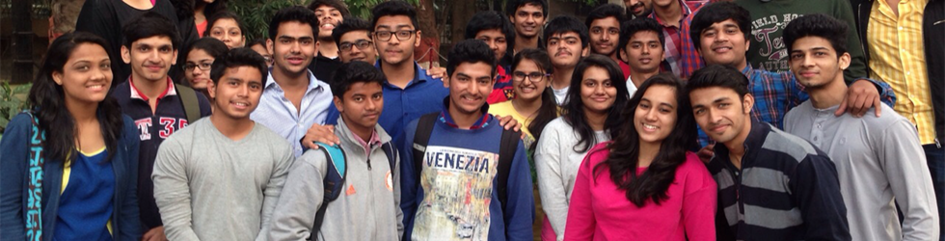
Delegates for International Road Federation Conference 2015 participate in #SaveKidsLives Campaign. (Photo credits-International Road Federation)
Updates from the 4th Meeting of Global Alliance of NGOs for Road Safety

Updates from the 4th Meeting of Global Alliance of NGOs for Road Safety

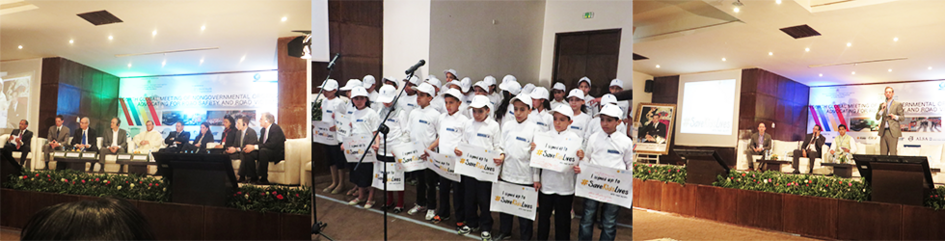
The Fourth Global Meeting of Non-Governmental Organizations Advocating for Road Safety and Road Victims was  held on 13 and 14 March 2015 in Marrakech, Morocco with participation of 170 delegates from 52 countries. YOURS was involved with a ‘pre-conference’ workshop on Fundraising alongside FedEx as well as represented the youth voice within the Alliance meeting.

Students studying Traffic Engineering with a focus on road traffic safety, in their pre-exam period worked on a special road safety campaign project; shooting video and creating the preliminary design of posters.

The aim of the campaign is to point out how dangerous it is to use a mobile phone while driving, whether for communication and especially when taking photos a.k.a #selfies. Although the Law on Road Traffic Safety allowed the use of hands-free devices, it is not considered completely safe and recommended that the mobile phone is not used while driving.

The Global Alliance of NGOs for Road Safety is an umbrella organization that represents over 130 NGOs active in road safety in more than 90 countries. Among other activities, every two years the Alliance produces a Global Meeting of Road Safety NGOs. To date they have held these meetings in Belgium, the United States, and Turkey.

The Fourth Global Meeting of Non-Governmental Organizations Advocating for Road Safety and Road Victims was held on 13 and 14 March 2015 at the Zalagh Kashbar Hotel & Spa in Marrakech, Morocco. The Fourth Global Meeting was kindly sponsored by the National Committee for Prevention of Road Accidents (Morocco), Global Road Safety Facility, World Bank, Allianz and FedEx.

Pre-Training Workshop

Prior to the workshop on the 12th March, YOURS parterned with FedEx and Safe Kids Worldwide to build the capacity of NGOs interested in gaining new knowledge on Fundraising. “How to “sell” your project and get funded”. Workshop in proposal writing and idea pitching. The workshop offered leads of NGOs the opportunity to learn about the NGO and Corporate Sector approach to partnership and funding explorations.

The training was run by Shane O’Connor; Communication Advisor at FedEx, Priti Gautam; Program Manager, International Pedestrian Safety at Safe Kids Worldwide, Floor Lieshout; Director at YOURS Youth for Road Safety and Manpreet Darroch; Communications Officer at YOURS Youth for Road Safety.

The objective for the day of training was to build the expertise level of the participants in developing a strong request for funds proposal.

The training took participants through a range of topics including understanding where to access grants, who provides them and what can you do to maximize your chances of being funded. Shane O’Connor of FedEx explained what corporations are looking for in a grantee including the desirable organizations as well as exmaples of good and bad grant writing practise. At the end, participants pitched for a real life project that they decided for in groups and were given feedback.

Students studying Traffic Engineering with a focus on road traffic safety, in their pre-exam period worked on a special road safety campaign project; shooting video and creating the preliminary design of posters.

The aim of the campaign is to point out how dangerous it is to use a mobile phone while driving, whether for communication and especially when taking photos a.k.a #selfies. Although the Law on Road Traffic Safety allowed the use of hands-free devices, it is not considered completely safe and recommended that the mobile phone is not used while driving.

A selection of photos from the closing of the workshop with certificates.

The fundraising workshop group take a group picture.

4th Global Meeting of the NGO Alliance

On the 13th and 14th March 2015, the 4th meeting of the Global Alliance for Road Safety convened and gave NGOs from around the world a great opportunity to share practise and meet one another. A range of topics were focused on during the meeting with objectives:

  • Organize the Alliance Second Assembly
  • Share knowledge, experiences, and good practices on road safety
  • Strengthen the capacity of participating NGOs for project management
  • Encourage and mobilize the NGO contribution to the Third UN Road Safety Week
  • Mobilize NGO contribution for the Ministerial Conference on Road Safety in Brazil, November 2015
  • A full breakdown of the conference agenda can be found here.

YOURS had the opportunity to share the Youth and Road Safety Action Kit with Minister of Equipment and Transport Najib BOULIF

Dubai student filmmaker nominated for awards for road safety film

Dubai student filmmaker nominated for awards for road safety film

Charlie Cracknell’s film titled ‘Safe Driving Saves Lives’ was recently nominated for Best Picture and Best Editing at the THIMUN Qatar Northwestern Film Festival held annually in Doha, Qatar. The THIMUN Qatar Northwestern Film Festival attracts young film makers from around the world. The Festival serves as a platform for young people to create advocacy films on local or global issues.

Through his film, Charlie hopes to make drivers stop and think before picking up their phones to text whilst driving which endangers not only their lives but also the lives of others as every single day many people die as a result.

In a study in the US alone over 3,000 people are killed each year through texting and driving.

“After witnessing someone in the car next to us texting and driving, I started researching the dangers and was shocked to discover that not only is ‘Texting and Driving’ now the leading cause of teen deaths but over 83 percent of adults use their phones whilst driving!

My challenge for this short film was to make people think seriously about the danger of texting and driving whilst avoiding anything too graphic or gory so that the film would make a real impact but also could be viewed by adults as well as children.” This year’s festival will be held from April 2-4, 2015.

YOURS wishes Charlie the best of luck in claiming an award for road safety and encourages him to continue to create these engaging and thought provoking messages for the cause! 

Youth to talk about road safety practices at Marrakech NGO meet

Youth to talk about road safety practices at Marrakech NGO meet

A group of Serbian students recently shared their campaign video with us on the trend of young using social media behind the wheel. In their efforts to raise awareness, the girls have created a campaign video focusing on “selfies” behind the wheel. Check it out here.

Students studying Traffic Engineering with a focus on road traffic safety, in their pre-exam period worked on a special road safety campaign project; shooting video and creating the preliminary design of posters.

The aim of the campaign is to point out how dangerous it is to use a mobile phone while driving, whether for communication and especially when taking photos a.k.a #selfies. Although the Law on Road Traffic Safety allowed the use of hands-free devices, it is not considered completely safe and recommended that the mobile phone is not used while driving.

Eighteen-year-old Akash Shah, a city-based activist who spearheads the non-profit organization (NPO) Action For Pune Development, is busy making last-minute preparations for his big day. Shah has been selected to speak at the Fourth Global Meeting of NGOs dealing with road safety to be held in Marrakech, Morocco on March 13.

“It is great that the committee selected a speaker on the basis of work. This is a very big platform and is a great opportunity for the youth group to express its views,” said Shah, a resident of Satara Road who is studying mechanical engineering in a city college.

The event is being organized by the Global Alliance of NGOs for Road Safety, which represents over 130 NGOs dealing with road safety in 90 countries, in collaboration with the World Health Organization (WHO). Shah is the only youth delegate to be selected to attend the bi-annual meeting as a speaker this year. This year, the event aims at sharing knowledge, experiences and good practices on road safety. It will also encourage and mobilize NGOs to contribute to the Third United Nations (UN) Road Safety Week.

“At the meet, I will present the strategies that we applied for the SaveKidsLife campaign and how we managed to rope in so many people without spending a single rupee. I will also showcase how the youngsters were able to work together and advocate this programme,“ Shah added.

“Akash will share his experiences on the UN Road Safety Week’s official campaign #SaveKidsLives. He has been chosen as he has very successfully mobilized thousands of youth in India to sign the Child Declaration which is a key part of the campaign,” said Lotte Brondum, administrative director, Global Alliance of NGOs for Road Safety.

YOURS has been liaising with Akash on the #SaveKidsLives Campaign and we are looking forward to meeting him in person in Marrakesh.

According to Lotte, Shah was asked to advocate for road safety by the Federation Internationale de l’Automobile (FIA) Foundation and the alliance in January 2015. He has been asked to reach out to people with the ‘Save Kids Lives’ Campaign, which is an official campaign for the Third United Nations Road Safety Week in May 2015. The campaign is to sign the petition for children’s safety and the target of the alliance was to reach 1 lakh people globally. Shah reached a target of 25,000 supporters.

Shah will also run a workshop in association with the FIA Foundation to mobilize its members to take part in the UN campaign.

Representatives from the alliance said the global meet is a step towards preparations of NGOs ahead of the two important road safety events that will take place this year, the Third UN Road Safety Week in May and the Ministerial Conference on Road Safety in Brazil in November.

For the Ministerial Conference, alliance members will finalize a joint statement from NGOs to governments titled ‘The Marrakech Declaration’, which is a call for collaborative efforts on road safety.As many as 150 participants from NGOs, experts on road safety and prominent guest speakers from the civil society, public health and the host country’s government are expected to attend the meet.

Shah has been involved in social work for the past two years. In 2013, he entered the Limca Book of Records for being the youngest person to establish a non-profit organization.

Continuing the Post-2015 Development Agenda push – Policy Briefing

Continuing the Post-2015 Development Agenda push – Policy Briefing

A group of Serbian students recently shared their campaign video with us on the trend of young using social media behind the wheel. In their efforts to raise awareness, the girls have created a campaign video focusing on “selfies” behind the wheel. Check it out here.

Students studying Traffic Engineering with a focus on road traffic safety, in their pre-exam period worked on a special road safety campaign project; shooting video and creating the preliminary design of posters.

The aim of the campaign is to point out how dangerous it is to use a mobile phone while driving, whether for communication and especially when taking photos a.k.a #selfies. Although the Law on Road Traffic Safety allowed the use of hands-free devices, it is not considered completely safe and recommended that the mobile phone is not used while driving.

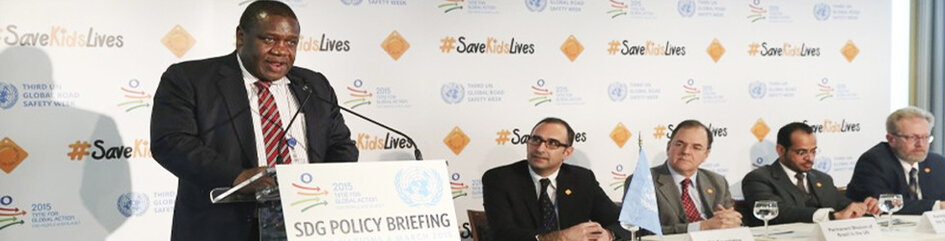
Governments, UN agencies and experts in road safety and sustainable transport convened at UN Headquarters in New York on 4 March to advance the agenda on road traffic injury in the Post-2015 Sustainable Development Goals (SDGs).

The briefing session, which was timed ahead of the forthcoming negotiations on the SDGs later in the month, was organised by the FIA Foundation and included 27 UN Permanent Missions, the World Health Organisation, the UN Environment Programme, UNICEF and the World Bank.

Leading the session were the UN Permanent Missions of the Russian Federation, the Government of Brazil, the Sultanate of Oman and the Republic of South Africa. The session provided an opportunity for Governments that are negotiating the SDGs to engage with UN agencies and experts on the proposed target to halve road traffic fatalities in the post-2015 goals that will replace the Millennium Development Goals when they expire at the end of the year.

In the draft SDGs being negotiated at the UN, road safety is included in two targets, within the proposed Health Goal (3.6) to halve road traffic fatalities and injuries and in the Cities Goal 11.2 which calls for access to safe transport systems. The UN Secretary General’s December 2014 ‘Synthesis Report’ on the SDGs includes action on road traffic fatalities as a health priority.

Dmitry Masksimychev, Deputy Permanent Representative of the Russian Federation to the UN spoke at the session. He said: “Road safety must become a global priority. It is important that the Sustainable Development Goals confront the carnage on the roads which is posing an unacceptable burden in many countries. This is an agenda for sustainable development and we have a duty to act and to save lives with road safety.”

Ambassador, Guilherme Patriota, Deputy Permanent Representative of Brazil to the UN said:

“Road traffic injury must become a priority issue for global development. Road injury is a burden on all countries. But there is a heavy impact on developing countries which account for over 90% of the 1.2 million road deaths worldwide each year.”

Brazil is hosting the Second Global High Level Conference on Road Safety in November 2015 which will review progress made in the UN Decade of Action for Road Safety, and can be the opportunity to focus on implementation of a post-2015 SDG target on road traffic injury.

Ambassador Kingsley Mamabolo, Permanent Representative of South Africa to the UN.

Delegates at the briefing session focused on how a post-2015 target on road traffic injury could be achieved. In his remarks during the opening session, Ambassador Kingsley Mamabolo, the Permanent Representative of South Africa to the UN said: “This is a man-made epidemic but we do not need to search for a cure. The solutions are well known: safe roads, safer vehicles, legislation enforcement and education, better post-crash care. Implementing these solutions can lead us to achieving a global target of halving road traffic fatalities. This is an ambitious target for the SDGs. But with sustained action and support we can achieve it worldwide.”

Representing their Governments, the UN Permanent Missions attending also included Argentina, Belgium, Canada, Columbia, the Czech Republic, Denmark, France, Georgia, Germany, Iceland, Ireland, Jamaica, Lebanon, Malaysia, Mexico, the Netherlands, New Zealand, Norway, Qatar, Singapore, the Slovak Republic, Thailand, Uruguay and Zimbabwe.

Technical briefing presentations on the post-2015 target were given by representatives of the World Health Organization, UNICEF, UNEP, the World Bank, Bloomberg Philanthropies, the High Level Panel on Global Road Safety being convened by the FIA, and Embarq. 

Werner Obermeyer, Deputy Executive Director, WHO Office at the United Nations

On behalf of the WHO, Werner Obermeyer, Deputy Executive Director, WHO Office at the United Nations presented data from the 2013 Global Status Report on Road Safety showing that some progress has been made in reducing road fatalities particularly among high income countries adopting a ‘safe system’ approach to road safety but more progress needs to be made particularly among low and middle income countries. He concluded that a 2030 target to halve road traffic fatalities globally from the current 1.2 million per year to 600,000 worldwide would be ambitious but achievable.

The FIA Foundation presented its policy briefing ‘2015 – Safe Roads for All’, and the session was chaired by FIA Foundation Director General Saul Billingsley.

Saul Billingsley chaired the briefing session.

He said: “This session has provided a highly valuable opportunity to gather Governments who are negotiating the SDGs together and to hear from a full range of UN agencies and experts on the proposed target to halve road traffic fatalities, and how it can be implemented. We are entering the final stages of negotiations on the SDGs in the coming months so it’s crucial that there is support for retaining the target as we move ahead.”

In its presentation the FIA presented the proposed work of a High Level Panel on Road Safety to be launched by FIA President Jean Todt, which will aim to advocate and attract further global support for road safety with a view to implementation of an SDG target.

Representing UNICEF, Nicholas Alipui, Director & Senior Advisor Post-2015 Development Agenda, said:

“The proposed SDG target to halve road traffic fatalities and injuries is of vital importance to our objectives. Building on the Decade of Action for Road Safety we could stabilise and begin to reduce the level of casualties in the next five years post-2015 – but only if we significantly increase the level of resourcing and political commitment globally. And then through to 2030, with sustained commitment, an SDG target to halve the total road traffic fatalities worldwide, for countries at all income levels, would be both ambitious but achievable.

“To fulfil the post-2015 vision we will need to ensure that the ‘Safe System’ is in place to protect the poorest and most vulnerable, and particularly our children.”

Participants at the session also pledged their support to the Save Kids Lives campaign which is calling for road safety to be included in the SDGs. The campaign has been launched ahead of UN Global Road Safety Week, 5-11 May which has road safety for children as its theme.

Support the Save Kids Lives campaign at www.savekidslives2015.org and show decision makers your stance that road safety should be a focus in the Sustainable Development Agenda.

UK drug driving campaign focuses on ‘paranoia’ effects

UK drug driving campaign focuses on ‘paranoia’ effects

Drink driving is a well documented cause with scientific backing on how alcohol impairs driving to a large extent. Blood Alcohol Content (BAC) is quite clear cut and now, drug driving is being given the same treatment in the UK. A new campaign by THINK! the road safety campaigning arm of the UK Department for Road Safety focuses on the effects of ‘paranoia’ on driving as well as the impairment effects of drug driving.

In the UK it is illegal to drive if your driving is impaired by drugs or if you have certain drugs above a specified level in your blood. If the police stop you and think you’re on drugs they will either test you at the roadside using a drug screening device or a “Field Impairment” test to assess your ability to drive.

If drugs are detected in your system or you are deemed impaired by drugs, you’ll be arrested and taken to a police station for blood or urine tests. If the tests show you’ve taken drugs or show a specified drug above the specified blood limits you could be charged with drug driving.

You don’t have to be on illegal drugs to be impaired to drive – prescription or over-the-counter medicines can also impair your ability to drive. If you’re taking medicines, talk to your doctor, pharmacist or healthcare professional before driving.

In the UK the penalties for drug driving are the same as for drink driving. If you are convicted you will receive:

  • A minimum 12-month driving ban
  • A criminal record
  • A fine of up to £5000 or up to 6 months in prison or both

It’s illegal to drive if either, you’re unfit to do so because you’re on legal or illegal drugs; you have certain levels of illegal drugs in your blood (even if they haven’t affected your driving).

Alcohol and drug consumption by road users results in a higher crash rate. These substances impact on human behaviour and judgment. No person is too skilled, too big, or too clever to avoid the effects.