Brian’s Column: Road safety back to basics – donkeys in Somalia

Brian’s Column: Road safety back to basics – donkeys in Somalia

In the high income countries, road crashes have been decreasing over the years although it remains a big cause of death across the world. In Africa, road crashes are still disproportionately high with neglected infrastructure, road safety law and enforcement and safe vehicles. In Somalia, our regular columnist Brian talks about the efforts to make the rudimentary form of transport safer; donkey carts.

Welcome to the New Year road safety ambassadors. January 2013 is here, it has been here, in fact, we are midway through it. I hope everyone had a very tasty Christmas (for the Christians). For the Muslims, hold up, Eid-el-Fitri is coming sooner. Greetings from Africa! Its still not too late for you to make your Road Safety New Year’s Resolutions, that is If you haven’t made them! Just do it! Ladies and gentlemen, it’s that same hour where we get an update on road safety situation in Africa.

First, before I forget, the hotly anticipated African Cup of Nations (2013) will be happening exactly 3 days from today in South Africa and the good news is that our African Soccer Road Safety Superstars Samuel Eto’O and Didier Drogba have not hidden the idea of creating some road safety awareness in Africa. They and Nelson Mandela Initiative on Road Safety are planning bigger (Stay tuned for an update on that one). A little outside, Africa, those fans of Manchester City Football Club may have a chance to see Carlos Tevez walking on foot because, he’s been banned from driving for six months after failing to respond to police letters about speeding. You can read more about that here. It is also my pleasure to re-echo the report of Tom Bishop who is the Africa director for Amend on Road Safety Situation in Tanzania. Please read his post here.

On 16th January 2012, we held a Skype call for a number of youth leaders in road safety from the African English Speaking Countries with the Regional Coordinator, Miss Sheila Athieno (don’t tell her I said this, but she will be changing her Facebook ‘single’ status soon ha-ha). The objective was to motivate, share and ensure strategic direction of the region in the next 1 year. Much respects to those who participated; Sheila will share feedback soon.

Now, back to the point….

Animals have been an integral part of the ideal African family for thousands of years! In fact, history states that the dog was the first animal to be tamed by man, with cattle and goats etc coming into the mix thereafter. But there is this animal called a Donkey! You have not heard about it, no? Very prominent in Somalia, donkeys have been part of Somalia’s history for thousands of years having existed as wild Asses before being domesticated.

The typical donkey cart transportation in Somalia.
Relating the donkey to road safety, there are no researched data on official figures for the number of donkeys and other animals killed or injured in road traffic crashes (sounds like a good research topic, yes?). Donkey carts are a common sight on Somali roads (there is no railway in Somalia) – unfortunately, all too often they are not seen by car and lorry drivers until it’s too late. Many of the people using donkey carts travel at night, without lights or reflectors. While the owners of horse-drawn carts have to pay a yearly fee to be licensed by the Municipality, and display a number plate, donkey carts don’t need licenses. This makes it hard to keep track of the carts and owners, and enforce the rule that no drivers should be under 16 years of age. Namibia has some interesting statistics; donkeys are involved in 25% of all road crashes in Namibia. Many of these crashes occur at night when the donkeys lie down on the warmer tarmac and are not seen by approaching vehicles.
Donkey reflector tags in the ears of the animal help them to be seen at night.
Donkeys among the Somalis do not belong to any clan, can be ridden by both males and females, easy to maintain, readily available throughout the season -a reason why they have apparently been embraced to address the pillar of road safety in the UN Decade of Action about Post Crash Response. Apparently, these animals are used as ambulances to quickly evacuate road traffic crash victims to hospitals. You should not be surprised to know that Somalia has been hit with civil conflicts that have hit the country’s educational, health and economic stand.
 
Somalia’s road safety agenda has been tailored to its cultural context of embracing the horse in road safety sensitization as well as quick referral of victims. Donkey Health of Somalia has developed special reflective ear tags (almost similar to those of Donkey Welfare in Namibia) which enable the donkeys to be seen from a far greater distance. The tags are picked up by the vehicles headlights and allow time for the driver to take avoiding action. To make the carts more visible at night, the Somali Road Safety Department designed, produced and distributed reflective plates to 192 donkey carts had been fitted with a set of these reflectors. The 2012 report however doesn’t capture how many of the owners had been trained in basic first aid response, how to load carts properly, how to balance the load better, and how to prevent harness wounds.
 
While the Somali road transport authority is still struggling to tackle the problem of irresponsible under-age donkey-carts drivers (16 to be precise) as well as scaling down this programme, this approach may turn around the road traffic fortunes of a country that is hungry for Ambulances and Human resources for health. We just have to hope that the Country’s Road Safety Department keeps an eagle-eye on road safety statistics and indicators.
A real use of donkeys as ambulance carts has improved post crash care in Somalia.
Interestingly, when we approach road safety in a high-income country, as is the sharing of good practice in forums around the world, in Somalia, we go back to basics with road infrastructure whereby donkey safety is road safety. It shows that even in ‘underdeveloped’ places where cars are not necessarily widespread, efforts to increase basic forms of transportation is important to save lives, secure economic goals and provide care such as post-crash care in the case of ‘donkey-ambulances’ in Somalia.
Make people a priority in growing cities – Guardian Development

Make people a priority in growing cities – Guardian Development

Many parts of Africa are under constant development; more houses, more apartment buildings, more business towers and inevitably, more roads. However, as cities grow in many low and middle-income countries, road safety is being neglected when transport is developed leading to disastrous results. Tom Bishop, Africa director for Amend writes for Guardian Development about this area of focus in Dar es Salaam, the capital of Tanzania.

Source: Guardian Development – Global Road Safety in Focus

A group of academics at Tanzania‘s Ardhi University this year produced a masterplan for the transformation of Dar es Salaam into one of Africa‘s next megacities. Their inspiration was Singapore, with its ambitious building projects, skyscrapers, bridges and ringroads.

Dar is already one of Africa’s boomtowns – it is the second-fastest-growing city in Africa after Lagos, forecast to double in size to more than 7 million people by 2025. And it contributes around 40% of Tanzania’s GDP, which is growing by more than 7% each year.

Yet while Dar es Salaam might aspire to be the next Singapore, the differences between the two cities are starkly apparent when it comes to the number of people who die on their roads. At least 480 people were killed on the streets of Tanzania’s commercial capital last year. In Singapore, 195 lost their lives, even though Singapore has a population of about 5 million, compared with Dar’s 3.5 million. 

Construction in Dar es Salaam, Tanzania is increasing rapidly as it becomes a ‘mega city’.

Unless something changes, the number of deaths and injuries on Dar es Salaam’s roads will increase as the city grows. Dar’s city centre is a riot of cranes and construction sites. Road-building projects are under way all around the city – to the north, south and west – and a bridge will soon link the existing urban area to the massively underdeveloped Kigamboni to the east.

But for those planning, designing and constructing the roads, it seems that vehicles are their top priority, rather than people. Perhaps it is because these people are part of the small but growing middle class who can afford cars – they are thinking about ease of access for a minority, but not of the vast majority of people who will never have a means of transport other than to walk, cycle or use the overcrowded, dirty and dangerous public transport system.

Narrow dirt roads, which wind through sprawling unplanned residential areas, are being paved – the tarmac squeezing out pedestrians and leaving no room for footpaths. People have little choice other than to walk on the roads, with cars flying past on one side, and deep, dangerous storm drains on the other. These new roads are deathtraps, especially after dark when the congestion has eased, the traffic police have gone home and the drink-drivers treat the streets as their own.

“Narrow dirt roads, which wind through sprawling uplanned residential areas are being paved”

Elsewhere in the city, roads are being widened with no traffic management systems, parked cars block footpaths, traffic lights function intermittently due to frequent power cuts, and an increasing number of motorcycle taxis are being driven by unlicensed, untrained young men.

People in Dar want safe roads. The dirt road outside my house was upgraded last week, transforming it from potholes and craters, where cars could barely go faster than 5mph, to a smooth, compacted surface used as a rat-run by speeding taxis, 4x4s and cheap Chinese motorbikes. Within a day, the local community had dug up parts of the road to create informal speed bumps, and had scattered rocks and disused tyres to slow the movement of traffic in an attempt to keep themselves and their children safe.

I have seen riots at schools after a pupil has been killed or injured. It is becoming increasingly common for children to lie down in the roads, forcing traffic to stop until the police and local MP arrive, promising speed bumps. But doing this after the event is too late.

The government and donor partners have many admirable plans to improve road safety. A national road safety strategy (pdf) and a road safety and traffic bill have been drafted. A national road safety agency is being established. But while these initiatives are being discussed in the conference rooms of five-star hotels, out on the roads people continue to die every day.

Amend’s See and Be Seen Program in Tanzania – see this video in the right column.

Change is needed, and fast; it need not be grand or expensive. Children need to get to school safely, and through our work on road safety in the city we have found that even small steps, such as projects to develop low-cost road safety infrastructure around schools and distribute reflector-enhanced school bags, make a difference.

The growth of Dar es Salaam is inevitable, but why lives should be put at risk in the name of development? The planning and development of the city needs to consider everyone – not only the small proportion of people who own cars. Road infrastructure needs to provide for all types of user, including the majority: pedestrians and cyclists, children and elderly people. Let’s not throw away lives and threaten the safety, health and quality of life of millions of ordinary people in our race towards skyscrapers and ringroads. Let’s build cities for people.

Last year, Amend and YOURS teamed up to deliver the See and Be Seen Program with the winners of the Embrace Life Campaign. Read that story and an interview with Amend here.

Spotlight on: Rev Magazine – a UK young drivers’ mag

Spotlight on: Rev Magazine – a UK young drivers’ mag

Our first spotlight of the new year focuses on an innovative young drivers’ magazine based in the UK. Its designer and creator, John Billington created the magazine to intertwine young people’s passion for driving and cars with safe messages. This, added to a sleek, vibrant and youthful design makes it an attractive publication. We talk to Rev magazine’s creator here.

YOURS spoke to Rev.UK magazine creator John Billington to hear about his interest in road safety and the messages behind Rev; the young people’s driving magazine in the UK.

So what’s your background in Road safety?
I started out in road safety talks to groups of teens and children.  After doing that for a couple of years I got the chance to work on the publications. I was amazed to find that other councils wanted to buy them too.  Over the years the response has been genuinely amazing.

My main focus is road safety for children and young people so I’m always looking at different ways to communicate what is in effect a pretty simple message.

The magazine, in its fifth edition focuses on a range of road safety topics to encourage young people to drive safer.

So what motivates you to be involved in road safety, especially young drivers?
I became particularly interested in young drivers after meeting Vicki Stone who had formed the charity “Learn and Live” after her daughter Kate had been tragically killed in a car crash.

I remember one day having a pile of school photos to scan in for a leaflet. They were all of teenagers who’d died in crashes – the fact they were real photos just like the ones of my own children really brought it home to me. As I worked more with Vicki I realised the appalling thing about these tragedies was that they were usually so similar, so predictable and I thought we could be doing so much more to stop them from happening in the first place. You only need to check the web and realise these sort of tragedies are happening across the world on a daily basis.

What’s the background to your publication Rev online?
I’d worked on several editions of Rev which were printed in the traditional way.  The latest magazine is completely online which means that anyone anywhere can read it for free! It can feature Youtube clips, which is ideal when you consider how much time the average young person spends on the internet it’s an inevitable route to go down.

I also use celebrity interviews. I like these as a contrast to the anonymous voice that tells you should and shouldn’t do. Obviously we can line up the questions and delete any answers we don’t like! I used Richard Hammond and James May from “Top Gear” in the latest magazine. They’re both extremely famous in the UK and around the world for their programme so hopefully people will sit up and listen to what they’ve got to say.

With exclusive celebrity interviews, the topic of road safety is given a fresh approach with well known public figures giving their views on driving in today’s modern world.

When it comes to young drivers we’re trying to give them information but also attempting to address their attitudes as well. We’ve got to produce resources that are actually interesting, relevant and readable. It’s no use if we’ve said everything and they’ve heard nothing.

What do you hope to achieve through the publication?
It’s tough enough when you first start driving so you’ve got to be 100% focussed on the task in hand. The problem can be that a few months down the line you can get over confident and think it’s easier than they led you to believe!  We cover all the “hot topics” – like overcrowding, speeding, using the phone, drink and drugs etc.

How can young people get involved?

Well we’re always keen to hear from young drivers about their experiences behind the wheel and what their views are.

People can submit stories, news, views, the lot! As well as the magazine itself we also run a WordPress site, twitter feed and Facebook page so we’re always looking for stuff to put out there! Just email me at john@room9media.com

You can follow all the links and read Revonline by going to our homepage: www.room9media.com

The magazine includes articles from young people, public safety adverts and opinion pieces to encourage attitude change in road safety.

Looking forward, YOURS encourgages to check out the messages in Rev.UK magazine and submit stories for future editions. John has given YOURS exclusive access to the magazine and we will, in the coming weeks, pull out some of the articles and feature them on our website as a special ‘Rev Feature’. To see the magazine online click here.

Happy New Year from YOURS – let’s make it count!

Happy New Year from YOURS – let’s make it count!

So its back to work for most of us around the world which means continued efforts for road safety. We would like to wish you a very Happy New Year and hope that is it prosperous, constructive and as groundbreaking as 2012 has been. The flame of road safety action for young people continues to burn around the world and we continue our service to the cause in the year to come!

Goodbye 2012 and hello 2013! A New Year gives us the chance to be bigger, better, more resourceful and accomplish more than the previous and that is exactly the plan here at YOURS.

We are delighted to have you on board and we thank you for your unwavering support over the last year! Can you believe that 2013 marks the fourth year of our operations? Since we launched in late 2009, YOURS has continued to expand its network and activities and now has members in over 70 countries! 

This year, we continue to expand our activities and will be inviting you; the youth of the world to take part in TWO global campaigns; calling for protection for pedestrians on the roads around the world: ‘The Long Short Walk’ and a special youth criteria submission to the ‘Global Road Safety Film Festival’. Its an exciting time to be part of the Global Youth Network for Road Safety as this year we open more opportunities, activities and actions for you to take part in. If you are yet to join our thriving online youth network then click here and see if you are eligble to join.

Coming shortly this month are videos from the Caravane Project and videos capturing our first full programme of the Training of Facilitators that took place in Nairobi, Kenya late last year.

As we look back at 2012, in customary fashion, we have created a ‘Year in Pictures’ pulling together some of the moments captured on camera in last year’s journey. We feel the gallery depicts diversity, the energy of youth and the growing work of YOURS! We look forward to working with you all in 2013.

Road safety tips this holiday season – celebrate and stay safe!

Road safety tips this holiday season – celebrate and stay safe!

The holiday season brings Christmas tidings, family gatherings and festive celebrations all the way through to the new year. As the yuletide song goes; ’tis the season to be jolly’ and young people around the world are the center of attention this season with families ticking off present lists. The winter period offers a chance for family and friends to celebrate the festive period and the end of the year but this season, we urge young people around the world to keep the festivities happy by committing to road safety by making it an embedded part of the enjoyment. Why let good times go bad?

In the winter period, most of the Northern Hemisphere is covered by snow and icy conditions, afterall many of us are ‘Dreaming of a white Christmas’ and white blankets of snow is the youthful preamble for snowmen, snowball fights, snow angels and wonderful memories immortalized in winter photo snaps.

Many of us are enjoying the festive period by coming home from university, college or home from work and will sit back at enjoy the winter party season with a few drinks (if you are that way inclined) and spending time catching up with friends and family. Here at YOURS, we are young people ourselves and we know that at this time, inhibitions are often lower than the rest of the year, kisses are claimed under the mistletoe and young people everywhere will be toasting to the new year ahead, so why let this happy period go sour?

In many countries around the world, the month of December constitutes one of the worst months for road traffic crashes with more crashes happening in this month alone than in the rest of the year. Why is this? There are increased cases of drink driving, drunk pedestrians, crashes related to poor road conditions and lots of other issues making road crashes more prevalent during this season. We don’t want to bring the happy spirits down but we do want preserve life and reduce road crashes! With this in mind, you can follow simple tips to ensure the holiday period continues without the tragic loss of life or serious injuries…keep safe this season to enjoy the year ahead!

During the winter period, there is often more traffic on the roads and as drivers you should: 

  • Always prepare yourself before traveling by using a serviced car that is suitable for the road
  • Ensure your car is fit for the road, check your battery and anti-freeze levels
  • Think about your journey before you leave and incorporate rest breaks to combat fatigue
  • During bad weather conditions, you should be prepared in case of a breakdown with extra clothing, blanket, torch and so forth
  • Always follow your nation’s safety rules in case of a breakdown
  • Leave extra distance from vehicles in bad driving conditions (icy, rainy, muddy etc)
  • Leave extra time for your journey and drive slower in bad driving conditions

Whether you are a driver or not, you can increase your safety by ensuring:

  • As a pedestrian, using reflective clothing in reduced light conditions and not being distracted
  • As a two-wheel driver, ensuring you can be seen and always wear a helmet
  • The driver never speeds and observes the safety rules
  • All occupants of the car wear a seat belt
  • The driver never drives tired and encourage regular breaks from driving
  • The driver is not distracted
  • Never ever drink and drive or drive under the influence of drugs 

This year, if you are driving, why not try ‘Mocktails’ instead of cocktails? They are alcohol free and you should definitely not drive under the influence of alcohol at all!

We wish everybody a very happy holiday season and hope you will all commit to road safety during this challenging driving period. Remember, road safety is not just important during the winter period, it is important all year round. We as young people embrace life and commit to road safety, just like our 2011 campaign, so continue to enjoy your life into the new year by being a road safety ambassador and protecting your loved ones and each other!

The power of peer education – an experience in Kenya

The power of peer education – an experience in Kenya

One of the mantras of our work at YOURS is based on the belief that young people of a similar age, background, interests and social identities can influence each other in positive ways. This approach to social health education is called ‘peer education’ and is a key proponent of our work. Read about the power of peer education in the example of Kenyan young people taking the lead in their own road safety workshops.

Peer education is powerful tool that has been embraced in life saving education programs the world over. One of the most profound examples in recent times has been the promotion of young people as ‘educators’ to their peers in the prevention of HIV Aids run by UNICEF.

Peer education is based on the reality that many people make changes not only based on what they know, but on the opinions and actions of their close, trusted peers. Peer educators can communicate and understand in a way that the best-intentioned adults can’t, and can serve as role models for change. Peer educators can help raise awareness, provide accurate information, and help their classmates develop skills to change behavior. – UNICEF

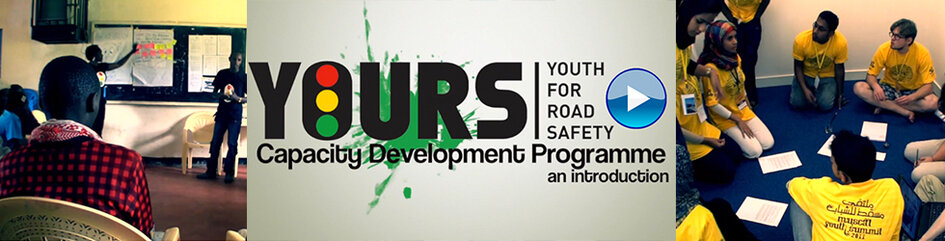
Translating this approach to road safety has also illustrated the groundbreaking strides that peer education can make. Most recently, our Training of Facilitators, a two-week intensive program that was undertaken from 26th November-6th December 2012 in Nairobi, Kenya put road safety peer education to the test.

After undergoing an intensive week of road safety theory through brain friendly, interactive learning workshops, our 11 facilitators from across Kenya became skilled in their topic of interest; preventing road crashes amongst their peers, loved ones and communities. The training equipped the young people with the skills needed to understand the road safety crisis in Kenya and steps needed to challenge the current status.

Facilitators wearing the ‘traffic light logo t-shirts’ connect with their local peers.

In the second week of the training, the practical element, YOURS staff undertook a demonstration workshop with local young people from Nairobi at the Kenya Red Cross, the purpose of which was to enable the facilitators to watch and observe the concepts of learning in practice with a relatively uninformed group of young people; uninformed in the case of road safety. On observation, the participants were receptive, eager to learn and engaged well in the training session, however, when the facilitators (all Kenya born and bred) took the reigns for their own sessions with another group of young people, the results were remarkable.

It is here that the power of peer education took its own dimension. The facilitators interacted with their peers, those of similar, background, interests and social expectations, in a way that our demonstration workshops clearly lacked. The ability of Kenya based facilitators interacting with their own ‘real’ peers manifested in an interaction between the peers in powerful demonstration of cohesion. The facilitators were able to draw upon local examples that struck chords with the participants; they were able to offer explanations in the local Kiswahilli language, engage the group in educative games sensitive to social expectations and connected with the group in a way that no other young people from any other country would be able to connect.

The facilitators designed their sessions in their own unique style engaging their peers in a local context.

In other words, local young people educating local young people; their peers, was more profound in transmitting a message than I could ever have imagined. On reflection of pre and post evaluation questionnaires (used to map attitude change in the young participants) there results were indicative of the power of peer education in changing attitudes. All participants who answered in the pre-workshop questionnaires a ‘lack in knowledge on a road safety topic’ showed that they had learned a lot in short period of time as noted in their ‘post-workshop questionnaire’. Some participants even stated that they would always wear a helmet on two wheels and will encourage all their friends to do the same because of its importance.

While peer education does have its limitations in the sense of assessing long term attitude and behavior change, what is clear is that skilled young people educating their peers is a very strong approach in transmitting messages of safety to young people; a group who is particularly difficult to reach in terms of public safety messages.  This approach, however, does only focuses on one aspect of the road safety system; that of awareness and education, however, if peer education is coupled with adequate road safety laws, enforcement, good road safety infrastructure and safer vehicles, strides could be made for road safety in Africa. This is why our program equipped our facilitators to also become advocates for road safety, calling for better road safety on all levels.

The dynamism of the young Kenyan people was harnessed in the facilitators’ own workshops.

Through follow-up with the facilitators and the participants of the workshops, we will map whether the group still hold the same attitudes towards road safety as they did at the end of the workshops. If young people, passionate about road safety can continue to convince their peers on the importance of being safe on the road, we can create a generation of safety conscious young people that include road safety in their agendas for decades to come. One day, road traffic crashes will cease to be the biggest killer of young people because young people themselves took action to change these statistics.