Development projects shape cities and systems for decades, defining how people move, where they can live and work, and how they experience public space. Yet, the people most affected by these decisions are often not part of how they are made, creating gaps that directly influence how infrastructure performs, how communities engage with it, and how sustainable outcomes can be over time.
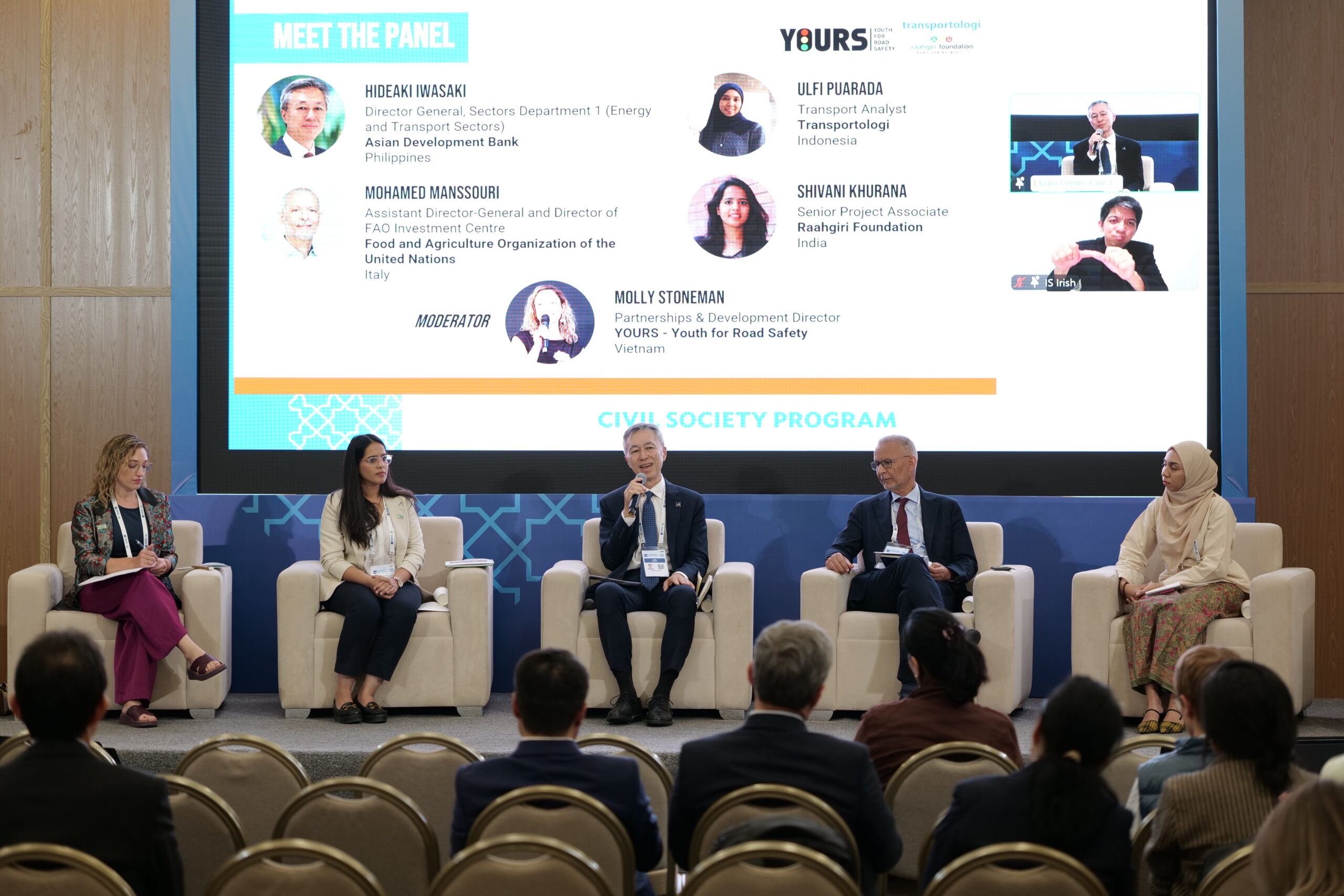
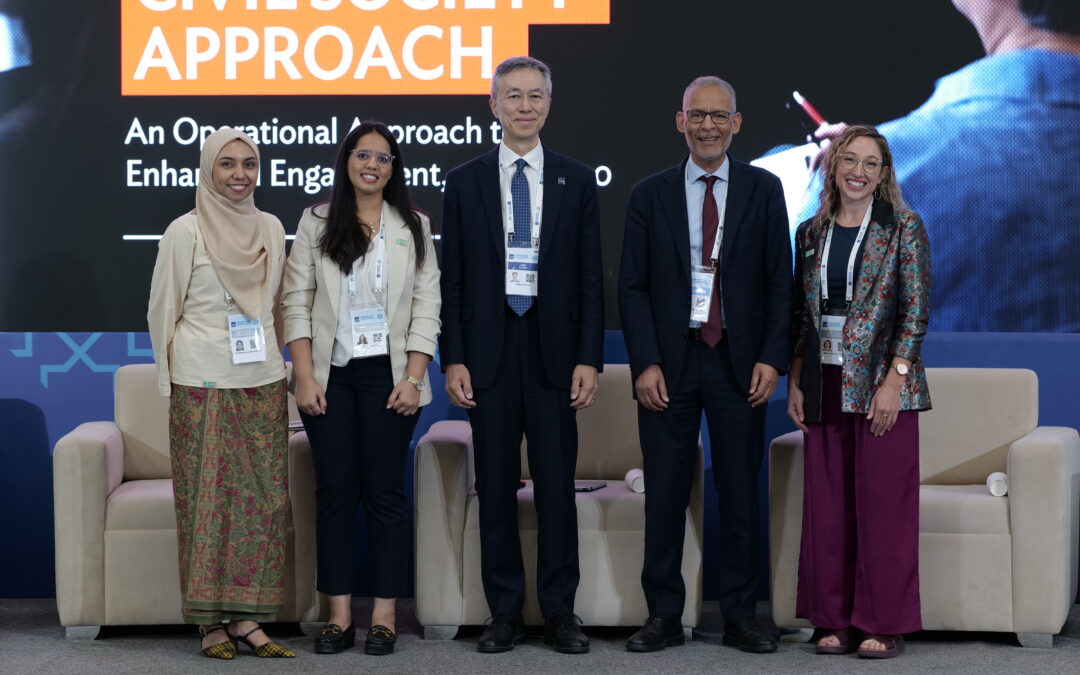
On 3 May 2026, at the Asian Development Bank’s Annual Meeting in Samarkand, Uzbekistan, YOURS – Youth for Road Safety facilitated a panel discussion on how youth and community engagement can strengthen the design and delivery of development projects. The conversation brought together Ulfi Puarada from Transportologi and Shivani Khurana from Raahgiri Foundation, both members of the Global Youth Coalition for Road Safety’s leadership teams representing the voice of the youth movement behind YOURS. Youth advocates spoke alongside Director General Hideaki Iwasaki from the Asian Development Bank, Sectors Department 1 (Energy and Transport Sectors) as well as Mohamed Manssouri, Assistant Director-General and Director of the Food and Agriculture Organization (FAO) Investment Centre, connecting perspectives from young leaders and communities with institutional experience in development and investment.
Invest the time up front, see the returns long-term
Across the discussion, a consistent idea emerged around the role of participation in shaping more effective and sustainable outcomes. Development processes that integrate communities from the earliest stages tend to deliver stronger results across implementation, performance and long term sustainability. When communities understand projects, contribute to their design and see their priorities reflected in decisions, they are more likely to support implementation, strengthen local ownership and sustain outcomes over time.
When asked about measuring return-on-investment from community inclusion, Mr. Iwasaki explained, “There are returns, but those returns take time. In my experience, there is no doubt that high community engagement gives better results. It takes more time and money in the beginning, but investing in communities over the long run is a more sustainable investment.”
Community consultation can look different
Meaningful participation becomes visible in how engagement evolves within project cycles, moving from listening through surveys and focus groups, into co-creation, and at its strongest, into shared roles in decision making, implementation and accountability.
Ms. Ulfi Puarada spoke clearly, “Start with consulting youth, but then bring us in to co-create, and then to lead.”
The panel shared examples of how to listen to the community’s feedback in their own way, including through creative exercises like drawing, music, poetry, and mural making.
One audience member asked about consulting youth and women in particular, when every citizen would be affected by a project. Ms. Shivani Khurana explained that projects should consider which identity groups are most affected by the decisions made — students, wheelchair users, elderly — and to design around the people most vulnerable. “In general, with young people and women, these are the voices that are often left out of the decision process, so we do need to prioritise including them,” she explained.
Rely on data and evidence
Evidence shared during the session reinforced how this approach translates into tangible results in practice.
Mr. Iwasaki shared his experiences from India’s Rural Road Programme in partnership with the Asian Development Bank, where strong community listening activities made the ADB-supported sections of road upgrades more effective and long-lasting. “If you do it right the first time by really listening to the community, your money goes further. Otherwise you will pay to revise and upgrade later.”
In India’s Rural Road Programme, community engagement frameworks were initially perceived as a potential constraint on delivery timelines. In practice, the sections of road that included structured community consultation progressed more efficiently into procurement, supported by stronger local alignment and ownership throughout the process.
This pattern can be observed across sectors, where projects that are co-designed with communities tend to benefit from stronger adoption, wider dissemination through local networks and greater long term sustainability. These outcomes are reflected in improved performance indicators and more resilient impact beyond initial investment periods.
Participatory practices fit into every part of the project lifecycle
YOURS continues to integrate youth and community participation across its work, embedding these approaches into project design, implementation and evaluation through participatory methodologies and community led processes. Across different contexts, these experiences demonstrate how participation can be embedded as a core component of development practice and contribute consistently to stronger results.
This approach also responds to existing gaps in representation across sectors. Decision making spaces in transport, energy and urban development remain limited in diversity, while young people, women and vulnerable communities continue to experience the direct impact of infrastructure and policy decisions over longer time horizons.
As Mr. Mohamed Manssouri shared: “Investing in the human and social capital of youth and women is essential for building strong community-based organizations, creating more and better jobs, and achieving greater impact across agrifood systems.”
Development institutions can build community criteria into loan frameworks, while civil society can reinforce benefits of opting in to governments.
Advancing this model requires integrating participation into development frameworks from the earliest stages, ensuring it is planned, resourced and implemented as part of standard processes across institutions and governments.
Community consultation is not a ‘nice to have,’ but a strategic return on investment
As global development agendas continue to evolve, this conversation reflects a broader shift already taking place across multiple platforms, where youth participation and road safety are increasingly recognised as essential to building sustainable and effective systems.