Do youth in the US think legal marijuana and driving is safe?

Do youth in the US think legal marijuana and driving is safe?

According to a new poll by Gallup, an American research company, only 30% of Americans believe that legalised use of marijuana will make drivers ‘a lot less safe’. Some U.S. states have legalized marijuana for recreational and medicinal use which could see the rise of drug driving incidents increase. We give you the low down on drug driving.

Gallup is an American research company that run the poll on marijuana use and driving attitudes.

As some U.S. states have legalized marijuana for recreational and medicinal use, 30% of Americans say legalization will make driving in those states a lot less safe. Another 17% expect it to make driving a little less safe. Half of Americans, however, say it will not make much of a difference.

Across the 23 states and the District of Columbia that have some form of legalization, 49% say marijuana legalization will not make much difference in driving safety. This is on par with the 52% in the other 27 states who say legalizing pot would not make much of a difference for road safety. Similarly, 29% in states with some form of marijuana legalization say the roads will be a lot less safe, roughly matching the 30% saying the same in states with no legalized marijuana.

Drug Driving campaign poster in Colorado, USA.

Legalized pot across the U.S. ranges from recreational to medical purposes, and marijuana use on the whole has increased since 2007. While in many states, medical marijuana has been legal for more than a decade, the legalization of recreational marijuana has started only in the past few years — with four states and Washington, D.C., having laws in place that permit pot use and actually regulating it for tax revenues. Studies have shown that marijuana use affects reaction times, judgment and awareness, but there is no consensus on whether driving while high will adversely affect road safety.

Results varied most noticeably when broken down by age. The younger the respondent, the less they’re concerned about legal cannabis impacting road safety; About 63 percent of those 18-29 and 57 percent of those 30-49 said legal pot wouldn’t make much of a difference on road safety. Those percentages lessened in older age groups. The 65-plus grouping was the only one that had more people saying streets would be “a lot less safe” (39 percent) than those saying it wouldn’t make much of a difference (31 percent).

Drug driving campaign poster, Australia.

If the trend toward states legalizing marijuana continues, it may affect millions more Americans directly or indirectly in the coming years. Gallup’s new study on public views about the effect of legalization on driving will serve as a baseline to measure how these perceptions may change over time.

While the effect of pot use on driving may not be as severe as the effect of alcohol, the National Highway Traffic Safety Administration has stated there are increased risks associated with driving while high. States’ efforts to strengthen regulations and enforcement related to driving after smoking marijuana will likely be guided by how frequently accidents can be traced to pot use. And this, in turn, will likely influence public opinion as well.

In the UK, drug driving such as smoking weed and driving has similar consquences to drink driving and carries similar penalties.

What do we know?
Alcohol and drug consumption by road users results in a higher crash rate. These substances impact on human behaviour and judgment. No person is too skilled, too big, or too clever to avoid the effects. In many countries including the UK, it is illegal to drive if your driving is impaired by drugs or if you have certain drugs above a specified level in your blood. 

Drug driving is incredibly dangerous. Behind the wheel, any impairment both physically and mentally will increase the likelihood of a crash happening.

In the UK, if the police stop you and think you’re on drugs they will either test you at the roadside using a drug screening device or a “Field Impairment” test to assess your ability to drive. Cannabis users often think they are safer when they are under the influence because they drive more slowly. However, cannabis slows reaction and decision times. It can also distort perception of time and distance, and result in poorer concentration and control of the vehicle.

In Colorado, the ‘Drive High Get a DUI‘ campaign promotes the legal risks of ‘driving under influence’.

Some advice:

  • If you take illegal drugs, plan how to get home without driving as many Government are cracking down on drug drivers.
    Consider your options and make plans by saving a taxi number to your phone, having a designated driver, or finding out about options for public transport before you go out.
  • Some legal medication might affect your ability to drive safely.
    Do not drive if you feel drowsy, dizzy, unable to concentrate or make decisions, or if you have blurred or double vision. Check with your doctor or pharmacy team if you think you are affected.
  • Taking a mixture of drugs to ‘sharpen up’ doesn’t work
    – in fact, combining drugs can have dramatic and unpredictable effects on a user’s state and ability to drive


Don’t accept a lift from a driver you know has taken drugs

#SaveKidsLives Campaign continues on to Brasilia conference

#SaveKidsLives Campaign continues on to Brasilia conference

As you will know, we have been big supporters of the #SaveKidsLives campaign and have helped with its implementation over the past year. We are delighted to announce that the global community has really gotten behind the campaign and pushed the signature counter beyond half a million signatures! The campaign is to continue all the way up to the 2nd Global High Level Meeting in Brasilia, Brazil where the signatures and support will illustrate people’s call to action. We are calling for road safety for all!

Children and youth are among the most vulnerable on our roads. They inspired the Child Declaration, demanding action to make the world’s roads safer for everyone – starting with children.

In a joint effort, the world’s experts also outlined measures that must be taken. Together we call upon decision-makers worldwide to take action. Make our roads safe. Let’s Save Kids Lives.

Read the Child Declaration for Road Safety.
(AR) (CH) (ESP) (FR) (GER) (IT) (JA) (PT) (RU)

In November 2015 Governments around the world will meet in the Global High Level Conference on Road Safety. Sign the Child Declaration now. Support #SaveKidsLives and call for action worldwide on road safety.

By signing the Declaration you are helping to:

  • call for action to stop the growing number of road deaths worldwide

  • urge decision makers to put road safety in place for kids and for all

  • support the movement for road safety led by children around the world

This Declaration is a call for action. It urges world leaders to commit to halve road deaths in the Post-2015 Development Goals. And it calls on Governments to take urgent action to save lives at the Global High Level Conference on Road Safety in Brasilia, 17-19 November. Kids everywhere must be protected on the roads. We call for road safety for all.

(If you want to collect signatures where there is no internet access, you can download the offline form here and send it to info@savekidslives2015.org.) 

We call upon the Global Youth Network for Road Safety to continue the momentum for the #SaveKidsLives campaign!

Calling on Caribbean Youth – National Champions for Road Safety

Calling on Caribbean Youth – National Champions for Road Safety

Our Regional Coordinator for the Caribbean Region, Mr Erland George from Saint Lucia has been on the hunt for National Road Safety Champions in the Caribbean Region. Having already recruited champions in Guyana, Barbados, Dominica, Trinidad and Tobago and Saint Lucia, Erland is now looking for champions in the rest of the region. Apply now to be part of this unique opportunity.

Road crashes are the leading killer of young people globally. More than 1000 young people die every day and thousands more are seriously injured. YOURS is a youth-led global organization that acts to make the world’s roads safer for young people. Join the movement!

Do you have what it takes to represent your country?

This is an exciting opportunity to work with a global organization with the opportunity to see how an international NGO works, experience meeting people from different parts of the Caribbean and most importantly, contribute to the global action for youth and road safety issues.
YOURS is looking for energetic and goal oriented young persons in the Caribbean Region to serve as National Focal Points for the following Caribbean Territories:

Anguilla, British Virgin Islands, Martinique, St. Lucia, Antigua & Barbuda, Jamaica, St. Vincent & the Grenadines, Cayman Islands, Montserrat, Suriname, Aruba, Grenada, Trinidad & Tobago, Bahamas, Guadalupe, Turks & Caicos Islands, Barbados, Belize, Guyana, Dominica, Haiti, St. Kitts & Nevis and the Dominican Republic

Brief description of the Role of National Focal Point
This is a voluntary role and includes:

1) Promoting active YOURS campaigns in country
2) Reporting on current road safety issues or milestones in country
3) Training and Capacity Development
4) Development of campaigns

Interested?

If you think you have what it takes, please complete the form at the link below:
http://goo.gl/forms/QvrAXwCgrw

Closing date has been extended to 11th July, 2015

Shortlisted candidates will be notified by email on Friday 17th July, 2015

For organizations who are aware of young people who have the potential to thrive in this international post, please forward this to them. You can read more about the role in the attachments.

In order to meet the vision of the organisation, YOURS has established a core group of 10 youth road safety leaders from around the world who act as Coordinators of the various regions. They represent every region of the world and work to be closer to young people on the ground, to offer regional support, resources and opportunities, and are integral in YOURS’ work to develop youth capacities in road safety.
The Coordinator for the Caribbean Region for 2014 to 2016 is Erland George, from Saint Lucia.

Mr. George is the first regional coordinator for YOURS in the Caribbean.

Could smartwatches be a new danger behind the wheel?

Could smartwatches be a new danger behind the wheel?

Road safety campaigners are calling for a ban on the use of wearable technology, including smartwatches, by drivers. Smartwatches from high-tech giants Samsung, Sony, Motorola and LG – which can be used for calls, texts and calendar notifications – are for sale in New Zealand. Apple is releasing its Apple Watch here later this year. Laws banning drivers’ use of phones – with an $80 fine and 20 demerit points – do not cover the use of wearable technology. Caroline Perry, of road safety charity Brake, said the law should be widened, stating motorists using smart technology on their watches while driving should face the same sanctions.


“Smartwatches and other wearable technology are extremely distracting if used while driving.

Our advice to drivers is to take them off and put them out of reach so that you aren’t tempted to use them at the wheel.”

Governments around the world are taking action over motorists using wearable technology. Canadians can face fines of up to $120 for using smartwatches while driving. In the UK, motorists using a smartwatch face the same $442 fine as motorists caught on a phone.

British research shows the use of a wearable device may be even more distracting than a handheld mobile phone.

A recent study showed a driver reading a smartwatch message took 2.52 seconds to react to an emergency situation. A driver talking to a passenger would react in 0.9 seconds and someone on a mobile phone would respond in 1.85 seconds.

With the rising trend of wearable technology and young people’s passion (where affordable) for access to the cutting edge of technology, it won’t belong before these gadgets are as common as the smartphone. As always, new technology brings some great benefits to life as well as some serious potential risks. In terms of distracted driving (and distracted pedestrians for that matter) the approach must be a simple one; no matter what the distraction, doing it behind the wheel could be disastrous.

Read more about Distracted Driving in the Youth and Road Safety Action Kit

Multitasking and driving don’t mix. Even for skilled and experienced drivers, driving safely requires that you use most, if not all, of your mental capacity: it doesn’t take much for your driving to be distracted.

For example, when talking on a mobile phone, one of your hands is holding the phone; your mind is on your conversation; your attention is on the sounds coming from the phone; and although your eyes are on the road, you will not be really ‘seeing’ what is happening around you. Using an earpiece will not solve the problem. You still haveto press a button to take the call; your attention will still be on the voice of the person talking to you, your mind will be processing what you are hearing, and you’ll be thinking of what to say next. The only distraction you have avoided is that of having to carry the phone in your hand. 

Smartwatches are on the rise and are ultimately adding to the number of potential distractions behind the wheel.

Distracted driving is a serious and growing threat to road safety. With more and more people owning mobile phones, and the rapid introduction of new “in-vehicle” communication systems, this problem is likely to escalate globally in the coming years. This Report focuses on the use of mobile phones while driving as one example of the broader problem of driver distraction. – Mobile phone use: a growing problem of driver distraction – WHO 

The result is that drivers using a phone to talk, text, or browse the internet are less able to stay in the appropriate lane, detect any changes around them and respond in time. Drivers talking on the phone are also more likely to exceed the speed limit and not maintain a consistent speed. When texting, people often drive at lower speeds, but their delayed reaction time and inability to maintain appropriate lane positions and assess traffic conditions still makes texting while driving extremely dangerous. Read more about this article from New Zealand.

If you knew how we saw you – 3 creative videos targeting UK youth

If you knew how we saw you – 3 creative videos targeting UK youth

As you will know, we are quite active on the Twittersphere and every so often, a Tweet comes along that has some awesome road safety targeted messages. This time, the campaign we are featuring comes from the UK and the West Midlands Road Safety Partnership. Three videos take a funny twist on a serious issue; wreckless and somewhat ‘childish’ behaviours on the road. As young people, sensation seeking behaviour or driving while distracted is not clever or funny and most people see it in a very annoying light.

The West Midlands Road Safety Partnership teamed up B3 Creative www.b3creative.com and Napoleon Creative www.napoleoncreative.com to create a set of road safety short films focusing on how people really see bad road safety behaviour. Let’s face it, most people are not impressed by reckless or immature driving, especially when we understand the risks on the road.

As you will be fully aware by now, youth aged 10-24 and in many cases up to the age of 29 are at the biggest risk of road traffic crashes in comparison to every other group. Many reasons form the factors as to why youth are at increased risk on the road:

Young people under the age of 25 are the main victims of road traffic crashes worldwide. More young people aged between 15-29 die from road crashes than from HIV/AIDs, Malaria, Tuberculosis or homicide. This means that road crashes are a serious threat to youth no matter where they are.  There are certain factors that put young people are particular risk, they are explained here.

What do we know?
The statistics are clear and there is no doubt that the crisis facing young people is very real:

  • Road traffic injuries are the leading cause of death among 15-29 year olds, causing more deaths than HIV/AIDS or Tuberculosis.
  • Over 30% of those killed and injured in road traffic crashes are less than 25 years old.
  • Among drivers, young males under the age of 25 years are almost three times as likely to be killed as females of this age.
  • Most young people killed by road traffic injuries live in LMICs and are vulnerable road users – pedestrians, cyclists, motorcyclists, and users of public transport.
  • The socioeconomic condition of a family affects the likelihood of a child or young adult being killed or injured in a road traffic crash. Those from economically poor backgrounds, in both richer and poorer countries, are at greatest risk.


A range of humour inspired videos offer a serious message. Click on the images below to watch them or see them in the right column.

Brian’s Column: Do we need Boda Boda training schools in Africa?

Brian’s Column: Do we need Boda Boda training schools in Africa?

Brian is back with his regular monthly column on all things road safety in Africa, especially youth issues! This month he reflects on a personal experience of a road crash, with a boda boda driver. A scary experience that illustrated his experience in handling first aid situations as well as a reflection on what could change to stop dangrous road behaviours.

Strange things continue to happen on our roads most so often that one’s blood pressure could be high enough to fly a plane. When I was younger, cycling was so much  fun as there were fewer people who owned motorcycles as finding a pregnant guinea fowl today. That has changed so fast in my sub urban town of Mbarara with an estimated 70,127 (as at 2014) yet harbouring more than 30,000 motorbikes, also referred to as ‘Boda Boda’s’. (Named after the taxi bikes that go border-to-border).

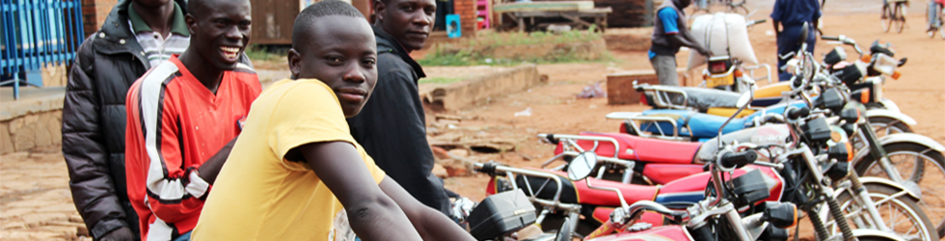
Boda Bodas lined up in Africa.

In fact, we don’t know how many motorbikes we have in this town, let alone the country. Wait, this means, for  every 2 adults, 1 owns a motorbike putting the need for ‘Boda Boda’ family planning to peak value. It’s no surprise as there isn’t really the second best alternative to travelling within the town, as most passenger taxis offer routes outside to neighboring smaller towns. ‘Boda Bodas’ enjoy a kiss- me- here kiss-me-there relationship with motorists and pedestrians as they struggle to share the rat-hole sized but surprisingly tarmacked road. Most children and adults alike either walk to town or jump onto ‘boda boda’s’ . The heart attack you will get for thinking about existence of City buses, in town passenger vehicles or at worst a train is still gathering momentum to strike you.

Believe it or not whole families often ride Boda Bodas.

For the record, there isn’t a ‘Boda Boda’ Rider Training School in this town which is seeking to be upgraded to city status. Most riders learn their trade from their peers with less knowledge and adequate time to familiarize themselves with road traffic rules and regulations. 2 Wheeled vehicles are the number 1 leader of hospitalization by injuries at Mbarara Regional Referral Hospital Emergency ward. As you might correctly suspect, young males aged less than 29 are most prone. This is a contributing factor to why mortality rate from road traffic injuries has been included in the World Health Organizations 100 Core Health Indicators in the Post 2015 Agenda. This is a major step in the right direction to providing funding and necessary attention to reduce avoidable deaths for the world’s untapped resource: young people.

So, on that beautiful Tuesday morning, as I was heading to work, a rocket-speeding ‘Boda Boda’ appeared on my driving mirror, impatiently lighting and signaling to overtake. As the traffic upfront was busy, I signaled a warning to not overtake just yet. The rider whom you’d think had just got a phone call to take the president to an emergency hospital, I suspect didn’t even understand my signal hit the back of my car with a sound which I am quite familiar with in Fast and Furious 7.

Getting out of the car, I found the gentleman and his passenger unconscious and as a trained EMT who carries a first aid kit, together with the mammoth of a crowd who quite sure knew they were dead, gave them first aid and manual stabilization before driving them to the emergency ward at Mbarara Regional Referral Hospital. They’ve spent 8 days so far nursing arm fracture and tibia fracture respectively. I will do a cost evaluation of how much time and money they’ve lost as well as their personal productivity. (Wish me luck)

While our governments are busy promising heaven on earth-like roads and constructing short term roads, we are yet to see a standard road that will not just take a test of time but also take provision for pedestrian walkways, 2 wheeled vehicles and 4+ wheeled vehicles. A University equivalent structure would not just continue to provide evidence for  death and injury concerns on the road, but also advise on ever changing trends on Engineering (road design), Education (Knowledge, skills, attitudes) Enforcement (law on who rides) and Emmergency (activation of ems and evacuation procedures). But again, policy enforcers have to first learn to WALK TALL whether it’s a local rider or a Member of Parliament violating road rules. It doesn’t seem the case so far. #RideSafe