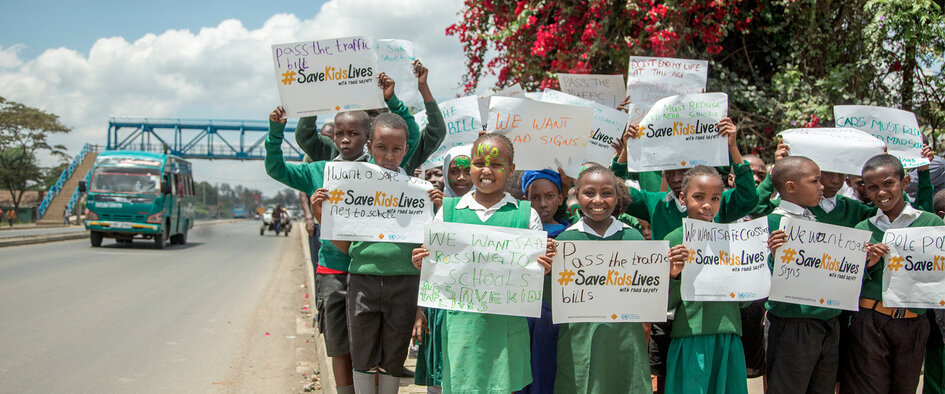


Participate in #SaveKidsLives – explore the 2020 Action Agenda with us

Participate in #SaveKidsLives – explore the 2020 Action Agenda with us

The #SaveKidsLives campaign is well into its second phase, which encourages campaigners and supporters to gather action and commitments from decision makers to enact five proven measures for road safety. The ultimate aim is to #SaveKidsLives. We fully support this campaign and invite the youth network for road safety to take part and follow the campaign’s steps. The 2020 Action Agenda is the centerpiece of the campaign. Explore it with us.


#SaveKidsLives is an official campaign coordinated by the United Nations Road Safety Collaboration. It was launched 6 months before the Third United Nations Global Road Safety Week in May 2015. The campaign is co-led by children and calls for urgent action to halve road deaths and injuries by by 2020; the target established in the Global Goals, the Sustainable Development Agenda for the next 15 years (2030).

It does so by: 

  • highlighting the plight of children and the vulnerable on the roads;
  • generating worldwide action to better ensure our safety on the roads, starting with children;
  • calling for strong commitments to save lives on the roads to reach the Global Goals targets.

The campaign operates on the principles of the Decade of Action for Road Safety 2011-2020 and is managed by a broad coalition of members from the United Nations Road Safety Collaboration.

The Five Key Priorities: 2020 Action Agenda

Call on your leaders at all levels to make public how they will reach the Global Goals target to halve road deaths in the next five years.

1. A safe journey to school for every child including safe roads and speed management around every school.

Every child deserves a safe journey to school. For many children around the world, walking to school through busy highways, with no footpaths, low visibility and no school patrols is a daily occurrence. Our children, our most valuable assets are put at risk, more than 500 of them don’t make it to school and are killed on the road every single day, all across the world.

A safe journey to school promotes healthier lifestyles, safer roads where special measures are put in place to protect children and much more. 

1. A safe journey to school for every child including safe roads and speed management around every school.

Every child deserves a safe journey to school. For many children around the world, walking to school through busy highways, with no footpaths, low visibility and no school patrols is a daily occurrence. Our children, our most valuable assets are put at risk, more than 500 of them don’t make it to school and are killed on the road every single day, all across the world.

A safe journey to school promotes healthier lifestyles, safer roads where special measures are put in place to protect children and much more.

3. Motorcycle helmets for all children where two-wheelers are the main family transport.

There are several reasons why helmets are important:

  1. In developing countries, motorbikes are the vast majority of the vehicles on the road and are involved in more crashes than any other type of vehicle;
  2. Wearing a helmet has been proven to decreases the likelihood of death by up to 39%; and decreases the risk and severity of injuries by about 72% in the event of a crash; 
  3. Helmets can be produced in-country, creating jobs and supporting road safety programs;
  4. Helmets are tangible, their use easily enforced, and wearing rates easily tallied, given human and financial resources.

(Source: Liu B et al. Helmets for preventing injury in motorcycle riders. The Cochrane Database of Systematic Reviews, 2005)

4. Vehicles safe for children and action to promote child restraints.

Infants and children need a child restraint system that  accommodates their size and weight, and can adapt to cope with the different stages of their development. Cars adapted for the safety of children can save many lives.

Simple steps such as action to ensure children have the appropriate seatbelts and child seats ensure that our children our safer in the car in the event of a collision. 

5. Enforcement and action against drink-driving.

Drinking and driving is one of the main causes of road crashes worldwide. In high-income countries about 20% of fatally injured drivers have excess alcohol in their blood, while in some low- and middle-income countries these figures may be up to 69%. Effective drinking and driving programmes have the potential to save thousands of lives, and was identified by the World Report on Road Traffic Injury Prevention as a proven and effective measure to reduce death and injury on the road.

Read the 2020 Action Agenda.

Visit the #SaveKidsLives Campaign and sign the 2020 Action Agenda.

Sign up free to the Lancet and get info on sustainable youth development

Sign up free to the Lancet and get info on sustainable youth development

Our future: a Lancet commission on adolescent health and wellbeing focuses on the study of children and young people and some of the most pressing issues facing our generation. The largest generation of adolescents and young people in human history (1.8 billion) demands more attention and action. Adolescents and young adults face unprecedented social, economic, and cultural change. This new Lancet Commission argues that there are both current threats, if inaction continues, but also tremendous unrealised opportunities not only for the health and wellbeing of young people themselves but also for the future of society and future generations

Young people’s health has emerged as a neglected yet pressing issue in global development.

Changing patterns of young people’s health have the potential to undermine future population health as well as global economic development unless timely and effective strategies are put into place. We report the past, present, and anticipated burden of disease in young people aged 10–24 years from 1990 to 2013 using data on mortality, disability, injuries, and health risk factors.

“Investments in adolescent health and wellbeing bring benefits today, for decades to come, and for the next generation”.

Some findings:
The leading causes of death in 2013 for young people aged 10–14 years were HIV/AIDS, road injuries, and drowning (25·2%), whereas transport injuries were the leading cause of death for ages 15–19 years (14·2%) and 20–24 years (15·6%). Maternal disorders were the highest cause of death for young women aged 20–24 years (17·1%) and the fourth highest for girls aged 15–19 years (11·5%) in 2013.

The global burden of road traffic crashes is the biggest for youth. Read more in our Annual Report.

Some Key Recommendations:
Findings call for increased efforts to improve health and reduce the burden of disease and risks for diseases in later life in young people. Moreover, because of the large variations between countries in risks and burden, a global approach to improve health during this important period of life will fail unless the particularities of each country are taken into account. Finally, results call for a strategy to overcome the financial and technical barriers to adequately capture young people’s health risk factors and their determinants in health information systems.

Read about how we empower young people to take action for their safety.

Brians Column: Who’s the sexiest? Helmet Vs. Non-Helmet Users

Brians Column: Who’s the sexiest? Helmet Vs. Non-Helmet Users

For a fact: Using helmets decreases the risk and severity of injuries by about 72%; decreases the likelihood of death by up to 39%, with the probability depending on the speed of the motorcycle involved; and decreases the costs of health care associated with crashes (WHO, 2006).

Students studying Traffic Engineering with a focus on road traffic safety, in their pre-exam period worked on a special road safety campaign project; shooting video and creating the preliminary design of posters.

The aim of the campaign is to point out how dangerous it is to use a mobile phone while driving, whether for communication and especially when taking photos a.k.a #selfies. Although the Law on Road Traffic Safety allowed the use of hands-free devices, it is not considered completely safe and recommended that the mobile phone is not used while driving.

We’re putting our foot into it…um…talking about it again..trying to ask perhaps, the question of the year.

Students studying Traffic Engineering with a focus on road traffic safety, in their pre-exam period worked on a special road safety campaign project; shooting video and creating the preliminary design of posters.

The aim of the campaign is to point out how dangerous it is to use a mobile phone while driving, whether for communication and especially when taking photos a.k.a #selfies. Although the Law on Road Traffic Safety allowed the use of hands-free devices, it is not considered completely safe and recommended that the mobile phone is not used while driving.

Who’s the sexiest: helmet Vs. non-helmet users?

On a rainy Thursday morning of 12th May 2016, I found myself jumping onto a Boda Boda (commercial motorcycle) from Kampala to Entebbe Airport before heading to Nicaragua via Juba. It’s a pizza of a mission sandwiched between my education and work struggles. Had I not used the Boda Boda, I’d have missed the flight as public transport on Entebbe road was slimmed: You know Mr Museveni was swearing in as president yet again since 1986.  Eish…see, I’m not a virgin at using Boda Bodas to know that a typical commercial motorcyclist holds casual conversations particularly when the passenger initiates the small talk.

A Boda Boda stand in Kampala, Uganda.

In the thick of the ride,

“How do you manage to use your helmet, buddy”, I managed to ask him.
He replied, with calmness “My wife likes it”.


Holy cow!…man, that wasn’t even close to what I’d anticipated. This response made my brain to jolt from Cairo to Capetown, Malabo to Mombasa all in 3 seconds. I froze before composing myself to remember that my reproductive health experience wasn’t a wastage afterall. Male condoms are known as ‘helmets’ especially among the ‘forever young’ urban generation in Uganda. Truth be told, I took a second eye to my rider noting he couldn’t possibly put himself in the ‘youth’ bracket. With a loud laughter, I burst out responding ‘Ssebo (local for ‘sir’), I’m not talking about condoms.

Surprised he was upon the mention of the word and calmed my now overdrive of anxiety, pointing to his clean black helmet:

“Mutabani (local for ‘son’), I’m talking about this helmet not condoms. You young generation may not understand it now, but it’s not muscles, hanging jeans or the long fake hair that make you attractive. I have been doing this (Boda Boda business) for 14 years now, but I have never taken a passenger who comes along with his helmet. At the first instant, I thought you weren’t Ugandan after all.” I wasn’t interested in this seemingly great trend of the discussion, so I applied inferential reasoning, probing:

Wait, about your wife, why does she like the helmet?”, I managed to say.

He responded with what looked like a 100% degree of confidence “My wife likes me to be safe. She tells me that knowing that I’m safety conscious was number 1 reason she chose me”. He continued reassuringly “If a man or woman is self conscious, they are serious with their lives. They want to live life up to their fullest. They are reliable and trust worthy. Is there anything more attractive in a man or a woman than that? There’s nothing attractive than a young woman who carries and uses her helmet”.

I was thunderstruck! This man deserves a hero’s award! Who’s sexier? With or Without Helmet?

YOURS Annual Report 2015 – read all about what we did last year!

YOURS Annual Report 2015 – read all about what we did last year!

We have published our Annual Report 2015, highlighting exacty what we we did in the previous year. It includes some key milestones for the last year and highlights how we as a global youth organization, contributed to several initatives as well as spearheaded our own. We have made our Annual Report easy on the eye so as you can get a grasp of our work easily!

FOREWORD – by Floor Lieshout Executive Director

Today’s generation of young people is the largest ever in our history. Over 3 billion people – nearly half of the world’s population – are under the age of 25. Of these young people, more than 1000 die every day on the world’s roads. Tens of thousands more are injured. Road traffic injuries have been the leading killer of young people worldwide for over a decade, so why are youth so often not included in preventing these tragedies?

Young people have a right to be adequately informed, consulted and empowered on road safety. YOURS believes that youth themselves have a vital role to help save lives on the world’s roads.  After all, this is the biggest threat to their lives. Young people can do so much to contribute. Is there any group better placed to act as role models, lead peer education, raise awareness, mobilize communities and advocate for change. YOURS has seen this first hand; we trained a second cohort of fifteen youth advocates and peer-educators on road safety in Belize. Together with the first cohort they have already reached over 2000 young people face-to-face with interactive youth workshops, and hundreds of thousands via their campaigns. We are very excited to continue our work with the Caribbean Development Bank and the Government of Belize over the coming years.

In addition, with the help of our regional coordinators, we selected the first national youth champions in Africa and the Caribbean. I welcome them to the YOURS family and I hope for a fruitful collaboration over the coming years.

2015 was also the year that YOURS received the Social Award for Best Road Safety Initiative out of the hands of Her Majesty Queen Sofía of Spain. We won this award for our unique youth capacity development programme. We thank the Mapfre Foundation for organizing these illustrious Awards. This prestigious award serves as an enormous inspiration and it is an important recognition for the involvement of youth in road safety.

We have a massive challenge ahead of us, which also presents exciting opportunities. For over two years, we have been leading a youth push for a road safety target within the Global Goals. And now the world has five years to deliver the most ambitious safety target ever set: to halve road deaths and injuries globally. We need a revolution for action on road safety. Surely we must look to young people to lead and energize this revolution.

In conclusion I would like to thank all partners for their support. Let’s continue to unleash the power of youth together. No more delay, and no more excuses. Let’s build a better future for all of our young people, for all of us and for the generations to come.

Dr. Adnan Hyder joins our Supervisory Board

Dr. Adnan Hyder joins our Supervisory Board

Since we began operations at YOURS back in 2009, our organization has been governed by a Supervisory Board. The Supervisory Board oversees the long-term objectives of the organization and ensures that the by-laws and rules governing the organization’s activities are observed. We are delighted to announce that Dr. Adnan Hyder of Johns Hopkins University joins our Chair, Dr. Wim Rogmans on the Supervisory Board.

Two highly experienced professionals in global road safety contribute to our Supervisory Board. They act to represent the interests of the organization and oversee the work of the executive director, staff, projects and output. The Board contributes to the accountability of the organization by enabling our work to be scrutinized, reviewed and held to account through a system of governance. 

Since opening its doors back in 2009, Dr. Wim Rogmans Chaired the Board and continues to do so. The board has since grown to include Dr. Adnan Hyder of Johns Hopkins University. Read more about both members:

Dr. Adnan Hyder – Member of the Supervisory Board

Dr. Adnan A. Hyder is Professor and Associate Chair, Department of International Health, Bloomberg School of Public Health, and Director of Johns Hopkins International Injury Research Unit, a leading center on injury research and training for the developing world and a WHO Collaborating Center for Injuries, Violence and Accident Prevention.

He said, “I am delighted to accept the position on the board of YOURS and look forward to helping empower youth with skills and knowledge on road safety. I strongly support the global youth movement for road safety in order to reduce the number of lives lost in their communities due to road traffic injuries”.

Dr. Wim Rogamans – Chair of the Supervisory Board

Dr. Wim Rogmans graduated in psychology and has received a PhD in social sciences at the University of Amsterdam. He is the founder of the Consumer Safety Institute (CSI) in 1983, based in Amsterdam, the Netherlands, of which he has been general director for 25 years. CSI is responsible for a nationwide Injury Surveillance System, risk analysis studies, the development of safety standards and for national safety promotion campaigns. Vulnerable road users is a major area of research and intervention development by the Institute.

As chair of the YOURS’ Supervisory Board Wim is responsible for supervising the management, the general affairs of the organization and the projects connected with it. The Board is guided by the interests of the organization taking into account the relevant interests of the organization’s stakeholders. The Supervisory Board oversees the long-term objectives of the organization and ensures that the by-laws and rules governing the organization’s activities are observed.

Executive Director, Floor Lieshout said, “It is an honour and a pleasure to welcome Dr. Adnan Hyder to our Supervisory Board. His exemplary work in the global road safety field, which includes breakthrough research, will be a welcome addition within our governance structure and will guide our work in the years to come. He will join our long standing board member Dr. Wim Rogmans who has been with us since the start and has been instrumental in the growth of our organization”.

US teens share top tips for safer driving: Jeremy & Mark say listen up!

US teens share top tips for safer driving: Jeremy & Mark say listen up!

We were recently contacted by some teens in the States that have been gathering information for safer driving as part of their youth center’s safety programme. Jeremy and Mark have been working hard to educate their peers and came across our website, which they gave the teen seal of approval! We are happy that they want to contribute to our site from a United States perspecitve. They say “Listen up folks”, and share some top tips for safer driving.

Avoid Personal Injury:
Tips for Safe Driving

Jeremy and Mark offer top tips for safer driving

Avoid Personal Injury by Driving Safely.
Despite technological improvements that have made cars safer, accident numbers across the country are continuing to rise. In 2014, there were over 299,400 car crashes in the state of New York and nearly 40% of them resulted in personal injuries. 1,026 people lost their lives in those crashes and in many cases, these incidents could have been prevented. By following some important safe driving tips, you can increase the chance that you and your passengers will arrive at your destination safely.

Observe the Speed Limit.
The speed limit signs posted on the side of the highway are there for a good reason. According to the NHTSA, speeding is a major contributing factor to auto crashes. In 2008, speeding was involved in 31% of all fatal car crashes in the U.S., resulting in over 11,600 personal injuries. Speeding is a problem in urban city driving, with people driving erratically to get to where they want to go as soon as possible. Increasing your chances of crashing by 50% and possibly losing your life by driving 10 mph over the speed limit isn’t going to get you to your destination as fast as you think.

Ditch the Distractions.
Any activity that prevents you from giving the road your complete attention while driving is extremely dangerous. Therefore, it is important to avoid distractions when you are behind the wheel. We live in an increasingly busy world and while it is no surprise that drivers attempt to multi-task to save time, these activities can be hazardous. For this reason, many states like New York and Maryland, have passed laws to ban texting and other cellphone activities while driving. However, technology is not the only problem. Eating while you drive, having an intense conversation with your passenger or trying to put on makeup while driving are also major safety concerns.

Don’t Tailgate.
Tailgating is a major problem in city driving, especially when maneuvering through congested areas. In cities like New York, Chicago and San Diego, the constant stop-and-go traffic often leads to drivers following too closely, resulting in accidents if drivers slam on their brakes too fast. Unfortunately, these rear-end collisions frequently lead to devastating personal injuries like whiplash and back pain. To avoid them, make sure that you are leaving a significant amount of space between your vehicle and the motorist in front of you, ensuring you have plenty of time to stop in the event of an emergency.

Have an Escape Plan.
In order to be safe on the road, it is important that you always have an escape plan in case of an emergency. This is a skill that develops with time and experience and involves constantly scanning what is going on in front of and behind you, as well as knowing what other motorists might be doing in adjacent lanes. Determining what you’ll do in the event of an emergency can help you to act quickly in the event of a problem.
A variety of things can go wrong when you are on the road. The semi-truck in front of you can have a tire blowout, a deer might dart out into the street or a car in the next lane might cut you off. It is important that you have a plan in the event of an emergency and by being conscious of your surroundings and maintaining control of your vehicle, you can reduce your chances of personal injuries.

Always Wear Your Seatbelt.
When worn properly, seatbelts can save lives, as they’ll prevent you from moving around inside of a vehicle during a crash and receiving personal injuries. Even more importantly, a seatbelt can keep you from being ejected from the car during an accident. According to the National Highway Traffic Safety Administration, more than half of all car accident fatalities were a result of people who did not wear seatbelts. Did you know that as the driver, you are not the only one in danger? Young passengers are also at risk. In fact, about 70% of fatal car crash victims ages 13-15 were not wearing seatbelts.

Most driving injuries could be avoided if motorists made an effort to stay safe on the road. By following these tips, you can work to keep yourself and other motorists safe when you are behind the wheel.

Read all of the original links from the source here.