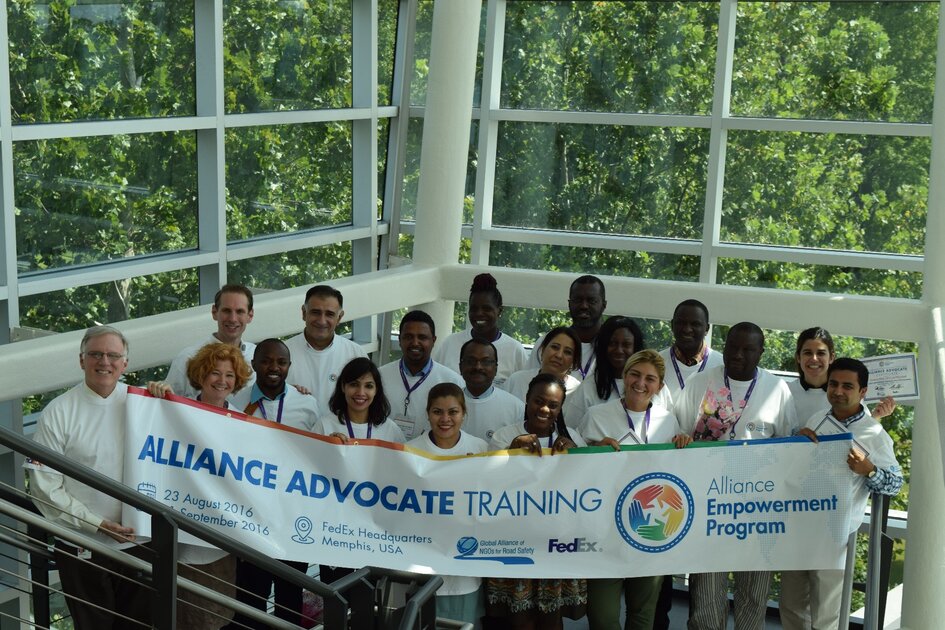
Alliance Advocates start their missions to save lives!

Alliance Advocates start their missions to save lives!

The Global Alliance of NGOs for Road Safety graduated its first Alliance Advocate cohort. The graduates have completed a state-of-the art training course -developed and delivered by YOURS- at FedEx Headquarters from 23 August to 1 September in Memphis, Tennessee, US.

The Alliance Advocate training gave representatives from 15 countries the opportunity to grow their expertise as they advocate for safer roads. This two-week tailored course is a part of the Alliance Empowerment Program, a capacity-building program sponsored by FedEx that aims to improve the ability of nongovernmental organizations (NGOs) working in road safety around the world.

“This is an important initiative for the Alliance in the years to come.”

“This is an important initiative for the Alliance in the years to come.” said Lotte Brondum, Director of the Global Alliance of NGOs for Road Safety. “The Alliance Advocates face a lot of road safety challenges in their home countries such as speeding in school zones. The training has given them the tools, knowledge, network and confidence to make a change that can contribute to overcoming these challenges. They have developed a clear plan for what they want to change when they get home, and we will follow their progress very closely and expect a lot from this investment.”

The learning wall – full with learning material- at the end of the training.

YOURS was in charge of the development and the delivery of the training. In very close partnership with the Alliance, we determined its strategy, agenda, trainers and methodology. “It was our aim to deliver the ‘best training experience’ the participants ever had.” said Floor Lieshout, lead-trainer. “I am incredibly proud of the Alliance Advocates and the work they have done during the training. I would also like to thank my co-trainer Mr Poghos Shahinyan – an amazing person and advocacy expert – all the other external speakers from Safe Kids WorldwideJohns Hopkins University and various departments within FedEx for sharing their knowledge. In conclusion I would like to thank the Alliance for their trust in our organization and FedEx for their amazing hospitality”. 

“It was our aim to deliver the
‘best training experience’ 
the participants ever had.”

The Empowerment Program encourages the design and implementation of initiatives that significantly reduce the risk of injuries and fatalities on the world’s roads, where 1.2 million people die in road traffic crashes each year. The program builds skills in communication, project management, and evaluation. Online webinars, mentorships and trainings are available for all Alliance members to learn from leaders and experts on various topics in the road safety field.

The Alliance Advocates will be role models who promote desired practices for helmet use, seatbelt use, speed management, drink and drive behavior, and safe school infrastructure. They also advocate for policy change in risk areas and hold government accountable. 

“Road Safety is a priority at FedEx, and we are pleased to support the work of those who are committed to helping save lives.”

 Shane O’Connor, Communications Advisor, FedEx Global Citizenship.

4th UN Global Road Safety Week 2017 – Save the Date!

4th UN Global Road Safety Week 2017 – Save the Date!

The UN Road Safety Collaboration is pleased to announce that the Fourth UN Global Road Safety Week will be held from 8-14 May 2017. The Week will focus on speed and what can be done to address this key risk factor for road traffic deaths and injuries. Speed contributes to around one-third of all fatal road traffic crashes in high-income countries, and up to half in low- and middle-income countries.

Countries successfully reducing road traffic deaths have done so by prioritizing safety when managing speed. Among the proven strategies to address speed include:

  • Setting and enforcing speed limits appropriate to the function of each road, for example:
    • Setting and enforcing a maximum speed limit of 50 kilometers per hour in urban areas;
    • Setting and enforcing a maximum speed limit of 30 kilometers per hour on roads with high concentrations of pedestrians, cyclists and motorized traffic;
  • Enforcing speed limits through the use of automatic speed cameras;
  • Installing intelligent speed adaptation technology in vehicles;
  • Building or modifying roads to include features that limit speed such as traffic lights, roundabouts and speed humps.

The Fourth UN Global Road Safety Week seeks to increase understanding of the dangers of speed and generate action on measures to address speed, thereby saving lives on the roads.

All stakeholders – national and local governments, international agencies, civil society organizations, private companies, and the public generally – are invited to plan and host events marking the Week.

Advocacy materials for the Week will be available on this web page as they are finalized.

Drug use and road safety…what are the experts saying?

Drug use and road safety…what are the experts saying?

There is growing concern around the world about  drug  use  and  road  safety.  Drinking  alcohol  and  driving  is  a  well  studied  risk  factor  for  road  traffic  crashes,  injuries  and  deaths  but  drug-induced  impairment  of  driving  is  causing  increasing concern  in  many countries around the world


For many years there have been several gaps in our knowledge, particularly about the global extent of the problem, the relationship between drug concentrations and crash risk, appropriate threshold limits in blood, legislation and enforcement of effective measures to prevent drug-driving. However, these knowledge gaps are progressively being filled by a growing body of evidence on drug use and road safety, including effective ways to reduce drug-induced road traffic crashes and injuries.

Psychoactive drugs affect the functioning of the brain and may lead to impaired driving (e.g. by delaying reaction time and information processing, reducing perceptual-motor coordination and motor performance, as well as attention, road tracking and vehicle control).

Prevention and early interventions

Measures that need to be in place and implemented in a comprehensive manner cover five essential areas: legislation, testing, enforcement, awareness-raising, and counselling and treatment.

Establishing drug-driving laws and regulations
The type of legal framework varies according to the social, legal and economic characteristics of a particular jurisdiction, as well as the historical context of the development of laws designed to improve road user safety.

  • Zero tolerance laws make it unlawful to drive with any amount of specified drugs in the body.
  • Impairment laws make it unlawful to drive when the ability to drive has become impaired following drug use, often described as being “under the influence” or in similar terms.
  • Per se laws make it unlawful to drive with amounts of specified drugs that exceed the maximum set concentration. The specific link between drug concentration, impairment and the risk of a crash still needs more research. To date, a few countries, including the United Kingdom, have adopted per se laws.

A total of 159 countries around the world have national legislation prohibiting drug- driving but most of these laws do not define what is considered to be a “drug”, nor do they specify a threshold. It will be difficult to enforce drug-driving laws in countries that have neither defined what is considered to be a “drug” nor specified a threshold.

Using drugs with or after drinking alcohol is never a good idea. People who combine alcohol and drugs are twice as likely to be involved in a crash as those drinking alcohol alone. Drivers with a BAC of more than 0.08 g/100 ml who combine drugs with alcohol are a hundred times more likely to be injured in a road crash.

Read more about impaired driving here.

Pokemon Go! Is catching Pokemon the new distraction on the road?

Pokemon Go! Is catching Pokemon the new distraction on the road?

Playing popular game Pokémon GO has made some people lax about their personal safety, according to police around the world. Many local authorities have began asking people playing the augmented reality game to look while they are crossing the road – or catching that Jigglypuff might just end up costing a life.

A PSA from Arizona’s Department of Transportation in the USA.

The game encourages people to ‘switch between the virtual world and the real world’ using their smartphones in the real world, which could potentially cause danger if people are not paying attention to the real world…and the dangers of the road.

Northern Territory Police in Australia warned on Facebook that people were being reckless while playing the game:

The Pokémon GO website explains how the game works. It says: “Travel between the real world and the virtual world of Pokémon with Pokémon GO for iPhone and Android devices.

“Get on your feet and step outside to find and catch wild Pokémon. Explore cities and towns around where you live and even around the globe to capture as many Pokémon as you can. As you move around, your smartphone will vibrate to let you know you’re near a Pokémon”.

“Once you’ve encountered a Pokémon, take aim on your smartphone’s touch screen and throw a Poké Ball to catch it. Be careful when you try to catch it, or it might run away! Also look for PokéStops located at interesting places, such as public art installations, historical markers, and monuments, where you can collect more Poké Balls and other items.”


In India, Mumbai Police have also issued warnings to consumers of the app that ‘Life is not a Game’ and shows a policeman catching a Pokemon. After hearing about all the incidents and injuries Pokemon Go has caused in the last few weeks (traffic accidents, broken bones, pedestrians hit), a few San Francisco creatives wanted to remind people to be careful.

The result is a series of safety signs featuring adorable Pokémon Road Kill. The posters and decals show Pikachu, Squirtle and other Pokémon favorites all run over by traffic, with the hashtag #GoSafely. The signs were put up around San Francisco, specifically at Pokémon Gyms and high-traffic intersections.

The dangers of distraction are all too real.

Campaigners in San Fransisco enourage players of Pokemon Go to #GoSafely

So what’s the verdict?
Pokemon Go is a a game changer, integrating a game into the real world landscape is truly exciting. The game offers players the chance to get up and get active, explore, meet new people and relive the nostaligia of being a Pokemaster! It also brings a whole new generation of Pokemon trainers into the fold making the world Pokemon crazy once again.

However, its clear that the game is also causing some dangers. Keeping our eye on the road is fundamental to safety as a pedestrian. Behind the wheel, distracted driving is absolutely deadly. We want our youth to enjoy the exhileration of catching a Pokemon, but we also know that it’s important to be wise to the road and stay safe. That’s why we say, happy ‘safe’ Pokemon hunting, and echo the point #GoSafely.


Tell us what you think by Tweeting us!

Pokemon Go! Is catching Pokemon the new distraction on the road?

Brian’s Column: Why do we applaud when a vehicle almost crashes?

A culture of road safety is growing in low and middle income countries but some approaches and attitudes still need challenging…Brian explores.

Ever been driving in a public taxi, you miss someone by a hair’s breadth and passengers applaud the driver, screaming ‘You should have finished him (pedestrian, cyclist, other vehicle) off’? Have you experienced the confusion of munching, regurgitating, and re-digesting this brilliance of utter madness? It is through this kind of a masterpiece that led one wise man to say “Understanding the behaviour and actions of humans is as good as future impossible tense!”. That wise man was me. (Save me the stick).

A typical Ugandan road.

Anyways…Having a rat escape from the cat’s canines literally justified by my escape back to Uganda following sporadic uncontrollable reactive and counter reactive political clashes in Juba, South Sudan midway last month, I had another encounter to never forget. Within the capital, Kampala lies an ant-like vehicle pattern characterized by public taxis which I hurled myself onto as I headed to my hotel. Like in most developing countries, the roads are narrow with limited designated pedestrian walkways, no two wheeled vehicle lanes:-you’d say our roads are organisingly disorganized.

As our driver maneuvered through the traffic, we had a near-miss with a commercial cyclist (also referred to as Boda Boda) as our vehicle lightly hit him from behind. Neither the rider nor the passenger sustained any injuries but they seemed visibly scared to death. It’s  like both the rider and passenger  just saw a parliament of ghosts sipping orange juice with that trademark Kermit line ‘None of my business!’ encrypted on their faces.

To my utter shock, about 6 fellow passengers were cheering the driver for a job ‘almost well done’. Within the lines (as I still need a PhD in Luganda:-the local language), I read that “These goons need to be swept off the road for good. They are a menace!” This is a common occurrence among young males living in urban and suburban areas.

Well, Uganda looses about 3.400 lives annually on the road according to Uganda Police (2013). But ofcourse, with the gaps at every stage of data collection and under reporting, the number is significantly higher. More than half of the registered injuries are pedestrians and two wheeled vehicles. Almost 50% of crash victims are more vulnerable road users such as pedestrians and cyclists.

As we correctly know, multitasking and driving don’t mix. Even for skilled and experienced drivers, driving safely requires that you use most, if not all, of your mental capacity: it doesn’t take much for your driving to be distracted.  You would expect empathy and patience to share the available road with calmness amongst ourselves. Besides, yelling at the driver or rider is already a form of distraction (auditory, physically, visual, cognitive) and passengers could earn themselves an unplanned encounter with their creator adding salt to an injury.

Young males might need to do a little more shopping…of ‘PATIENCE’ Cheers from Bangladesh. Wait, that’s another long story related to Emergency Response!

Stay calm as Christmas is close!

Do you have what it takes to be a youth champion for road safety?

Do you have what it takes to be a youth champion for road safety?

We are building a generation of road safety conscious young people all around the world. Young people that not only live the ideals of good road safety practise, behaviour and attitudes but also encourage their friends, relatives, loved ones and peers to also adopt safer approaches. Do you have what it takes to be a youth champion?

Become a YOUTH CHAMPION for road safety!

We believe young people should be part of the road safety solution. Start by being a role-model and pledge to be a road safety champion!

A youth champion in Kenya.

A youth champion for road safety has no specific profile; no defined background, ethnicity, colour, educational record, wealth, income or status. Just as the carnage of road traffic crashes care little about the person in the crash, so is the universal approach to saving lives, one role model, one champion at a time!

A youth champion in Canada

It doesn’t matter where you are from, what you do or how you do it, if you care about saving lives on the roads or have even been affected by road traffic crashes; we invite you to become a road safety champion today!

Become a Youth Champion for Road Safety. This is what it takes!

You pledge to..

  • use a seatbelt
  • wear a helmet
  • respect the speed limits
  • not drive under the influence of alcohol or drugs
  • not get distracted when driving
  • be visible on the road as pedestrian or cyclist
  • know how to react in the case of a crash

A youth champion at the Kenya Red Cross.

And you want to take action! You commit to…

  • act as a role-model for your friends, family and your community.
  • learn about road safety. Download the Youth and Road Safety Action Kit, which is an easy and good introduction to road safety.
  • reach out to your Regional Champion! They are here to help you taking the next step.
  • spread the word: You don’t have to be a professional or formally engaged in the field to talk about road safety. Spread the word among your family, friends, colleagues, and anyone else you know. You could use our posters!
  • join our campaigns. For example you could check out the #SaveKidsLives campaign and help promoting it.


Become a Champion – Join Us!