Letting Teens Live – drawing paralells between gun control and road safety in USA

Letting Teens Live – drawing paralells between gun control and road safety in USA

On the Saturday night of their high school’s homecoming weekend in 2009, four teenagers were driving together in Coral Springs, Fla., when their Volkswagen jumped off the road and plunged into a canal. A 15-year-old in the car escaped. Three 16-year-olds — Anthony Almonte, Sean Maxey and Robert Nugent — drowned.

Their families were devastated. Their high school reeled. On Monday morning, one entire class was “hysterical,” a student recalled. But outside of their community, few people noticed. Fatal car crashes aren’t big news. That same week, dozens of other crashes across the country also killed teenagers.

I’m telling you about this particular crash because of the school that Anthony, Sean and Robert attended. It was Marjory Stoneman Douglas High School, in Parkland, Fla., where last month 17 people were killed in a mass shooting.

Since that shooting, the survivors have done something many people thought impossible. They have changed the debate over guns. They’ve started to shake this country out of its passive acceptance of avoidable death. They have demanded that adults start protecting children from violence.

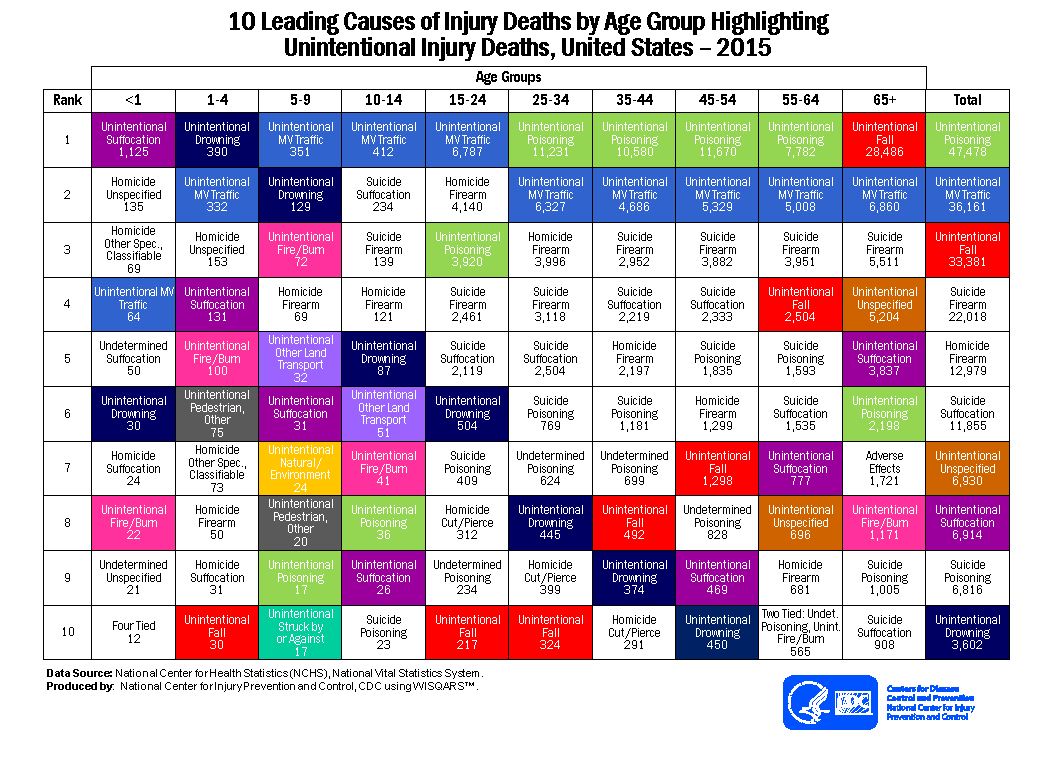
No other affluent country subjects its teenagers to the risk of violence — or early death — that the United States does, and guns are one of the two big reasons. In 2016, 1,675 Americans between the ages of 13 and 19 were murdered with a gun. That made gun homicides the second leading cause of teenage death.

The top cause, by a large margin, was motor vehicle crashes. They killed 2,829 teenagers.

If the Stoneman Douglas shooting is finally going to stir Americans’ consciences about the unique violence of childhood here, let’s make sure that the discussion doesn’t end with guns. The goal, after all, should be saving lives.

As recently as 1990, driving in America was less dangerous than in most other high-income countries. Today, we have a higher death rate than all of our peers. And teenage driving is a huge part of the problem.

In some ways, guns and car crashes are similar public-health issues. With both, other countries have reduced deaths by following the evidence, and we can follow their lead. If anything, though, reducing vehicle deaths should be easier.

Guns have become a defining partisan and cultural clash — Republican versus Democrat, rural versus metropolitan, old versus young. As a result, reducing gun deaths depends on either persuading one political party to abandon a core position or defeating that party.

Vehicle safety is different. There is no lobbying behemoth like the N.R.A. insisting that teenagers get unrestricted licenses. The states that have adopted the safest teen-driving policies lean left, but only somewhat. Alabama, for example, passed new rules last year. Most states have gotten tougher in the last two decades, and deaths have fallen. But they haven’t fallen nearly enough, because the laws are not tough enough.

Wherever you are on the political spectrum, you should be able to support a campaign to reduce teen-driving deaths. For gun-control supporters like me, it’s part of a broader public-health effort. For N.R.A. supporters, it’s a way to save lives that avoids the Second Amendment.

What about teenagers who don’t like the idea of losing freedom? Many may not actually be upset. Today’s teenagers aren’t as enamored with driving as previous generations.

The solution, experts say, revolves around a system called “graduated drivers licenses,” in which teenagers slowly gain privileges as they gain experience. The reality is that most 16-year-olds aren’t ready to operate a lethal 2,000-pound machine that can punish a few seconds of inattention with death, for the teen or someone else on the road. The fatal-crash rate for 16- and 17-year olds is about six times higher than the rate for people in their 30s and 40s. Teen driving kills a lot of people.

The ideal system would create three license tiers: first, a permit allowing supervised driving, starting at age 16 or later (not 15, as most states allow); second, an intermediate license, which forbids nighttime driving and distractions, like phone calls or other teens in the car; and finally, after many hours of driving, the full license.

Within this framework, states can still make different choices. Rural states — where driving matters more to daily life — might choose to have somewhat lower age cutoffs. New Jersey, the most densely populated state, makes people wait until age 18 for a full license. New York and Delaware, the two states with the best laws, according to Advocates for Highway and Auto Safety, have sharply cut deaths in the last decade.

No set of laws can eliminate driving deaths. But it’s clear that we can keep a lot more teenagers alive. The question is whether we care enough to do so. The students of Stoneman Douglas have held the country’s attention in recent weeks because of the raw moral power of their plea: Stop letting children die, and start acting like adults. Let’s get to it.

Adapted from New York Times Article
Opinion piece was written by @DanielLeonhardt
See our new infographic – a spotlight on youth statistics in road safety

See our new infographic – a spotlight on youth statistics in road safety

There is so much data out there on a range of risk factors, death rates and influencing variables when it comes to road safety. From the difference between low and middle-income countries to high-income countries, regional differences to modes of transport. All of this data can be quite confusing, especially for data on youth. That’s why we have done the work to segment data from the global statistics and draw a spotlight on youth statistics on death rates facing 15-29-year-olds.

We have put the information together in a range of interactive graphs and maps so as you can get a clearer picture of how road traffic crashes affect young people.

Our new infographic highlights the urgent action needed for road safety with a particular focus on young people aged 15-29. Road traffic crashes remain the biggest cause of death for young people with over 350,000 deaths annually. The data illustrated in the infographic focuses on a number of factors including location and gender.

LINK TO THIS INFOGRAPHIC

YOURS set to deliver Alliance Advocates Africa in March with Global Alliance

YOURS set to deliver Alliance Advocates Africa in March with Global Alliance

As part of our ongoing partnership with the Global Alliance of NGOs for Road Safety, we have been gearing up to deliver the next Alliance Advocates Training. After successfully delivering two high impact trainings for the Alliance in 2016 and 2017 in Memphis, Tenessee, USA, the Alliance has begun the process of taking the global training to a regional level. 

A set of regional trainings are being delivered in 2018 with first being an African Regional focus in March. We have been working with the Alliance to plan and design the training curriculum, which we will deliver in Nairobi, Kenya.

There are less than two weeks to go for the next Alliance Advocates Training, taking place this year in Nairobi, Kenya. We have been working closely with the Global Alliance of NGOs for Road Safety to set up the training content, which we will deliver in Kenya alongside the World Health Organization and other partners.

19 African leaders have been selected from the pool of Alliance Members after a rigorous selection process, ensuring that action after the training will be robust, impactful and sustainable. The training is part of the Alliance’s Empowerment Programme that aims to equip NGOs around the world with the strategic skills, knowledge and focus to make stronger impact in their countries for road safety.

YOURS Executive Director, Floor Lieshout said, “We are looking forward to delivering another training for the Global Alliance of NGOs for Road Safety. It is a privilege to be working together with some of the brightest African NGO leaders on improving school areas for this regional training”.

Alliance Advocates in 2017 at the FedEx Global Headquarters, Memphis, Tennessee, USA.

Following the Alliance Empowerment Program mid-term evaluation, the Alliance is changing the way it will deliver the Alliance Advocates training in 2018.

alliance empowerment clickdown logo 1To align more closely with our members’ regional needs and cultures, instead of one global Advocates training course, we will run several regional courses. In March, the first regional practical training will be offered in Nairobi, Kenya, for member NGOs from Africa.

In the Nairobi training, Advocates will work on a real-life project around two school zones in the city. They will gather and analyze data and turn it into advocacy for interventions to upgrade these schools from high risk to three-star status. Advocates will have the opportunity to present the proposals to Kenyan decision makers. They will then build an action plan to replicate what they have learned in their own countries.

This is an exciting opportunity to learn about and use road safety best practices, test out new tools and methodologies, and take away tangible learning points to be translated into other contexts and environments. Advocates will learn from experts from Youth for Road Safety (YOURS), the Association for Safe International Travel (ASIRT) Kenya, WHO, iRAP, and the Alliance.

Interview with two African Advocates

The Advocates training will include 20 Alliance members from 15 countries around Africa. The Alliance Advocates will work on a safe school zone data collection project using best practice tools and techniques.

The Alliance interviewed two of the new Advocates to hear about their work and their expectations for the training.

stephanieStephanie Aketch, Humanity & Inclusion, Kenya

Humanity & Inclusion (Hi), formerly known as Handicap International, works alongside people with disabilities and other vulnerable groups, focusing on their essential needs, improving their living conditions, and promoting respect for their dignity and rights.

In June 2017, an amendment to the Traffic Act was passed in Kenya, which should become operational this year. Stephanie says, “The act introduces safe school zones among other measures that seek to minimize the risks faced by children as they journey to and from schools.”

Stephanie hopes to use what she learns in the Advocate training to help move this legislation forward: “At the moment, it is not clear how aspects of speed-calming measures will be introduced to a number of high-speed roads servicing schools. From the mapping exercise for high-risk schools, I hope to draft a policy paper that informs the rules and regulations on how to identify roads servicing schools with high crash risks. This can then guide the roads authorities on which roads to prioritize and the nature of interventions they require.”

1u4a6457 1 250x300Horst Heimstadt, Private Sector Road Safety Forum, Namibia 

The Private Sector Road Safety Forum (PSRSF) act as a link between government and the private sector, pushing for accountability and implementing joint projects to reduce road casualties. They already work within schools in Windhoek, the capital of Namibia, doing safety assessments, implementing infrastructure improvements and school patrols, and educating the students—they estimate that, so far, they have trained 17,000 primary schoolchildren in road safety and, in partnership with police, have trained schoolchildren in eight schools as patrol guards.

“We want to learn how to do better assessments,” says Horst Heimstadt, about the Alliance Advocate training. “We have done assessments but we have not had any official training. We are familiar with the iRAP concept but have never used it, so I am particularly interested in the Star Rating for Schools tool.”

Horst’s plan, after the training, is not only for PSRSF to use the tools itself but to train other organizations in Namibia to use them too. Says Horst, “Namibia is a huge country with few people. It makes it hard to do projects in the north of the country especially without funding. So, rather than us do the projects, we can train partners located there.”

Be sure to stay tuned and connected with us on Twitter for live updates of the Alliance Advocates Africa Training.

READ MORE ABOUT THE ALLIANCE ADVOCATES

Call for Proposals Open: Development of a Road Safety Education Resource

Call for Proposals Open: Development of a Road Safety Education Resource

Together with Michelin Corporate Foundation and Fondation d’entreprise Total, GRSP has launched a Call for Proposals for the development of an innovative educative resource (tool kit) that can address the key road safety issues affecting 10 to 18-year olds globally, while facilitating the development of partnerships with Education Ministries and non-governmental organizations (NGOs) involved in education.

This Call for Proposals comprises the complete design, development, field testing, refinement and production of a modular, and multi-layered road safety resource which can be easily tailored to local conditions for global deployment.

The two foundations wish to capitalize on lessons learned from earlier programmes, new global evidence and crash data and to acknowledge changes and new trends in road safety strategy and education, with the development of a multi-layered road safety intervention targeting children aged 10 to 18. This being ‘the Resource’ and the primary output of this project.  
In defining the nature of this Resource, the partners recognize:

  • the need for finding new educative solutions while conserving a base of “traditional” knowledge in tackling the key themes related to safer road user behaviours.
  • the opportunity to work with educative authorities in order to have a real quantitative impact and greater sustainability.
  • that although Road Safety Education takes place mainly in schools for the younger age groups, it may also be implemented in different ways in the community (ex: in sport clubs, via mobile phone applications etc).

The two foundations want to contribute to the improvement of road safety for 10-18-year-olds, however recognize that due to different stages of maturity and exposure, intervention strategies for this age group will most likely require two distinct modules, one intervention strategy designed for children 10-14 and another targeting those aged 14-18.  

GET MORE INFORMATION FROM THE GRSP WEBSITE

Belize: where youth take the lead on awareness – one catchy jingle at a time!

Belize: where youth take the lead on awareness – one catchy jingle at a time!

Belize is a leading example of how young people, who have been empowered by skills and knowledge can go on to build massive awareness across the country. In 2015 and 2016 we trained 34 young leaders in road safety. From understanding the road safety crisis facing youth in Belize to the action and steps they can take to make a difference. Since then, we have seen continuous action, endless creative output.

Belize continues to see a generation of youth growing up listening to catchy road safety jingles championed by their peers as well being exposed first hand to road safety peer-education through in school workshops.

One of our massive successes in capacity development and empowering youth is the two-year programme established in partnership with the Caribbean Development Bank (CDB) and the Government of Belize (GOBZ).

Having seen our ground breaking workshops in action at the VYBZING Forum in Saint Lucia, CDB approached YOURS to help them reach their goals to educate and inspire young people to take road safety action in Belize. These efforts were part of the Bank’s wider all-encompassing road safety project, which focuses on improving Belize’s infrastructure, emergency response, enforcement and education.

YOURS realized this mission by establishing a strong partnership with the government, universities, youth groups and media and to train 34 young facilitators over two years. We trained two cohorts, one in 2014 – one in 2015, and took young leaders from Belize through the full YOURS interactive workshop experience. These facilitators successfully trained a further 2000+ youth in road safety by the end of 2015.

Since then, the youth have reached over 3000 young people in school trainings as well as created a selection of well-produced, catchy and culturally relevant interventions such as radio spots, tv adverts, public service announcements (PSAs) and a range of other creative outputs. The group became registered organization BYRS – Belizean Youth for Road Safety and have continued to promote road safety in the country.

Their latest video is called ‘Reach the Light’ and is about raising awareness of how people approach traffic lights. It seems like a very basic concept, however, in many low and middle-income countries, road safety good practice must be reiterated. In other parts of the world such as in high-income countries, this road safety culture building has taken place over several decades. In Belize, it is the young people setting the trends.

Caption: The Belizean Youth 4 Road Safety in collaboration with Belize Road Safety Initiative and Sol Belize proudly presents, “Reach the Light” by Yung Proti-Jay aka “The Trafficman”. This is a second video to the first one, but it takes place at night and focuses on different driving attitudes and behaviors when at a Traffic light. We would like to express our sincere gratitude to everyone who made this video a reality despite the fact that we had to be dodging the weather . Like we always say ,road safety is everybody’s business . Lets all be courteous road users for a better future. Please like and share. #BYRS #Trafficman

Caption: The Belizean Youth For Road Safety in collaboration with SOL Belize along with the Belize Road safety Initiative Proudly presents, “MY Helmet” by Yung Proti-Jay AKA The Trafficman. This is an educational music video that emphasizes the importance of using both motorcycle and Bicycle helmets and their different parts. We would like to say a special thank you to Mr. Delroy Thompson and Yung Proti-Jay for a job well done with the song production and all those who directly and indirectly assisted to make this video production a reality. #MY #HELMET #BYRS

These videos are another example of how youth culture, intertwined with support and creativity can raise awareness of pertinent social issues such as road safety.

READ MORE ABOUT OUR WORK IN BELIZE

Don’t stream and drive day – a focus on distraction free driving

Don’t stream and drive day – a focus on distraction free driving

Distractions behind the wheel are a real and dangerous phenomena. We’ve covered distractions extensively in our news artices and risk factors feature and continue to place a spotlight on distraction free driving.

Over in the UK, a campaign has been gaining momentum with its ‘Don’t stream and drive day’ championed by road safety campaigners and policeman Sgt Neil Dewson-Smyth. The campaign reminds drivers of the importance of distraction free driving with a particular focus on streaming video via mobile phones, while behind the wheel. This year the ‘Don’t stream and drive day’ takes place on 3rd April.


In 2015 the practice of livestreaming via a social media platform opened up to a much wider audience when Twitter launched the application Periscope. Overnight thousand upon thousand of users had access to an easy to use and reliable platform to share their experiences by live video. The founder of this campaign Neil Dewson-Smyth (@SgtTCS on Twitter)  was quickly aware of the platform and after a very short time saw some great opportunities for the police to use live video. He has been a proponent of live video for police engagement ever since.

However, as he continued to use the platform and it’s popularity grew, he began to see the practice by some users to livestream whilst driving. The dangers and risks of this were blatantly obvious. He chose to try and do something about this and began a low level approach of challenging drivers about their behaviour and pointing out the dangers.

2016 was lauded as the livestream year and indeed it was. As popularity grew the practice of streaming and driving became more prevalent. Neil consolidated his efforts into a national awareness day that became #DontStreamAndDrive Day on 8th April 2016. The day was a huge success with great support from many police forces, ambulance services, fire & rescue services, individual officers, road safety organisations and more.

During the remainder of 2016 the campaign continued to grow with many other social media users across the globe getting behind the hashtag.

Sadly there have been and we continue to see fatalities as a consequence of this behaviour. Many drivers are oblivious to the dangers and risks this presents. More worrying are those drivers who recognise the dangers but livestream anyway in the belief they are a good driver.

Driving is a complex operation and needs your full concentration all the time. Drivers need their hands on the wheel and their “eyes and mind” on the road too. The loss of one of these vital components, even for a fraction of time, can be the difference between life and death.

Road safety is the responsibility of every road user. Together we can make a difference and reduce the number of unnecessary and totally avoidable deaths and serious injuries on our roads.

We will be supporting the Don’t Stream and Drive Thunderclap on Twitter and encourage you to do so too below!

JOIN DON’T STREAM AND DRIVE’S THUNDERCLAP

READ MORE ABOUT DISTRACTED DRIVING