We are excited to announce that YOURS has teamed up with Snap2Live, a fashion statement for the global cause of road safety! Snap2Live is an innovative belt made from seatbelt material which snaps together in the same way that a seatbelt does. It is a reminder of our commitment to road safety. Snap2Live is giving some of its profits to YOURS everytime you buy a belt.
Snap2Live is an innovative fashion statement for road safety! The Decade of Action for Road Safety has the mission of saving five million lives by 2020 and awareness of the cause will remain a big factor in promoting road safety on the world stage! This unique belt is a cool new way to support road safety and look good doing it. Social entrepreneur Ernesto Arguello makes a life-saving fashion statement with his funky Snap2Live belts.
Snap2Live has teamed up with YOURS to give $10 profit from each belt sold to YOURS for its work. By entering YOURS at the check out support code!
The Snap2Live belt is a reminder of what we can do to be safe on the road, not only promoting the use of seatbelts in motor-vehicles but also of road safety in general and the risk factors that contribute to road crashes all around the world. The Snap2Live belt is a fashion statement for road safety, it is made from seatbelt material, which snaps together in the same mechanism as a real seatbelt. It reminds us to buckle up when driving, not to text and drive and to never drink and drive.
The belt is offered in a one-size fits all belt in a variety of colours. With the purchase of this belt, you’re committing to the cause and becoming an advocate for road safety. The packaging has been carefully designed to be an informational piece giving the user quick and easy to learn facts to become an active supporter of the awareness campaign. Wearing the belt itself is a reminder of your commitment to road safety and an eye catching accessory that will engage others.
When buying a Snap2Live belt, $10 will go towards YOURS’ work around the world; improving road safety for young people. This can be achieved by entering YOURS in the support code box.
Floor Lieshout, Director of YOURS said, “The overall aim with this partnership is to raise awareness on youth and road safety issues. With this new Snap-2-Live belt we have another tool in our awareness raising toolbox. We hope this wil lead to more awareness and actions to prevent road traffic injuries”.
The Akili Initiative see a world where young people have a permanent seat at the table of high level policy and decision making on youth health. The initiative has just launched a new competition; an essay competition focusing on the most important health problem in the world today!
“As the MDGs come to a close, now is the time to shape our future in the next development agenda. The Akili Initiative is a youth-led, youth-focused effort uniting young people around the world in the movement towards a healthier post-2015”.
The Akili Iniatiative appreciate that youth are not invicible, as much as we believe that the world is our oyster, young people are at particular risk of many pressing health concerns, particularly road traffic crashes; the biggest killer of young people globally.
The Akili Initiative are inviting young people to write an essay on what they feel is the most important health problem facing youth in the world and why? Submit a response of 500 words or less to akiliinitiative@gmail.com for a chance to attend the World Conference on Youth 2014 in Colombo, Sri Lanka.
We encourage you, the Global Youth Network for Road Safety, passionate about road safety and global health to write your thoughts down and submit your essay to this competition!
Timeline of deadlines:
April 15 – Top 10 Essays Selected, Finalists Notified
April 16 to Apr 30 – Popular Vote – Top 10 Essays
Top 10 essays will be selected and shared with the world on our site for a popular vote! Popular vote will count as 1/5th of the final vote. Spread the word about your great essay, open to friends, family, and complete strangers alike for voting before our expert panel of judges has the final word.
April 16 to Apr 30 – Expert Panelist Vote – Top 10 Essays
The panelists judging the essays are world-renowned youth advocates with experience in a wide range of youth health issues. Click on this event to check out their bios.
May 1 – Winner Announced!
May 6 to May 10 – World Conference on Youth, Colombo, Sri Lanka
One Grand Prize Winner will win a fully funded trip to Sri Lanka to represent Akili in the World Conference on Youth, and have the opportunity to directly engage and advocate for youth health in the post-2015 development agenda.
Click here to find out more information on how to take part in this opportunity.
Brian is back with his monthly column on the world of youth and road safety issues in Africa. Brian has joined YOURS as social media champion and will be running a range of online social media ‘chats’ on topics of road safety via Twitter and Facebook. An exciting new way to engage young people in road safety across the world!
Lights, cameras ready, we count three, two, one: ACTION! Yes, a new month is well pregnant with 10 days under our belt already! Hold your horses…Slow down the Rap already because we’re back! #BriansColumn.
Following last month’s article: Brian’s Column: Your skull isn’t made of diamond! Use your helmet! We got insightful feedback and boy, were they cool! Much respects to everyone who participated. We’re proud to present to you #RoadSafetyThursday: an online tweet-up session where we shall be using the power of social media (Twitter & Facebook) to reach out to ourselves and other road safety stakeholders over the real issues in road safety. As usual, opportunities, networking, capacity building and advocacy shall form part of the dish.
Is your appetite up already? Our hashtag, shall be #RoadSafetyThursday! So, be sure, to get your fingers tweeting…
One of the outcomes during our last #RoadSafetyThursday tweep up session was a number of myths and facts about the helmet itself. And then ‘the shape of the head’ came in! Seriously? You bet! We all know that head shape and helmet fitting are not universal, and are of great importance, but do we really know what we are talking about when we determine which helmets go on which heads? Anyways, we all agree that the primary reason for buying a motorcycle helmet is safety and protection to your head in the event of ‘an accident’ –a CRASH to be precise. To get the best protection your helmet needs to provide a really good comfortable fit. A bad fitting helmet can come off in a crash even if the chin strap is done up.
In order to find a motorcycle helmet with the correct fit, you should know your head size measurement before you buy any helmet. Here’s the golden rule for finding a good comfortable fit: Your head size + Your head shape = comfortable fit
Although human heads have an infinite variety of shapes and sizes, most of us fall into these two categories: very narrow, ‘long oval’ head shapes and very wide ’round’ earth head shapes Some of us may have a combination of these two head shapes. It’s possible to have combinations of these shapes in an infinite number of variations. Fortunately many motorcycle helmets are manufactured with internal shapes that roughly match these “oval” or “round” shaped head categories.
Source: World Motorcycle Helmet Safety Standards (2013)
It’s important to know your head shape because you can roughly know which helmet brand and model will fit by matching your head shape to the helmet’s internal shape. Not every helmet will fit the same and almost every helmet brand and model is different. Shape is one of the most important factors to understand when purchasing a motorcycle helmet. Always remember – there are different helmets are produced in a range of sizes to satisfy a mass market. Your head shape and size are unique to you, so take your time to use the above tips when selecting your new motorcycle helmet. So, in fact, all this talk about categorizing head shape and helmets isn’t complete BS. 😉
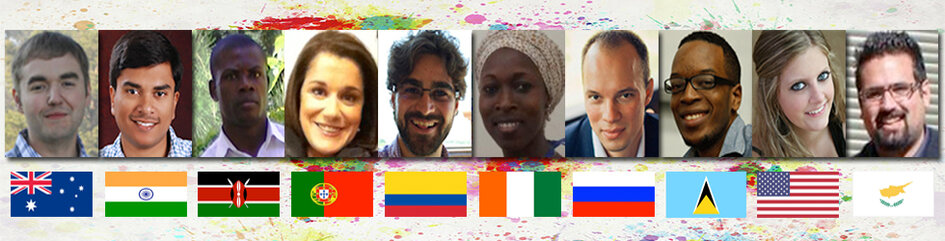
We are very excited to announce the establishment of the next CORE Group 2014-2016. We are very happy to let you know that we have found a full CORE Group representing every single region of the world. This means that we now have representation on every part of the world bringing us closer to young people on the ground as well as illustrating that young people all around the world care about road safety and are taking action!
The CORE Group is made up of 10 youth and road safety leaders from every region of the world.
Finding our CORE Group was a rigorous process. We were inundated with applications from passion young people all around the world who have illustrated real action for road safety in the countries and regions. It was therefore an incredibly difficult process to name our final selection. After careful deliberation, we have now chosen our final CORE Group who join the YOURS team in our fundamentally youth participatory and youth-led organization.
The CORE group explain their roles and grouped them into three key areas of focus:
The YOURS Global Youth Network for Road Safety: ‘To improve what we currently have’- to expand, share more information about youth and road safety projects and create a thriving quality network.
Coordination and Guidance: ‘To improve what we currently do’- of youth and road safety initiatives in every region consisting of coordinating and guiding activities, YOURS capacity development programs and creating regional information hubs on youth and road safety activities.
Advocacy and Promotion – ‘To be heard and seen more’ – for YOURS to have a known and heard network worldwide and to reach out to the media more frequently.
The CORE Group is made up of 10 young leaders from across the world: – you can click on each name to read more about them.
Mr Alexander Revskiy – Coordinator of the Russian Federation “As a member of the CORE Group I intend to inform the representatives of the different countries about new projects being implemented in Russia. I hope to share the expertise and experience of our organisation in running public awareness campaigns and to discuss the development of a youth road safety movement in Russia”.
Ms Ana Rita Lavdo – Coordinator of the European Region “As regional coordinator I’ll be 100% committed in working in new strategities, new actions and new approaches. Also work on a better way to spread the message of what we are doing to the rest of the world”.
Mr Daniel Cano – Coordinator of the South American Region “I hope to start a change in the we interact with the road. We don’t need to build awareness, but to change our every day practices on the street. As a Regional Coordinator, I will work to make this paradigm shift possible”.
Mr Erland George – Coordinator of the Caribbean Region “Coming off the heels of the Youth & Road Safety Vybzing Forum conducted in partnership with YOURS and the Caribbean Development Bank, held in St. Lucia last year, I have had a eagerness to further bring awareness of how important road safety is and the current impact on our youth and I am keenly interested in acquiring more theoretical/practical knowledge in this field”.
Ms Emily Reynold – Coordinator of the North American Region “I hope to get into our school systems and start the good habits young. I believe that change is very possible, and within our grasp. I am extremely honored to be a member of the YOURS CORE group and here is to a beautiful and successful term!”
Ms Maferima Kone – Coordinator of Francophone Africa “I thank all the team YOURS for my nomination to this position. I will do my utmost to carry out the tasks entrusted to me and I will worthily represent the Francophone Africa region during my mandate”.
Mr Naren Nallapeta – Cooridinator of the South East Asia Region “Like the famous saying a single candle can ignite another 1000 candles, likewise one educated being can ignite and educate another 1000 beings. I will try being that candle and I will find many more candles that can spread light in the minds of millions of people in the Southeast Asian region. Let’s all join hands and make our roads safer, working together is the only solution”.
Mr Raymond Obouyo – Coordinator of Anglophone Africa “I’m looking forward to put my management skills and passion for road safety to increase awareness on road safety, build capacities and join efforts in making youth voices heard in demanding for safety on our roads”.
Manpreet Darroch, Coordinator of the Global Youth Network for Road Safety said, “I am very excited to have recruited a CORE Group which that represents every single region of the world. The amount of young people that applied is testament to the fact that road safety is considered a serious issue in the world by young people. Of course there is a lot of work to be done to increase awareness of youth and road safety issues on a global level and with the new group, I am confident that we will expand our activities”
Our next steps is an orientation webinar to bring all CORE Group members to aligned goals and missions. The CORE Group will also act as a key advocacy for bringing road safety to the Post-2015 Development Agenda.
As the Post-2015 Development Agenda continues to engage with global leaders on what should be included in its document, the youth consultation and including young people’s thoughts on the issue remains high on the agenda. In our consistent push to bring road safety to the international agenda, our Global Youth Network for Road Safety strongly believes that road safety should be on the agenda, so we have written a letter to the United Nations Secretary General Ban Ki Moon’s special Envoy on Youth Mr Ahmad Alhendawi. We publish it here for you to see.
Mr Ahmad Alhendawi Secretary-General’s Envoy on Youth Office of the Secretary-General’s Envoy on Youth United Nations Headquarters, 15th Floor New York, NY 10017 Subject: Road traffic injuries and the youth submission to the Post-2015 agenda
Dear Mr Ahmad Alhendawi,
On behalf of YOURS – Youth for Road Safety I am writing to you about the importance of including road safety within the youth submission to the UN’s Post-2015 development agenda. Road traffic injuries are a global, man-made (and preventable) epidemic with a health burden on the scale of HIV/AIDS and Malaria. Over 30% of those killed and injured in road traffic crashes are less than 25 years old. According to the World Health Organization road traffic injuries are the leading cause of death worldwide for young people aged 15-29 (1). The vast majority of casualties occur in middle and low-income countries which are experiencing rapid motorisation.
YOURS is a global youth-led non-governmental organization that brings together over 150 youth NGOs active in road safety in more than 100 countries (2). We are delighted that your second priority as Youth Envoy is Advocacy and aim to promote stronger youth participation and a youth-friendly Post- 2015 Development Agenda. On behalf of our global youth network for road safety and on behalf of their regional youth coordinators, we actively reach out to you to participate in this process.
I would like to congratulate you with the online crowdsourcing platform (The Global Partnership for Youth in the Post-2015 Agenda) that facilitates a debate on youth priorities. I recently posted my ‘Road Safety’ idea in its health challenge (3). I am happy to see that this idea was well received by the online community and I am positive that road safety will be further discussed under your leadership. With this letter I would also like to offer my help to further develop the road safety ‘idea’ which hopefully results in a concrete proposal in the document “Youth Voices”.
Governments and international agencies must do more to prioritise road safety and integrate it into wider sustainable development agendas. As a crosscutting issue road safety and sustainable mobility can also assist in achieving wider health, transport and environmental objectives, including reducing air pollution, supporting low carbon transport and enabling the fight against obesity-related non- communicable diseases.
In conclusion, I ask for your help to save our future generations from being killed on our roads while they try to get an education. Access to safe mobility is a human right and must be part of our priorities.
Yours sincerely, Floor Lieshout Director
floor@youthforroadsafety.org
1) Global status report on road safety 2013: supporting a decade of action, Geneva, World Health Organization, 2013 2) www.youthforroadsafety.org 3) https://crowdsourcing.itu.int/post/39575
About the Secretary General’s Envoy on Youth: Mr. Alhendawi
The UN Secretary-General (UNSG) has identified in his second term working with and for young people as one of his top priorities. In this regard, he tasked the UN Volunteer Program to establish a Youth Volunteer Programme and the UN Inter-Agency Network on Youth Development (IANYD) to develop a System-Wide Action Plan on Youth. Moreover, he appointed Mr. Ahmad Alhendawi of Jordan as his first ever Envoy on Youth. The Envoy assumed his position on 17 January 2013 to advocate for addressing the development needs and rights of young people, as well as to bring the work of the United Nations with and for youth closer to them.
The Envoy on Youth is mandated with the task of bringing the voices of young people to the United Nations System. Moreover, the Envoy on Youth also works with different UN Agencies, Governments, Civil Society, Academia and Media stakeholders towards enhancing, empowering and strengthening the position of young people within and outside of the United Nations System. The role of the Envoy on Youth is also described by the UN Secretary-General as a “harmoniser between all UN agencies” bringing them together to explore cooperation opportunities for working with and for young people.
The workplan of the UNSG’s Envoy on Youth outlines 4 priority areas; Participation, Advocacy, Partnerships and Harmonisation. During the first year, increased focus will be placed on Employment and Civic Engagement while ensuring the integration of a gender perspective across all work areas. In parallel, the Envoy will support the Education First Initiative and the planned activities in relation to youth and education.
As consultations on the post-2015 development agenda move forward, it is now important to amplify young people’s voices and advocate for road safety. Reducing road traffic injuries must be a priority which should be reflected as concrete commitment in the post-2015 agenda.
On 18 February 2014, the President of the General Assembly launched a Global Partnership on Youth in the Post-2015 Development Agenda facilitated by the Secretary-General’s Envoy on Youth to bring together a wide spectrum of stakeholders to be a unified voice for youth priorities in the post-2015 development agenda. The Partnership will aim to create an inclusive platform for young people to formulate concrete ideas that can be proposed for the inter-governmental deliberation.
YOURS signed up for the Global Partnership on Youth and is advocating for road safety. But we need your help! We encourage all youth advocates for road safety to let your voices be heard and vote, tweet, comment on the road safety idea!
We need you to go to this link, sign in with your social media accounts and vote for our ‘Road Safety is No Accident!’ page idea on the crowdsourcing platform.
As a first step, thecrowdsourcing platform was launched to consolidate the outcomes of national, regional, global and online consultations into concrete proposals for the post-2015 development framework. These proposals will be informed by the latest available data and reports, including those from the United Nations and the High Level Panel on Post-2015.