Brian’s Column: Are the police in your road safety plans?

Brian’s Column: Are the police in your road safety plans?

Our regular monthly columnist Brian Bilal Mwebaze is back with another column on road safety opinions and happenings in Africa. This month, Brian briefly addresses the importance of involving the police in your road safety actions, afterall, road safety laws are only as good as their enforcement.

April! That’s right! And what a whole load of road safety events you have come along with! If you didn’t know #ICPD47 is in high definition, as the introductory Statement on the Reports of the Secretary-General on the Operational Review of the Programme of Action of the International Conference on Population and Development Beyond 2014 mention youth and road safety.

The reports conclude with the following seven paths, based on the collected findings of the review for the further implementation of ICPD Beyond 2014 to ensure a sustainable world, which cant exist without safe mobility. We cant forget the #RoadSafetyThursday Tweet-up sessions! Join us every Thursday on twitter!

Back to the police…

Yeah, they’ve been known under a number of trademark and street names:- cops, policia, police, polisi-mention it. Are they important for your road safety campaign? Do you like them? Or Do you run into hiding upon sight of them?

See, we know that the traffic safety situation and existence of different entropy reasons in our national traffic safety system inevitably puts a special importance on traffic policing, control and enforcement. Can you imagine what hell of a mess would be on the roads if there was no one to act like a class monitor?

We all know one classical rule of road safety planning: Road safety cannot be the responsibility of government alone. The commercial sector, service organizations and non-Governmental Organizations (NGOs) play an important role in increasing road safety awareness at grass roots level. Effective traffic enforcement is one the most important requirements for road safety. We can have the best Rules of the Road, but if these are not enforced effectively, we will continue to have an increase in fatal crashes on our roads.

Read about the WHO’s report on how countries can tackle law and enforcement hurdles.

Of course, laws often exist without enforcement and really, what’s the point in that? In one respect, enacting road safety law does show the country’s stance on a topic in that a democratic decsion is reached by the people and representatives to tackle the road safety issue at hand, however, without enforcment and education on th law in question, many key risk factors are still perperated. We need to advocate on all levels of the road safety system!

Click here to see the road safety system ‘Haddon Matrix’ in more detail.

If you’d like to know how your local organization can strengthen and realize outputs in law enforcement, Email: k.johnson@fundforglobalhealth.org http://fundforglobalhealth.org/ Don’t say I didn’t tell ya!! Listen, this isn’t an April fool’s day joke! 😉 #STAYSAFE

Don’t forget #RoadSafetyThursday! Read more about it here.

United Nations pass resolution for road safety and Post-2015 Agenda

United Nations pass resolution for road safety and Post-2015 Agenda

Last week, the United Nations convened for the 19th Road Safety Collaboration Meeting (UNRSC) followed by the meeting of the General Assembly. Global action to combat a growing worldwide epidemic road deaths and injuries must become part of the UN’s new priorities for development, the UN General Assembly was told on 10 April as it passed a new Resolution to address the crisis.

Governments, including Brazil, Jamaica and Russia, urged inclusion of road safety in the post-2015 goals due to be agreed next year. Many speakers in the debate, including the US Ambassador to the UN, Samantha Power, pledged support for the Decade of Action. The US co-sponsored the resolution, which was introduced by Russia’s Deputy Interior Minister, Victor Kiryanov.


Governments at the UN have pledged to stabilise and reduce road deaths and injuries in a Decade of Action for Road Safety from 2011-2020, but progress is falling short. The issue must become part of the Post-2015 development goals so that millions of lives can be saved, the UN was told.

Speaking at the UN, Lord Robertson of Port Ellen, Chair of the Commission for Global Road Safety, called for renewed action to save lives on the roads around the world. He was joined by global road safety ambassador, actress Michelle Yeoh, who also addressed the UN General Assembly as it passed a new Resolution to improve global road safety.

Global advocate Lord Robertson, Actress and Global Road Safety Ambassador Michelle Yeoh and Russia’s Deputy Interior Minister General Victor Kiryanov address the General Assembly in New York.

Lord Robertson, who was representing the UK Government during the UN debate, called for urgent global support for the Decade of Action: “We have not come as far as many of us hoped, or expected,” he told the UN.

“In 2010, when the General Assembly established the Decade of Action, more than a hundred countries endorsed the objective of stabilising and then reducing road deaths by 2020. But we have not yet seen the levels of international cooperation, political leadership or resourcing necessary to achieve this. This new Resolution recognises the Commission for Global Road Safety’s call for a target for reducing road deaths to become part of the new development goals. Such a global commitment is vital to save millions of lives around the world.”

The new Resolution calls for a global Ministerial conference to be held in 2015 to assess progress of the Decade of Action for Road Safety. The Government of Brazil has offered to host the Ministerial. The Resolution also asks the WHO to plan a Global Road Safety Week in 2015 on the theme of children and road safety.

At the last Global Ministerial Conference on Road Safety – YOURS was launched alongside a Moscow Youth Declaration on Road Safety

The new UN Resolution encourages Governments to consider road safety when negotiating the post-2015 development goals. The Commission is calling for a specific global target to reduce road fatalities by 50% to be included in the new Sustainable Development Goals. This would be consistent with the objectives of the Decade of Action for Road Safety.

Michelle Yeoh, Global Road Safety Ambassador and a member of the Commission, spoke on behalf of Malaysia. She called for further global support for the solutions which have been proven to save lives in countries irrespective of income level.

“In my visits to many countries, alongside the sadness and loss, I have also seen the many ways in which solutions are being implemented and lives protected,” she said. “But if we are to achieve our objectives to save millions of lives globally, we must, and can do much more. Safe mobility should be something we should all expect, irrespective of whether we are rich or poor, or from the north or south. Like clean water, like education, we should all have safe access to our streets. This should be true for all, especially so for our children.

“We need new sources of funding to support road safety campaign. And we need new momentum in support of our shared objective for the Decade of Action, beginning with inclusion of road safety in the post-2015 goals.”

The Resolution also calls further progress to be made in implementing the Decade of Action in a range of key areas. These include:

  • additional funding for activities, including through contributions to the Road Safety Fund established by the World Health Organization and the FIA Foundation;
  • further implementation of NCAP crash test programmes as being promoted by the Global New Car Assessment Programme;
  • encouraging member states to implement national plans on road safety, with emphasis on protecting vulnerable road users and promoting sustainable mobility.

The UN Decade of Action for Road Safety 2011-2020 aims to reduce road deaths and injuries across the world with a five pillar Global Plan. More than 1.2 million people die every year on the world’s roads, and up to 50 million are injured.The World Health Organization, which reports on the Decade of Action, has shown that while some progress on road safety has been made particularly in high income countries, many low and middle income countries are facing increasing levels of injury and fatality on their roads. Developing countries account for 90% of the global total of road deaths.

The 19th Session of the United Nations Road Safety Collaboration was the preamble to the UNGA’s resolution.

At the UNRSC Meeting, YOURS shared information about our recent updates and news from the world of youth and road safety including our successful inception mission for our next Capacity Development Training in Belize and updates on the push for road safety to be including in the youth sides of the Post-2015 Agenda.

Hands-free is not risk-free – infographic from NSC USA explains

Hands-free is not risk-free – infographic from NSC USA explains

In our modern, we know that distracted driving is a major cause of road traffic crashes. Our mind just cannot multi-task and we also know that talking on a mobile phone has been banned in many countries already but what about handsfree talking? A new infographic from the National Safety Council in the United States have explained that ‘Hands-free is not risk-free!’,

About the National Safety Council
The National Safety Council is a nonprofit organization whose mission is to save lives by preventing injuries and deaths at work, in homes and communities and on the road through leadership, research, education and advocacy. NSC advances this mission by partnering with businesses, government agencies, elected officials and the public to make an impact where the most preventable injuries and deaths occur, in areas such as distracted driving, teen driving, workplace safety and beyond the workplace, particularly in and near our homes. 

Update from South East Asia – Epidemiology of crashes in India

Update from South East Asia – Epidemiology of crashes in India

Epidemiology is the science that studies the patterns, causes, and effects of health and disease conditions in defined populations. Our CORE Group Representative for South East Asia, Dr Naren Nallapeta shared a key study by the TATA Trust focusing on the causes of road crashes in his home country of India. It shows rapid motorization in one of the most populated coutries in the world.

India accounts for as high as 6 per cent of the world’s RTCs, although it has 1 per cent of the world’s vehicles. The RTC rate of 35 per 1,000 vehicles in India is one of the highest in the world and so is the RTA fatality rate of 25.3 per 10,000 vehicles.

Background

  • India has a total rural road network of over 3,000,000km and urban road network of more than 250,000km with:
           – National highways / expressways being 70,548km
           – State highways being 128,000k
           – Major and other district roads 470,000k
           – Village roads 2,650,000km. 
  • Data indicates that the total motor vehicle population in India has increased from 300,000 in 1951 to about 73,000,000 in 2004.
  • The percentage share of road traffic accidental deaths in India is 34.5 per cent according to a recent NCRB (2009) report
  • 100,300 males and 17,939 females totalling 118,239 persons were killed during the year 2008, while travelling by various modes of transport on roads.


Rapid motorization without a real focus on safety has left India with of the highest death rates due to road traffic crashes in the world.

Epidemiology is the science that studies the patterns, causes, and effects of health and disease conditions in defined populations. Our CORE Group Representative for South East Asia, Dr Naren Nallapeta shared a key study by the TATA Trust focusing on the causes of road crashes in his home country of India. It shows rapid motorization in one of the most populated coutries in the world.

India has the highest proportion of deaths due to road traffic accidents in South East Asia. The situation is problematic in India because of lack of proper infrastructure facilities, poor road designs, poor implementation of traffic rules and regulations and a high load of a range of vehicles on the roads.

Fatalities and morbidities from RTAs mostly affect the economically productive age group. Studies indicate that young adults in their early thirties continue to be the victims of RTAs.m Pedestrians, users of non-motorised vehicles and users of motorised two-wheeled vehicles, who are often from poor or lower middle class households, are the victims of fatal RTAs.

Gaps in knowledge

In spite of the high burden of RTAs in the country, there is a lack of systematic information on the extent of the problem and its multi-dimensional nature. There is limited information on the patterns, distribution, and outcomes of RTAs across the country.

Lack of systematic data generation mechanisms both at the national and state level leads to limitations in designing appropriate intervention strategies to deal with the problem in the country.In addition to this, research efforts to understand the social and economic consequences of deaths, injuries and long-term disabilities and their implications for the different sections of the population are limited.

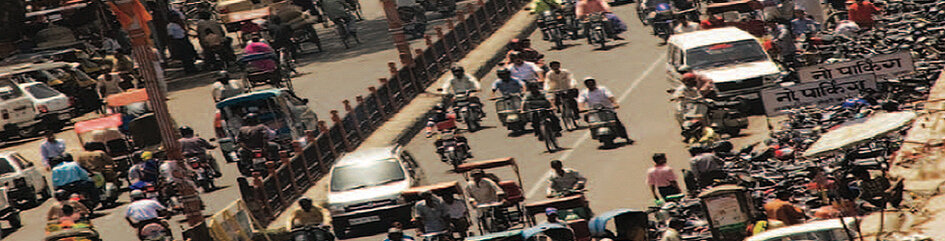
A common site in India; lack of helmet use and incredibly unsafe mobility.

The way forward
The way forward could include:

  • A multi-pronged approach, and efforts at systematic data generation to understand the true extent of the problem.
  • Awareness and educational programmes directed at both the vehicle users as well as road users.
  • Strict law enforcement mechanisms to control and regulate traffic on the road.
  • Improvement in trauma management systems to reduce the intensity of injuries suffered by the victims.
  • 100,300 males and 17,939 females totalling 118,239 persons were killed during the year 2008, while travelling by various modes of transport on roads.
  • Encouraging use of safety aids such as helmets among the public and improving infrastructure to make roads safer.
  • Encouraging research on improvement in the existing technologies such as helmets by adapting them to local circumstances; promote better vehicular designs that are more stable and crash-resistant.
  • Creation of a common platform at the national level to pool research inputs for better understanding of RTAs and encourage evidence based policy formulation to attend to this problem in our country.


Click here to read Naren’s poem on helmet use.

YOURS joins the Global Partnership for Youth on Post-2015 Agenda

YOURS joins the Global Partnership for Youth on Post-2015 Agenda

We are very happy to announce that we have officially joined the Global Partnership for Youth on the Post-2015 Development Agenda. This partnership brings together a list of organizations around the world interested in the youth element of the Post-2015 Development Agenda.

The objective of this partnership is to ensure that young people are actively participating in setting, implementing, and evaluating the new development agenda due to replace the MDGs in 2015. This partnership offers a unique platform for all stakeholders working on youth development to express their views, and help identify specific targets and indicators for youth empowerment, which could feature in the Post-2015 Development Agenda. 

Under the five thematic areas that emerged as top priorities for young people in the My World 2015 survey—Education, Employment and Entrepreneurship, Health, Good Governance, and Peace and Stability—young people are crowdsourcing their recommendations to policy makers. The online crowdsourcing platform is being moderated by both UN agencies and youth organizations, and will allow for instant interaction between thousands of young people from around the world—complimented by a series of offline events. The expected outcome is a consolidated list of youth priorities to be shared with Member States for the intergovernmental deliberations at the ECOSOC Youth Forum.

“Our collective task in the partnership is to allow young people and youth development actors to sharpen youth priorities using the crowdsourcing platform” – Ahmad Alhendawi, Secretary-General’s Envoy on Youth

YOURS continues to invite you, the Global Youth Network for Road Safety to log in to our idea (which is currently #1 on the Crowdsourcing Platform) and vote for your priorities.

The crowdsourcing offers a platform for thousands of youth and youth-development actors from around the world to help identify and formulate concrete youth priorities to be proposed in the post-2015 development framework as it pertains to youth. Under the five thematic areas Education; Employment and Entrepreneurship; Health; Good Governance; and Peace and Stability, the platform offers a virtual space for young people to express their priorities and how these can be reflected in the design and implementation of the post-2015 development agenda.

Click here to vote for the Right to Safe and Sustainable Transport

Caribbean CORE Group Rep at Third Caribbean Regional Congress

Caribbean CORE Group Rep at Third Caribbean Regional Congress

The International Road Federation is proud to announce that the 3rd IRF Caribbean Regional Congress will be held in Port of Spain, Trinidad, May 7–9, 2014. The Congress will be hosted by the Ministry of Transport of Trinidad and Tobago and endorsed by the Caribbean Development Bank, the Inter-American Development Bank and the Global Road Safety Facility of The World Bank.

The third edition of this event will serve as a means to deliver world-class knowledge resources and practical guidance across shared transportation challenges, including road safety, infrastructure asset management; urban development & mobility; and funding transport Infrastructure. It will bring together regional and local industry stakeholders from government, academia, multilateral banks, civil society, and private sector to help find solutions to the region’s transportation challenges. 

egpic.jpg
Our CORE Group Representative for the Caribbean Region Mr Erland George will be attended the event and has been invited by the Caribbean Development Bank to represent YOURS at the event.


The International Road Federation
 is a nongovernmental, nonprofit organization with the mission to encourage and promote development and maintenance of better, safer and more sustainable roads and road networks.

Erland George’s attendance builds on our work in the area since our training in Saint Lucia 2013 with the Caribbean Development Bank.

Working together with members and associates in over 90 countries, the IRF promotes social and economic benefits that flow from well planned and environmentally sound road transport networks. It helps put in place technological solutions and management practices that provide maximum economic and social returns from national road investments. The IRF plays a major role in all aspects of road policy and development worldwide.

For governments and financial institutions, the IRF provides a wide base of expertise for planning road development strategy and policy. For its members, the IRF is a business network, a link to external institutions and agencies, such as the United Nations and European Union, and a business card of introduction to government officials and decision makers. For the community of road professionals, the IRF is a source of support and information for national road associations, advocacy groups, companies and institutions dedicated to the development of road infrastructure.

Read about our work in the Caribbean includin the Caribbean Youth Declaration for Road Safety 2013

With a wide network across over ninety countries on six continents, the IRF believes that it can make a difference by providing best practices and expert advice to today’s multi-faceted world of transport.