A Present for my Little Ones – Road Safety Poem by Kenyan Leader

A Present for my Little Ones – Road Safety Poem by Kenyan Leader

In late 2012, YOURS worked with an exceptional group of young Kenyan leaders to train them as facilitators. Many of them still talk of the day that road safety spark was ignited in them and passion for the cause born. One of those facilitators, a young leader working for the Kenya Red Cross, was inspired by the #SaveKidsLives campaign and wrote this poem.

Poem written by Joel pictured in the middle (pink and white shirt)

Present for my Little Ones
By Joel Njorogejoe

Teenage has beaten me,
Off and my young age starts to melt
Like snow that curses sun rise
But with countless quotes of my tender years
When I was befallen by inability
I needed protection from my seniors
That today stamps my well being

My eyes floods with tears
My heart mourns and tears
When I hear my ‘little ones’ vanishing
Through the harming enemy of carelessness
Most say they are just accidents,
But not;
For road traffic crashes can be prevented
Our young ones can still live happily
With good health from our caution

Count these losses;
Of lost hopes for nations and world
Youngsters leaving us in pain
Why go this early in life?
We ask countless but rhetoric
Future mentors and gloom of the nation
Gone for good and never to come back
Not even to read this message of hope

We have lost many and are tired
And now beg we take a ponder
Embracing the safety strives
Actions to protect our little ones
From the merciless mandibles of
Traffic road crashes, as I give today;
The present for my little ones
By joining all positive ventures
Fight negligence and wave your pledge
Save the little kids.

Poem by; Joel Njoroge (Daddy Poet)
Twitter: @_njorogejoe

WHO Publish Road Safety Media Brief for journalists and media

WHO Publish Road Safety Media Brief for journalists and media

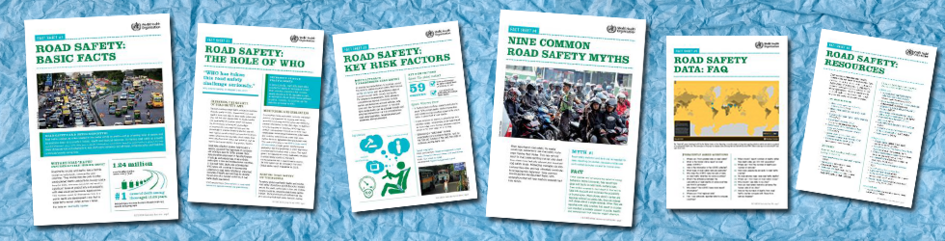
The World Health Organization have published a new Road Safety Media brief to enable journalists all around the world to accurately report on road safety around the world. The brief gives media personnel around the world bitesized evidence based information ready for publication, especially in placing a much needed spotlight on the cause as a major global health issue.

The Road Safety Media Brief aims to support journalists who are producing stories on road safety. The brief compiles information on a variety of road safety topics with the objective of making this information more easily accessible to media from all over the world.

Road traffic crashes are often covered in the media simply as events—not as a leading killer of people and an enormous drain on a country’s human, health and financial resources.

By framing road safety as a health and development story, with data and in-depth information, journalists have the opportunity to affect the way these stories are told and potentially to help shift public behaviour and attitudes, influence policy and therefore contribute towards saving lives.

The Road Safety Media Brief consists of the following six downloadable fact sheets with active links to additional resources from WHO and other organizations:

Road Safety: Basic Facts – This fact sheet briefly defines the problem posed by the lack of safety on the roads, its consequences for countries and some possible solutions. Download the PDF.

Road Safety: The Role of WHO – is fact sheet explains what WHO does in the field of road safety and how the Organization can help reporters write more comprehensively about it. Download the PDF.

Road Safety: Risk Factors – This fact sheet summarizes facts and information on risk factors such as speeding, drinking and driving, and failing to use motorcycle helmets, seat-belts and child restraints as well as the level of progress being made in some countries to address these issues. Download the PDF.


Nine Common Road Safety Myths – This fact sheet clarifies some “common beliefs” or myths that might lead media to report inaccurately about the problem or the solutions. Download the PDF.

Road Safety Data: FAQ – These frequently asked questions and answers guide reporters on ways to find, interpret and use data particularly on road traffic fatalities. Download the PDF.

Road Safety: Resources – This fact sheet compiles almost one hundred active links to publications, fact sheets, case studies, projects, databases, and events – offered by WHO and other organizations – that reporters can use to write on the topic of road safety. Download the PDF.

This media kit bridges the gap between a lack of knowledge on road safety for media professionals as well as highlighting the gravity of the road safety issue from a neutral and evidence based stand point. This kit will enable media professionals a level of information that brings them up to speed on road safety as a major public health concern.

We are also very happy to note that WHO have included YOURS in its resources section as an active NGO for youth and road safety issues.

Getting ready for the Post-2015 Development Agenda negotiations

Getting ready for the Post-2015 Development Agenda negotiations

Our friends at the FIA Foundation explain the latest processes of the Post-2015 Sustainable Development Agenda and what it means for road safety. Read how you can get involved with the Sustainable Development Goals (SDGS) and the latest information on the process as it reaches its climax this year.

The advocacy effort calling for road safety to be included in the post-2015 Sustainable Development Goals (SDGs) is showing signs of progress, but the critical work lies ahead with UN negotiations building momentum over the coming months.

At the UN, the process to negotiate the SDGs has entered its final stages. A stocktaking session was completed in January, with work on the text of the opening declaration for the SDGs due to start on 17 February. Negotiations on the substance of the goals and targets will then commence in March with the concluding sessions over the summer.

So we are at the start of the final and most important phase, the culmination of the long-running process to establish the global development agenda for the next 15 years. For the inclusion of road safety in the SDGs, the outlook is positive but the stakes are high. Progress had been made over 2014, and inclusion of road safety in the two most important UN reports on the SDGs means that the issue has a place at the negotiating table.

The UN Secretary General’s ‘Synthesis Report’ on the SDGs together with the draft SDGs from the UN’s Post-2015 Open Working Group (OWG) will frame the upcoming negotiations between Governments at the UN.

In his Synthesis Report, UN Secretary General Ban Ki-moon called for the post-2015 agenda to address ‘road accidents’ alongside other major health concerns such as AIDS and tuberculosis, non-communicable diseases and water, sanitation and hygiene. This followed the OWG draft goals which specifies the target (3.6) within a Post-2015 Health Goal to halve global deaths and injuries from road traffic accidents. This is reinforced in the Cities Goal where target 11.2 calls for safe, affordable, accessible and sustainable transport systems.

The fact that road safety was included in both of these influential reports, means that the issue will be given due consideration during this final and critical negotiating phase. The task ahead is to ensure that during the rounds of negotiations Governments support the target to halve road fatalities in a Post-2015 Health SDG.

The advocacy effort through 2014 taken forward by a broad and effective coalition succeeded in rallying support from Governments at the UN. The FIA Foundation, together with the FIA and its member clubs, along with partners from across sectors including the NCD Alliance and the Partnership on Sustainable Low Carbon Transport (SLocAT) worked hard to advocate for the road safety SDG target throughout last year. The coalition certainly had an impact as reflected in the proposals from Ban Ki-moon and the OWG. Indeed, the message has also started to get through to mainstream development organisations with major influence at the UN.

In January, the group of ‘Child Focused Agencies’ convened by UNICEF and including Save the Children, World Vision, and the ChildFund Alliance were briefed on the need to include a focus on child road injury in their post-2015 advocacy. The new global partnership between UNICEF and the FIA Foundation will play a key role in taking the advocacy forward with this group. UNICEF has highlighted road safety as one of the Post-2015 ‘targets of crucial importance to children’.

This work must now be taken forward over the next few months, and it is the ‘#SaveKidsLives’ campaign that provides the platform for a big advocacy push. #SaveKidsLives focuses attention on why we need the road safety target. It is an agenda to protect the most vulnerable, our children who are on the front line of the global epidemic of road traffic injuries. All too often, they are the innocent victims of an unsafe system, one which neglects the human dimension of development.

The campaign provides the opportunity to mobilise support for road safety both nationally, and globally. It’s an opportunity to call for real action, a post-2015 SDG target to halve road fatalities, to combat a major and growing burden on young people, to save millions of lives.

To support the #SaveKidsLives campaign visit www.savekidslives2015.org

Read the FIA Foundation’s road safety briefing for the Post-2015 Sustainable Development Goals
See ways that you can get involved in the SDG campaign

Promoting walking in Africa – what’s at stake? – Article by CityLab

Promoting walking in Africa – what’s at stake? – Article by CityLab

Africa is the world’s most rapidly urbanizing continent. Transit in cities will have to adapt to encourage walkability and prevent isolating sprawl. There has been a focus on ‘sharing the road’ for some time. This article by CityLabs written by Sam Sturgis explains the African situation.

John Howe, a widely published academic in the field of African infrastructure and transportation, posed a series of questions back in 2001.  Each sprung from a larger, underlying curiosity: Why haven’t African cities been investing in pedestrian infrastructure?

Why is this? Is it the very ubiquity of walking, or simply that it lacks any sense of sophistication, or modernity, that many seem to yearn for? Is it perhaps because it has been, until comparatively recently, largely an unqualified phenomenon? Or is it simply because it is regarded as unimportant?

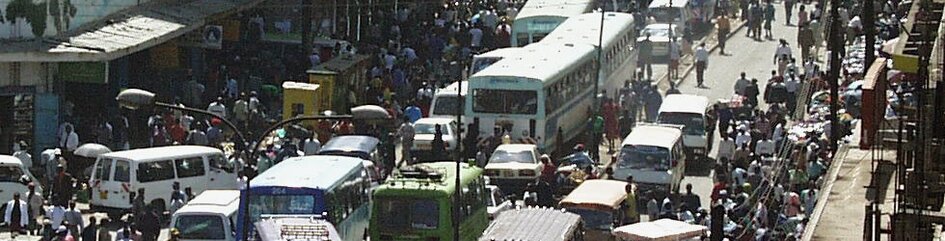
The reasons undergirding urban Africa’s relative dearth of pedestrian infrastructure are the subject of incomplete debates on the influence of history and colonialism, among many other factors. But what is undeniable is that people in Africa’s cities commute heavily on foot. In Kinshasa, capital of the Democratic Republic of the Congo and home to 10 million residents, an estimated 60 to 80 percent of travelers walk, according to a 2012 report. In Dar es Salaam, the largest city in Tanzania, about 70 percent of all travel is done either on foot or bicycle. “The share of walking trips in sub-Saharan Africa is higher than in any other region of the world,” a 2013 U.N. report states.

This shouldn’t come as a surprise. Cities in sub-Saharan Africa, once shackled by colonial exploitation, remain relatively poor (though they are catching up). Poverty, as the 2000 book Compact Cities: Achieving Sustainable Urban Forms explains, is closely correlated to rates of pedestrian transit.

But now more than ever is a good time to revisit the relationship between Africa’s urban hubs and walking. In the 14 years since Howe explored the topic, both the perception of walking as transit and the state of urbanization in Africa have changed greatly.

Africa is expected to become the most rapidly urbanizing region of the world five years from now. Between 2020 and 2050, Africa’s urban population will triple, the U.N. projects, with many entirely new cities developing along the way. (CityLab has covered urban walkability and its potential benefits extensively, including herehere, and here.) For better or for worse, urban Africa’s sheer volume of pedestrian transit makes it the global epicenter of walking at a time when “walkable” cities have never been more in vogue.

Tackling a topic of such dimension is a daunting task. The African continent is too big and diverse to be summarily defined. Nonetheless, urban planning efforts  underway in Addis Ababa, Ethiopia, and Nairobi, Kenya, demonstrate that some cities south of the Sahara are positioning themselves to be more walkable urban hubs.

David Rifkind, an academic that has studied Addis Ababa extensively, believes that walkability has always been an important part of the Ethiopian capital’s short history. Unlike other urban hubs in Africa, where the quality of sidewalks has eroded noticeably (if they are present at all) in recent decades, sidewalks are ubiquitous in Addis Ababa, and investing in pedestrian infrastructure has been a consistent priority. Nevertheless, the city’s accessibility on foot has gradually given way to sprawl.

The city’s horizontal expansion has been well documented, becoming so extreme that residents on the periphery, suddenly facing consumption by the capital city, have reacted in protest. In a 2012 report, American urban planner Wendell Cox warned of such perverted growth, arguing that Africa’s cities had, “become too spatially large for walking to suffice.”  By the end of this month, Addis Ababa is expected to complete an ambitious $475 million light rail project. This will be sub-Saharan Africa’s first rapid-transit network, David Rifkind says. And the new rail system should encourage much-needed residential density, mitigating sprawl as well as catalyzing greater volumes of foot traffic outside the urban core.

“What [the light rail] is going to do is open up all kinds of affordable housing for the emerging middle class,” explains Rifkind, who also teaches at Florida International University in Miami. Dense, middle-class communities are the lifeblood of more accessible, pedestrian-oriented commerce, he says. Just like young professionals in cities like Washington, D.C., Addis Ababa’s young workers are gravitating to neighborhoods around the new rail stations—even before they open. There, they expect to find retail shops and restaurants easily accessible on foot.

A man walks along the electrified light-rail transit construction in Ethiopia’s capital, Addis Ababa. The project presents an opportunity for the city to develop dense, walkable neighborhoods. (Reuters/Tiksa Negeri)

“The new light rail stations going out into the periphery of the city already have neighborhoods growing up around them,” Rifkind says. “It’s going to create even denser development. So you’ll have a whole neighborhood with all sorts of shops and restaurants.”

The state of walkable transit is far less rosy 700 miles south of Addis Ababa, in the Kenyan capital of Nairobi. “The road is really contested. And there’s a lot of attempts to claim ownership, or claim rights to be on it.” explains Amiel Bize, a Columbia Ph.D candidate who has been studying pedestrian safety in Kenya since 2010. “[T]he default in Nairobi for the proper road user is the car.”

50 to 70 percent of all traffic accidents in Nairobi involve a pedestrian, according to Bize, who calls that a ballpark estimate and notes that the aggregate number of pedestrian fatalities is likely underreported. Nairobi represents a sliver of the dangerous environment pedestrians face across the continent. According to the WHO’s 2013 Road Safety Report, 38 percent of road traffic deaths in Africa involve pedestrians, which is 16 percentage points higher than the world average.

The ongoing battle for the roads of Nairobi is an extension of the city’s broader class segregation: Cars, a transit option for the city’s upper classes, command the road with superiority. Pedestrians, many of whom belong to Nairobi’s lower class of informal laborers, are funneled into dangerous and uncomfortable walking environments. (One study found that residents of Nairobi’s slums were twice as likely to walk to work rather than travel by automobile). But the government of Nairobi is signaling that it’s ready to break this socio-spatial status quo.

In February, the City County of Nairobi is expected to present a non-motorized transit policy, a first of its kind in Kenya. No formal proposal has been presented yet, but it will likely incorporate facets of the U.N. and FIA Foundation-sponsored Share the Road campaign, a detailed guideline for non-motorized transit put forward in 2013. (The proposal was developed with input from Kenyan authorities). And Nairobians eager for a more walkable, pedestrian-friendly city are anxiously awaiting the new intiative.

“Walking and cycling have been completely neglected in Kenya’s capital,” an African urban planning blog argued in December. “Kudos to the City County of Nairobi for starting a process of developing the first NMT policy in the country.”

Whether Addis Ababa’s rail network and Nairobi’s non-motorized transit plan will truly render sub-Saharan cities more walkable will be tested by time. Their efficacy will hinge greatly on whether pedestrian fatalities drop and if dense, walkable neighborhoods emerge. But they already represent a resounding shift in the perception of urban walkability.

Death Rides a Moto – global article focus by Foreign Policy

Death Rides a Moto – global article focus by Foreign Policy

The world’s most pressing public health crisis isn’t AIDS or Ebola or malaria — it’s a soaring number of motorcycle fatalities. And it’s costing developing countries billions. An article written by Foreign Policy, an online and print news outlet have placed renewed focus on road safety. It places a spotlight on the increasing rate of motorcycles in the low and middle-income countries and its rising burden of road crashes.

On a typically steamy afternoon in Phnom Penh, Chhay Hour, a 26-year-old engineer who works for Cambrew, Cambodia’s largest brewery, has been bargaining hard for a used Honda in the capital’s Prampi Makara district, known for its hundreds of used motorcycle shops. This will be his first bike. He used to walk to work from company-provided housing at its main facility near Sihanoukville. But he’s been transferred to a new job in the capital and will have to commute about four miles. Hence the need for wheels.

I ask Hour, a lanky fellow with a self-assured air, if he has a license.

“Who needs a license?” he replies with an amused laugh and raised eyebrow. “I have no intention of getting one. It’s just a piece of paper. If the police stop you — even if you have license — they will find some way to steal your money. If the police stop you, you just pay.”

This attitude — and this kind of petty corruption — is pervasive across Southeast Asia. If the traffic police don’t take traffic laws seriously, why should anyone else?

The graft, people seem to think, is just the cost of doing business in a developing economy — a necessary evil that greases the wheels. As one senior police official in Bangkok told me, “People are not complaining about it. If they can buy a police officer, it’s much better than the whole tedious process of going through the courts and paying a heavier fine. So they prefer it this way, even if it makes the whole society corrupt.”

Only about a quarter of Cambodia’s drivers bother to get a license, and a recent survey found that 70 percent of the country’s motorists didn’t understand the meaning of a simple stop sign. Which might explain why the country is at the head of world’s most-overlooked health crisis: the sharply rising death toll that has trailed the developing world’s motorcycle boom.

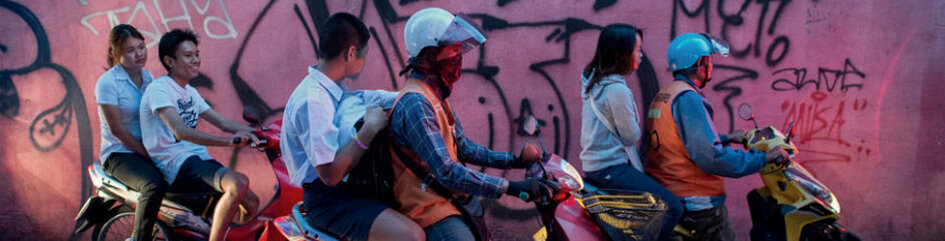
In wealthy countries like the United States, motorcycles typically represent 3 to 5 percent of the vehicles on the road, but a disproportionate 12 to 20 percent of the road fatalities. Across Asia, which is the epicenter of the motorcycle boom, two- and three-wheeled vehicles account for about a third of all highway deaths, with the highest numbers in Southeast Asia. In Cambodia, for example, motorcycle crashes represent 67 percent of all road deaths; in Thailand and Laos it has reached a staggering 74 percent. With the number of vehicles in the region doubling every five years, the number of fatalities is expected to grow commensurately.

On an official level, governments pay lip service to making roads safer and the need to accommodate the growing number of motorcycles, but they appear to view the body count as an unavoidable cost of economic progress. This, however, is a serious miscalculation.

According to World Bank estimates, road crashes are costing the economies of Southeast Asia between 2 and 3.5 percent in annual GPD. Loss of productivity due to death and long-term disability (the overwhelming majority of motorcycle fatalities are male breadwinners), the burden on the health care system and property damage are the main factors. Ratnak Sao, a WHO road safety specialist in Phnom Penh, told me that road crashes cost the Cambodian economy $337 million last year. “It’s not just the people who are killed,” said Sao. “Everybody pays.”

Read the rest of the article here.

Brian’s Column: Does Music instruct us to drive recklessly?

Brian’s Column: Does Music instruct us to drive recklessly?

Our regular columnist, Brian Bilal Mwebaze is back on all things youth and road safety, from an African perspective. This time, he addresses some of the messages in music. While many things interact with our understanding of road behaviour, could music be another factor in play? Brian explores!

February is here! The shortest month of our calendar, it’s only 28 days, so hold your horses. For the rest of us who’d really have loved to WhatsApp your Lord about our struggles with our school’s demands, take it easy because, we all know it: -the most successful things never came without hard work! Aint no kidding: See;

  • Nelson Mandela was in prison for a whole 27 years! And now, we all know about him.
  • It took Michelangelo 2 years non-stop to make his masterpiece David.
  • Michael Jackson was always forced to undergo more hours of rehearsals than his brothers by his father! And now, we call him the King of Pop
  • Wasn’t it hard enough to spend 9 months in our mothers’ womb? So, whatcha you worried about? 

It’s said that even Michael Jackson was the hardset worker out of all of his brothers!

Anyways, I don’t know about you, but I spent, literally the whole weekend following the 24th African Union Summit in Addis Ababa, Ethiopia where I had a chance to grab 2 signatures from the Botswana Minister of Gender and Zimbabwe’s Minister of Culture to #SaveKidsLives Campaign. Unfortunately, security didn’t allow me to take photos but yeah…Cheers to that! Cold Play says, ‘You can see your future in a glass of water..’-whatever that means, huh. Tired like a door mat, I headed home upon which I asked a mate to give me the ‘coolest music’ he’s got on his ear-thingy! Boy, I needed to chill out.

And boom, the music went like…

“I got this feeling on a summer day, when you were gone,
I crashed my car into the bridge, I watched, I let it burn,
I threw your sh*t into a bag and pushed it down the stairs,
I don’t care, I love it.
You’re from the 70’s, but I’m a 90’s b***h!”

Yeahhh…ofcourse I know ICONA Pop’s ‘I love it’ song which’s got great beats, but hell breaks loose when she confidently insists on crashing her car into the bridge and watching it burn.  I don’t know about you, but doesn’t such kind of music in some way influence one to think they are invincible? Take more risks on the road? Drive like they do in the movie? Couldn’t this be one of the confounding factors to the sad fact that Road traffic crashes are the leading cause of death for young people aged 15-29?

What about the ‘You’re from the 70’s, but I’m a 90’s b***h!” Don’t break my leg because I might be wrong if I hypothesized that, this could trigger young people to think, we don’t need no advice  about how we drive or act while on the road. That we have all the answers all the time…

Does some music give off a negative message in terms of road safety?

On the other hand, I am not saying we should all have a Pope Benedict’s i-pod or Maria Theresa’s disc, I just think that, may be, we could be more rational, enjoying the music but toggle tasking onto the lyrics:-this could make us a little wiser, and be safe on our roads. Pardon me too, but am aint got no musicophobia syndrome thanks to Busta Rhymes FET Linkin Park ‘Together we made it, we did it even though we had our backs against the wall…’

So while music lyrics probably don’t determine your actions, lets be a bit less reckless in our messaging. After all, we MUST preserve the next generations and stop lives being taken on our roads. What I’m saying is, question some of the things you hear in your music!

Maybe everyone should take a listen to ‘Safe and Sound’ by Capital Cities:

“I could lift you up
I could show you what you wanna see
And take you where you wanna be

You could be my luck
Even if the sky is falling down
I know that we’ll be safe and sound

We’re safe and sound

Ahhhh, and there is 14th February….winks…if you know what I mean! #StaySafe #RoadSafety #Africa