Child Health Initiative launched to support ‘safe journey for every child’

Child Health Initiative launched to support ‘safe journey for every child’

The Child Health Initiative comprises a founding partnership of UNICEF, Save the Children, UNEP, the World Resources Institute, the Overseas Development Institute (ODI) and the FIA Foundation. Intended as an implementation partnership for the Global Goals, the headline mission is to work towards a vision that, by 2030, every child should enjoy a safe and healthy journey to school.

The initiative was launched at an event held at ODI in London, with key note speakers including road safety advocate Zoleka Mandela; ODI Executive Director Kevin Watkins; the Chairman of the FIA Foundation, Lord Robertson; and the new Executive Director of UNICEF UK, Michael Penrose.

With at least 500 children killed every day on the world’s roads, thousands more injured in road traffic crashes and millions suffering from chronic respiratory illness or stunting as a result of air pollution, a significant proportion of which can be attributed to motor vehicles, there is a clear need to make safe and sustainable mobility a priority policy issue. The Child Health Initiative aims to work to support three key rights of the child:

  • Safe, accessible, low-carbon mobility to promote equity and combat poverty

  • Clean air and a healthy environment;

  • The role of safe and healthy mobility in enabling the right to an education.


The partnership will focus on global advocacy research; evidence building through demonstration programme implementation; and support to countries and cities through technical assistance and catalysing national action coalitions. With initial funding from the FIA Foundation, each of the partners will build on existing programmes or establish new work with a specific child health focus.

One element of the initiative is an initial two year, €2 million, partnership between UNICEF and the FIA Foundation to build road safety capacity and support for legislative change through UNICEF country offices in South America and South East Asia. Save the Children will also provide advocacy support. The World Resources Institute is focusing on assisting cities with urban design change to enable safe walking and cycling; while UNEP will work with countries to provide similar active mobility technical assistance. ODI is undertaking a two year research study on the political economy of implementing sustainable mobility change, which will include recommendations for specific cities.

Zoleka Mandela with Coombe Girls School headteacher Deborah Walls and pupils in the memorial garden to Lavna Chuttoo.

The partners will seek to coordinate activities and identify joint interventions, while the FIA Foundation will also seek to align support for its regional NGO partners with the Child Health Initiative objectives and activities. Working alongside existing environmental partnerships including the Partnership for Clean Fuels & Vehicles and the Climate & Clean Air Coalition, the initiative aims to provide advocacy on behalf of children to support efforts to reduce harmful vehicle emissions, especially particulate matter.

Speaking at the launch of the Global Initiative for Child Health & Mobility, Zoleka Mandela said: “In planning and in policy, children seem to be at best an afterthought – or in the worst cases, just totally neglected. You have to conclude that there’s not much value being placed on safeguarding our children on the roads. This has to be seen as a violation of our children’s rights. And it is incredible that such a violation is allowed to continue. This is not a society I want to live in. As a mother, I am angry and I am scared. And as a mother, I want a different future for my children. The partners assembled here today are uniquely placed to take this agenda forward. This is a partnership to push for delivery on the Sustainable Development Goals. It’s an initiative for the health of future generations, for the right to an education, for the fight against poverty. This is an initiative for all of us, for every child, on every journey.”

Hosting and moderating the event, Kevin Watkins, Executive Director of the Overseas Development Institute, said: “This is one of the great development challenges of our age. On the world’s roads, every single day 500 children lose their lives and many thousands more are left with permanent disabilities. So much of this happens on the journey to school. This journey ought to be the safest journey that any child takes. Yet it’s too often a matter of life and death.”

FIA Foundation Chairman Lord Robertson said: “We are here to ensure that road builders thinking of designing yet another expressway rather than a new cycle-way, think twice; the city planners risking damage to local communities by prioritising trucks over tricycles, think twice; the car makers plotting the next emissions cheat device, think better of it; that all of these decision makers will think of children and then think twice. Our vision is that by 2030 every child should have a safe and healthy journey to and from school. This is ambitious, yes. But it is a vision that will resonate with people around the world. It is a vision that countless communities from New York to New Delhi are already organising and fighting for. Schools are a vital social network. They sit at the heart of every community. And this important journey that our children make every day is the ideal starting point for a transformation of the entire mobility agenda.”

Michael Penrose, Executive Director of UNICEF UK, said: “At UNICEF UK, our priority is action for every child in danger. That’s why we’re so proud to be part of the Global Initiative for Child Health and Mobility. It’s unacceptable that today, and each day, 500 children die in road crashes, and the majority of them in fast developing countries. This initiative will be critical for getting the evidence base to respond to this growing crisis. Unless we tackle this issue, we cannot ensure that children thrive and survive. This issue is fundamental to the UN Convention on the Rights of the Child and it’s imperative that we tackle it.”

The event also heard from a panel of initiative partners: for the FIA Foundation, its Director, Saul Billingsley; for WRI, Senior Associate Ben Welle; for Save the Children, Seung Lee, Senior Director for School Health and Nutrition; for UNEP, Rob de Jong, Head of the Urban Transport Unit; and for UNICEF Child Protection Specialist Gbemisola Akinboyo and Road Safety Adviser Avi Silverman.

Zoleka Mandela at the launch of the Global Initiative for Child Health Mobility

Ahead of the launch event Zoleka Mandela visited London schools to discuss road safety with pupils. One of these schools, Coombe Girls, experienced a tragedy in November 2015 when a 14 year old student, Lavna Chuttoo, was killed by a HGV while walking to school. Zoleka Mandela talked with girls at the school about the incident and joined them in a memorial garden to remember their colleague and to call for action for better road safety for all children in the future.


One of India’s most popular actors says #BeTheBetterGuy

One of India’s most popular actors says #BeTheBetterGuy

Shah Rukh Khan is one of India’s most celebrated actors, and is joining a road safety campaign therefore has the potential to reach people residing in India and beyond.

Hyundai has always been an advocate of Safe Driving. Hyundai believes the process of safety begins with the driver taking responsibility for their individual actions. ‘Safe Move- Road Safety’ awareness films are unique in nature as they highlight various situations in our day-to-day life highlighting actions which can prevent mishaps. The messages in these films revolve around creating innovative content, pressing on to ‘#BeTheBetterGuy’ in an adverse situation related to road safety and Behavioral Change.

Road Safety films focus on bringing ‘Behavioral Change’. The key communication focuses on Safe Driving habits related to Use of Seat Belts, Over Speeding, Drunk Driving and Mobile phones usage while driving.

“Hyundai Motor India is a Caring Brand, we want all the drivers to realize the importance of safe and responsible driving. We are confident that with these films, Safe Move Campaign will become a Social Movement with people’s participation for a better future.” – Mr. YK Koo, Managing Director and CEO, Hyundai Motor India Ltd.

“I am proud to be part of Hyundai Safe Move- Road Safety films as they are unique and well thought out. All films aim to deliver safety messages about different driving habits to bring positive Behavioral Change. These films will create a sense of responsibility in the mind of every driver and I am sure it will make a realistic on ground difference.”  – Mr Shah Rukh Khan, Corporate Brand Ambassador, Hyundai Motor India Ltd.

#BeTheBetterGuy | Road Safety ft. Shah Rukh Khan | Use Seat belt
“Aapki Car Mein Aapki Safety ke liye sab kuch hai, Because we care about you, but do you care about yourself? Put Seat Belt On When You Drive, Be The Better Guy” .

#BeTheBetterGuy | Road Safety ft. Shah Rukh Khan | Don’t Over Speed
“Aapki Car Mein Aapki Safety ke liye sab kuch hai, Because we care about you, but do you care about yourself? Don’t Over Speed, Drive Responsibly, Be The Better Guy” .

#BeTheBetterGuy | Road Safety ft. Shah Rukh Khan | Don’t Drink and Drive
“Aapki Car Mein Aapki Safety ke liye sab kuch hai, Because we care about you, but do you care about yourself? Don’t Drink & Drive, Be The Better Guy” .

#BeTheBetterGuy | Road Safety ft. Shah Rukh Khan | Don’t Use Mobile while Driving
“Aapki Car Mein Aapki Safety ke liye sab kuch hai, Because we care about you, but do you care about yourself? Don’t Use Mobile When You Drive, Be The Better Guy” .

On social media, the public is invited to take the pledge to be take road safety seriously online. Scored of people from all around the world have pledged their methods to #BeTheBetterGuy.

Check out the #BeTheBetterGuy hashtag here

Brian’s Column: Why don’t we give #ZebraCrossings the respect they deserve?

Brian’s Column: Why don’t we give #ZebraCrossings the respect they deserve?

Our monthly columnist and Regional Champion at YOURS for Anglophone Africa, Mr Brian Bilal Mwebaze is back with his views on all things African Road Safety. This month, he is back with a column about the importance of Zebra crossings around the world and a lack of respect in many low and middle income countries, predominantly in Africa. Read his latest column here.

There’re a number of African theories advanced in an attempt to explain why they are called ‘Zebra Crossings” in the first place. There is one chronic rumour however, “On that night, a successful meeting of all herbivores passed a resolution to lead a kill-all revenge attack on all carnivores. Somehow, a skunk (who was and is still confused to date as he is omnivorous) leaked the news. Consequently, the Zebra was asked to step outside and disguise the carnivores with his multiple coloration as the rest of the herd escaped through the backdoor”. That ability to be seen at night is an asset that man (another painful earthly creature) used, consequently naming a bunch of typically 40 to 60cm wide black and white stripes into Zebra Crossings.

There’s another modern rumour that roads were usually made of tar-which is black and to increase visibility of crossing points, white was a more logical colour.

Anyways…by law in every country Zebra crossings give a right of way of pedestrians to cross the road.  Policy wise, it’s the most probable chance that a pedestrian will cross a road. But that’s not the juice on the table you see…

Countless times you must have seen a pedestrian do a Usain Bolt run out of nowhere and before you know it, he’s crossed the road. At other insanely painful times are those poor school children and the elderly impatiently at the mercy of drivers to stop so they could cross.

One out of ten traffic victims is a pedestrian and more in low and middle income countries.

What’s more disturbing is the utter brilliance of madness exhibited by some drivers who continue to drive/ride consequently invading pedestrians already on the zebra crossing line! Interestingly, most times there’re no traffic cops or a universal national toll free line to report such cases.

I mean come on! If you’re a legally licensed driver (which isn’t always the case), you’re taught that you must stop if a pedestrian has stepped on the Zebra crossing! But it seems true too that as pedestrians, we don’t know that we have a right of way and shouldn’t dash on and off the Zebra crossing like a Kenyan runners at the Olympics! Make no mistake, the traffic law-Road Safety Education Curriculum are already there, but the traffic police (and most often our leaders) seem to be sipping their juice at a time when we’re dying or getting seriously injured at Zebra Crossings.

Ok. So it’s no longer a myth. Africa already has the most dangerous roads in the world The average rate of road death across the continent is 26.6 per 100,000 population. Globally, nine out of ten countries with the highest estimated rate of road traffic death are on the continent, with Libya -73 per 100,000 and Malawi, at 35/100,000,joining Thailand in the top three.

With an estimated 35,600 annual deaths Nigeria has the fifth highest real level of road traffic fatalities in the world (after China, India, Brazil and Indonesia), although the government’s own official figures only recognize a toll of 6,450! These could be significantly brought down if respected and killed no one on Zebra Crossings! We could do better.

Delft Road Safety Course delivers another successful programme

Delft Road Safety Course delivers another successful programme

The Delft Road Safety course (DRSC) is a cooperation between Delft University of Technology, SWOV Institute for Road Safety Research, Delft Post Graduate Education and Road Safety for All. The objective of DRSC is capacity building for road safety professionals in low and middle income countries by transferring knowledge on effective road safety strategies, action plans and projects.

The annual Road Safety Course in Delft is one of the core activities, besides on line learning, organizing similar courses abroad and supporting training and research programmes in LMIC’s. FIA Foundation is supporting DRSC.

It is my pleasure to announce the new two-week course on road safety in low and middle income countries. As in 2015 the course is offered by Delft Road Safety Courses (DRSC) in association with FIA Foundation. Both organizations can build on several successful years of running this and similar training programmes.
– Fred Wegmans

 In many low and middle income countries (LMIC’s), the number of road traffic fatalities and serious injuries are high with mortality rates up to ten times higher than the best performing countries. The World Health Organization (WHO) estimates that every year 1.25 million people are killed in road crashes and it is estimated that annually as many as 50 million people are injured in road crashes . According to the WHO, almost 90% of traffic casualties occur in low and middle income countries. Not only is this a tragedy for all concerned, also from an economic point of view this leads to a tremendous loss of (human) capital.

This development is not imperative, however. It is demonstrated that even in countries with a strong economic growth and a rapid increase of motorization, a reduction of fatalities and injuries can be reached through implementing effective road safety strategies. The Netherlands is one of these examples.

Since the United Nations Decade of Action for Road Safety and the recent acceptance of the UN Sustainable Development Goals, in which road safety is included, the political priorities have been clearly set. Now it will come down to design the cost-effective national strategies and implement action plans. The Road Safety Course in Delft aims to present to you the vast knowledge and expertise underpinning strategies and action plans.  Our course leader professor Fred Wegman and the lecturers are recruited from the world’s leading experts on road safety. They will provide you with the latest state of art. 

Our Executive Director Floor Lieshout delivered a presentation at the course on advocacy and our work.

As part of the session on Awareness Raising and Advocacy, a Question & Answer sesson was also conducted with the participants asking the panelists questions about the topic, Joop Goos also joined the session.

Read more about the Delft Road Safety Course here.

Alliance Advocates start their missions to save lives!

Alliance Advocates start their missions to save lives!

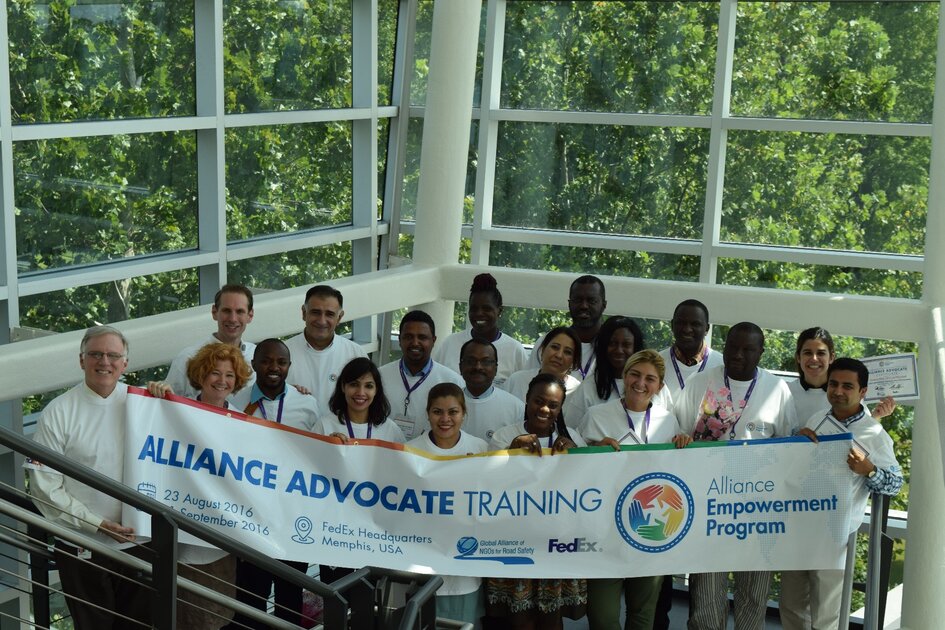
The Global Alliance of NGOs for Road Safety graduated its first Alliance Advocate cohort. The graduates have completed a state-of-the art training course -developed and delivered by YOURS- at FedEx Headquarters from 23 August to 1 September in Memphis, Tennessee, US.

The Alliance Advocate training gave representatives from 15 countries the opportunity to grow their expertise as they advocate for safer roads. This two-week tailored course is a part of the Alliance Empowerment Program, a capacity-building program sponsored by FedEx that aims to improve the ability of nongovernmental organizations (NGOs) working in road safety around the world.

“This is an important initiative for the Alliance in the years to come.”

“This is an important initiative for the Alliance in the years to come.” said Lotte Brondum, Director of the Global Alliance of NGOs for Road Safety. “The Alliance Advocates face a lot of road safety challenges in their home countries such as speeding in school zones. The training has given them the tools, knowledge, network and confidence to make a change that can contribute to overcoming these challenges. They have developed a clear plan for what they want to change when they get home, and we will follow their progress very closely and expect a lot from this investment.”

The learning wall – full with learning material- at the end of the training.

YOURS was in charge of the development and the delivery of the training. In very close partnership with the Alliance, we determined its strategy, agenda, trainers and methodology. “It was our aim to deliver the ‘best training experience’ the participants ever had.” said Floor Lieshout, lead-trainer. “I am incredibly proud of the Alliance Advocates and the work they have done during the training. I would also like to thank my co-trainer Mr Poghos Shahinyan – an amazing person and advocacy expert – all the other external speakers from Safe Kids WorldwideJohns Hopkins University and various departments within FedEx for sharing their knowledge. In conclusion I would like to thank the Alliance for their trust in our organization and FedEx for their amazing hospitality”. 

“It was our aim to deliver the
‘best training experience’ 
the participants ever had.”

The Empowerment Program encourages the design and implementation of initiatives that significantly reduce the risk of injuries and fatalities on the world’s roads, where 1.2 million people die in road traffic crashes each year. The program builds skills in communication, project management, and evaluation. Online webinars, mentorships and trainings are available for all Alliance members to learn from leaders and experts on various topics in the road safety field.

The Alliance Advocates will be role models who promote desired practices for helmet use, seatbelt use, speed management, drink and drive behavior, and safe school infrastructure. They also advocate for policy change in risk areas and hold government accountable. 

“Road Safety is a priority at FedEx, and we are pleased to support the work of those who are committed to helping save lives.”

 Shane O’Connor, Communications Advisor, FedEx Global Citizenship.

4th UN Global Road Safety Week 2017 – Save the Date!

4th UN Global Road Safety Week 2017 – Save the Date!

The UN Road Safety Collaboration is pleased to announce that the Fourth UN Global Road Safety Week will be held from 8-14 May 2017. The Week will focus on speed and what can be done to address this key risk factor for road traffic deaths and injuries. Speed contributes to around one-third of all fatal road traffic crashes in high-income countries, and up to half in low- and middle-income countries.

Countries successfully reducing road traffic deaths have done so by prioritizing safety when managing speed. Among the proven strategies to address speed include:

  • Setting and enforcing speed limits appropriate to the function of each road, for example:
    • Setting and enforcing a maximum speed limit of 50 kilometers per hour in urban areas;
    • Setting and enforcing a maximum speed limit of 30 kilometers per hour on roads with high concentrations of pedestrians, cyclists and motorized traffic;
  • Enforcing speed limits through the use of automatic speed cameras;
  • Installing intelligent speed adaptation technology in vehicles;
  • Building or modifying roads to include features that limit speed such as traffic lights, roundabouts and speed humps.

The Fourth UN Global Road Safety Week seeks to increase understanding of the dangers of speed and generate action on measures to address speed, thereby saving lives on the roads.

All stakeholders – national and local governments, international agencies, civil society organizations, private companies, and the public generally – are invited to plan and host events marking the Week.

Advocacy materials for the Week will be available on this web page as they are finalized.