European Road Safety Tunes – engaging youth in road safety creativity

European Road Safety Tunes – engaging youth in road safety creativity

We were recently involved in the European Road Safety Tunes final conference that took place in Warsaw, Poland. The conference brought together participants from all participating countries to showcase all the positive outcomes of the project, which saw youth all around Europe using creativity to engage in road safety. The result being an array of colourful outputs, with youth using their imaginations to convey road safety messages.

Results of the European Project European Road Safety Tunes were presented to 91 conference-participants in Warsawa at the premises of Motor Transport Institute (ITS). The coordinator of the project Elke Weiss from Austrian Mobility Research, Mr. Konrad Romik, secretary of the polish national Road Safety Council in the Ministry of Infrastructure and Construction and Marcin Slezak, the general director of the Motor Transport Institute, welcomed the participants.

Participants to the conference heard about the how young people engaged with road safety.

The project “European Road Safety Tunes” – From idea to realization, Elke Weiss, FGM-AMOR
The coordinator presented the reason for the project and its main objectives. The aim of the project is to improve road safety by reducing accidents, injuries and fatalities of young drivers by raising awareness for a responsible and social behaviour in traffic, through attractive youth oriented workshops and actions. The Safety Tunes methodology combines a peer approach, an emotive know-how transfer and social art with road safety. A practical and creative “feeling and understanding” of risky behavior should lead to a changing in attitudes and behavior.

The methodology was presented by Hannelore Depypere (Mobiel21) in interaction with the audience. The modules feel it – know it – do it – spread it were explained and examples from each module were shown.

Presentation of outputs of the project from students and partners
The focus of the conference was the presentation of the creative results of vocational students from the participating countries Austria, Belgium, Czech Republic, Hungary, Poland, Slovenia, Spain and the Netherlands.

Informal exchange round of experts, Discussion round
After Lunch, Tina Panian (FGM) moderated a discussion round with experts from Hungary (Edina Fóris, teacher), Czech Republic (Ivo Rusak, traffic and transport expert and Jaroslav Heinrich, HBH), Slovenia (Marta Novak, national road safety expert for kindergarten, primary school and high school level, National Education Institute Slovenia), Spain (Daniel Macenlle, police officer), Belgium (Hannelore Depypere, Mobiel 21), England (Manpreet Darroch, YOURS) and Hungary (Maria Bognar, GRSP Association Hungary).

Experience in working with young people in road traffic safety and the implementation of safety tunes were exchanged and the safety tunes methodology and the transfer to other countries were discussed. All the participants in the expert round agreed that it would be useful to continue the methodology of safety tunes after the end of the project. The students also took part in the discussion and confirmed the impact of the SafetyTunes method on their behavior in road traffic. The conclusion that emerged in the discussion with the students was: “Let’s make road safety sexy”.

manpreet thumb

Our YOURS communications director Manpreet Darroch said, “European Road Safety Tunes is a brilliant way of engaging young people in road safety in Europe. YOURS is a big fan of creativity in road safety as young people are inherent creators. They are at the forefront of technology innovation and finding new ways to do things better, easier, more efficiently but also finding the element of fun. I think European Road Safety Tunes is a great example of how young people can create unique road safety messages that speak to other young people”.
READ MORE ABOUT EUROPEAN ROAD SAFETY TUNES

Youth Ambassadors for Road Safety trained in Limpopo Province, South Africa

Youth Ambassadors for Road Safety trained in Limpopo Province, South Africa

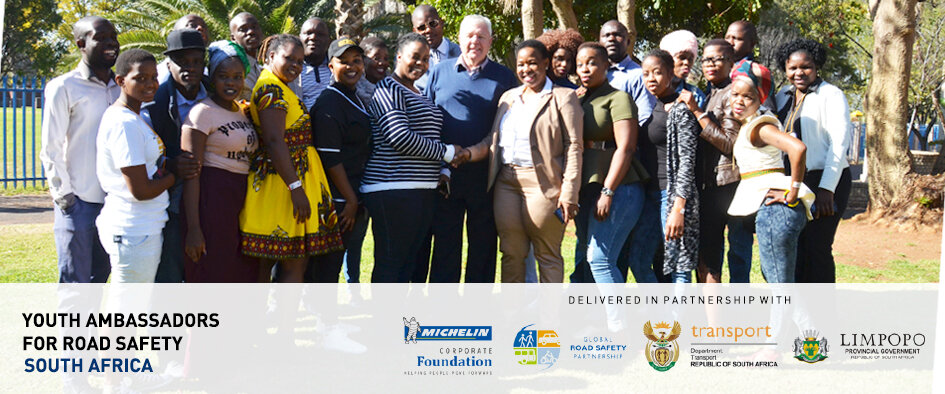
Last week, our team was in the beautiful province of Limpopo in South Africa to train 20 youth leaders in road safety. The project, funded by the Michelin Corporate Foundation and conducted in partnership with the Global Road Safety Partnership South Africa (GRSP ZA), the Department for Transport and Provincial Government of Limpopo took place from 17-21st July 2017. The trained Youth Ambassadors are the first of their kind in South Africa who have been set the mission to reach out to their communities with road safety messaging.

As being one of our favourite continents in the world to train, you can be sure that our recent training in Limpopo, South Africa was vibrant, engaging, energetic, informative and fun! From 17-21 July 2017 we delivered our first Youth Ambassador for Road Safety Training in the country.

The programme was initiated in 2015 by the previous South African Minister for Transport Dipuo Peters who envisaged a National Youth Structure to involve young people in road safety. This was formed around the principles of YOURS, to empower young people to be part of the road safety solution by building their capacities (skills, knowledge, attitudes and intentional behaviour) to improve the situation of youth on the road.

Since then, the Global Road Safety Partnership South Africa (GRSP ZA) and our long standing founding member Michelin (through the Michelin Corporate Foundation) formed a strategy to educate and activate the elected youth in the National Youth Structure for Road Safety. This was realized in the First Youth Ambassadors Training initially focused on the Province of Limpopo.

“I’ve never attended a training of this calibre…I learned a lot, for the first time I sat throught a whole training and never felt bored, we will take what we have learned as ambassadors for road safety back to our communities”.

Lesidi, Youth Ambassador for Road Safety

20 young leaders selected from Limpopo underwent a 5 day intensive training on road safety theory using YOURS’ unique training methodology that couples active, youth friendly learning with key road safety knowledge. Participants were trained on the following topics:

  1. Peer Education
  2. Scope of the Road Safety Problem – in the world and in South Africa
  3. Youth and Road Traffic Injuries
  4. Distracted Driving
  5. Speeding
  6. Seatbelts
  7. Drink and Drug Driving
  8. Facilitation Skills
  9. Presentation Skills
  10. Developing a Youth and Road Safety Workshop
  11. Spreading the Message
  12. Action Planning

The Youth Ambassadors, having learned a whole range of road safety topics and methods to engage their peers in their communities, will go back and filter our road safety messages using their own creativitiy and language contexts. Every youth participant pledged to take robust action to play their part in reducing road traffic crashes in Limpopo, a province with a particularly high rate of road crashes amongst young people.

“The YOURS Youth Ambassadors Training really exceeded my expectations, it was wonderful to see how the youth participated…the knowledge they have gained and the enthusiasm they will leave with, we look forward to the implementation phase”.

Dr. Pieter Venter, GRSP South Africa

The next phase of the training will see the Youth Ambassadors implement road safety communcations in their community and connect their learning to road safety interventions. The Ambassadors will be training young people in Grade 11-12 in Limpopo on the risks of the road through creative methods as well as campaign for road safety on a national level.

Peer education is an especially suited modality because it provides the opportunity for youth to work together cooperatively and collaboratively, and to support each other in making wise choices.  In addition, when peers have first-hand, authentic experience of the issues being addressed, they are more credible role models than adults, who may appear as though they are preaching.  Such a modality usually encourages high participation and continued long term motivation, especially so among young males, who are more significantly influenced by role models who understand their issues from a personal perspective.

Watch our video from the training:

What does a year of action look like at YOURS? – Annual Report 2016

What does a year of action look like at YOURS? – Annual Report 2016

2016 marked the starting point to reach one of the most ambitious and challenging targets within the entire Global Goals: by 2020, halve the number of global deaths and injuries from road traffic accidents. Governments signed up for this, and it is our duty as civil society to ensure they keep their promise. We continue to ask youth champions around the world to urge their government to make their action plans to reach the target public, and to take real action for road safety. Read more about our work in 2016.


Foreword to the Annual Report 2016

2016 also reflects within the very successful #SaveKidsLives campaign. Together with the other members of the campaign team, we developed the 2020 Action Agenda. And with the support of more than one million people, we now put forward five simple interventions that can save children’s lives.

On 15 April 2016, YOURS witnessed the United Nations General Assembly debate on global road safety culminating in the passing of a new UN Resolution: Improving Global Road Safety. Together with the Global Goals target and the appointment of the UN SG’s Special Envoy for Road Safety; it seems that road safety now has the attention of world leaders. That is a big step forward for our field. The question today is how to translate this global recognition into real local implementation? When will we see the difference on our roads?

I am convinced we can’t wait for these global initiatives to land from the sky. More than 1000 young people under the age of 25 years are dying every day. Action must be taken now and let’s start with ourselves, before we point to somebody else. Therefore I am happy to see that youth and the wider NGO community are bolstering up. Empowerment is key and YOURS celebrated two big achievements in 2016 in this area: we returned to our ground-breaking youth empowerment work in Belize and assisted the Global Alliance of NGOs for Road Safety in developing and implementing their Alliance Academy.

Furthermore, we are preparing a youth empowerment programme in South Africa that will start in 2017. This is really exciting and we are looking forward to work on this project with the South African Government and our close partners the Michelin Foundation and GRSP South Africa.

Finally, I am very happy to welcome Dr Adnan Hyder to our Supervisory Board. His credentials in the global road safety field are unmatched and I am delighted to see such a renowned practitioner supporting our cause. Finally I need to thank all of our sponsors, youth champions, supporters and friends around the world for another fruitful year of collaboration.

Floor Lieshout
Executive Director

PSA from Samsung India raises awareness of the selfie craze

PSA from Samsung India raises awareness of the selfie craze

After selling smartphones with the proposition of taking desirable selfies, Samsung is now creating awareness about the risks of taking selfies without enough safety precautions. The #SafeIndia campaign is part of Samsung’s CSR initiative to create road safety awareness.


The new campaign film, #SafeIndia, seeks to make people aware about the dangers of taking a selfie while driving. This is the first of several initiatives that Samsung India will launch to educate people as part of the ‘Safe India’ campaign. The online and offline campaign has so far garnered over 19 million views on YouTube.

In the video, NitinGadkari, Union Minister of Road Transport & Highways and Shipping, notes that:

India has the highest number of road accidents globally and accounts for more than 50% of total selfie deaths in the world.

This trend seems to have the government worried and at the same time has led mobile phone makers like Samsung step in and be the voice of reason. “As a market leader, we consider it our duty to step forward and support the government’s vision of reducing road accidents caused by irresponsible usage of mobile phones, including taking selfies on the road. This is one of the key reasons why Samsung offers safe mobility apps on its smartphones which encourage people to use them responsibly, while on the road,” said Ranjivjit Singh, Chief Marketing Officer, Samsung India.

Leading automobile marketplace, Droom, has also joined the government’s road safety campaign and initiated a creative campaign against speeding on roads. As part of the campaign, Droom fitted cars with God bobble heads that warn drivers to slow down if they cross city speed limits.

Talking about the campaign, Sandeep Aggarwal, Founder and CEO, Droom, said, “Thedeath toll last year due to speeding cars was over 57,000 people. We wanted to do something about it. We wanted to ask people to ‘slow down’ in a voice they cannot afford to ignore.”

Droom took advantage of the trend of car buyers fitting idols of gods on dashboards. “We equipped these deities with accelerometers, thereby lending them a pre-recorded voice. Whenever the person behind the wheels speeds beyond the limit, the ‘Talking God’ warns them,” Aggarwal explained.

Behind the wheel, selfies become an increasingly dangerous form of distracted driving.

Virtual reality: negative emotions weaken levels of engagement

Virtual reality: negative emotions weaken levels of engagement

Research into the use of virtual reality (VR) road safety films suggests that playing on negative emotions through the use of, for example, a crash scene weakens the level of engagement and is likely to lead to participants detaching themselves from the scenario.

The study, commissioned by Safer Roads Humber and carried out by Road Safety Analysis (RSA), also found that the use of a VR film as a standalone activity will not lead to the required behaviour change, and as such the films should be used as part of a wider intervention such as a classroom presentation.


Described as a ‘new and innovative method of delivering content at interventions’, VR technology is gaining in popularity among the road safety community.

Much of this is due to an increase in its affordability and commercial application, as well as the quality of material that can now be displayed through it.

The RSA research, which evaluated the psychological and physiological effects that take place when viewing differing types of content through 360 VR headsets, centred on the ‘Virtual Reality Fatal 4 – 360 (VF4 360)’ film.

Developed by Leicestershire Fire and Rescue Service in 2016, VF4 360 is designed to give young drivers the ‘most realistic experience’ of a road traffic collision from the front seat passenger’s perspective.

The research, conducted among more than 120 college students, explored the impact of the VF4 film in standard 2D, compared with the 3D VR film. The researchers found a ‘clear distinction’ between viewing the films in these different formats – with 3D having a greater impact on students.

Safer Roads Humber hopes the research will enable road safety professionals to understand how ‘different emotional stances affect the level of presence when using VR’, thereby allowing practitioners to build upon current projects and take VR to the next stage.

Brian’s Column: #Riding for Humanity, Interview with a Kenyan Youth Leader

Brian’s Column: #Riding for Humanity, Interview with a Kenyan Youth Leader

This month, our guest columnist Brian Mwebaze Kanaahe takes us to Nairobi Kenya where he talks to Esther Muiruri: a self anointed environment and climate change addict leading the Ride for Humanity Campaign and how it relates to youth and road safety in Kenya’s  elections  already in high definition mode.

Last month, May was THAT month where we celebrated (or better climax) the UN Global Road Safety Week. If you have not heard or done anything about it, STOP what you’re doing, Go to:http://www.unroadsafetyweek.org and get involved now! In a spine chilling BBC Report   news more than 34 students were killed in #Arusha, #Tanzania when their bus crashed as they headed for an academic contest. Has anybody done anything to make sure this NEVER happens AGAIN? (Pause)

Right, so despite being on an international training on Water and Sanitation and Food Insecurity Programming run by the International Federation of the Red Cross & Red Crescent in  Nairobi, I came to learn about the Ride for Humanity Road Safety Youth Campaign, and yes you guessed rightly, I plunged myself into it consequently interviewing  Esther. Read on:

Brian K:

Exactly, what is this Ride for Humanity madness?

Esther M:

Ride for Humanity, is an annual 10 km ride within Nairobi organized by the Kenya Red Cross Nairobi County Youth that aims at raising awareness on road safety and urban disasters. This year, the ride aim was to raise awareness on youth action on road safety and peace while reaching out to those in the dire need. The event was held on the 7th May 2017 under the theme of “SAFETY AND PEACE FOR EVERYONE” which is in line with the 2017 world Red Cross day theme of “Everywhere for Everyone”.  

Brian K:

Umm, the Ride for Humanity Theme, how does it relate to the well being of youths here?

Esther M:

The theme communicated to the raising cases of traffic accidents at Nairobi County and in Kenya as well as raising concerns of internal conflicts and political temperatures ahead of the Kenya’s general election. The Ride was designed by young people and for young people to help address challenges that are faced by the largest demographic dividend of the youthful population in Nairobi and Kenya as a country.  Many young people are often vulnerable to being used as destructive tools by politicians during electioneer periods; hence the need to urge the youth bulge to be agents of peace in their communities.

Brian K:

Aha, how does this campaign address the elections excitement especially crazy risk practices by youths on the road?

Esther M:

This project contributes to priority number one of the Sendai Framework of understanding disaster risk. This is based on the belief that disaster risk management should be based on an understanding of disaster risk in all its dimensions of vulnerability, capacity, exposure of persons and assets, hazard characteristics and the environment where such knowledge can be used for risk assessment, prevention, mitigation, preparedness and response. Hence ride for humanity addresses the key underlying risks posed by use of motorbikes and bicycles on the roads while advocating for peaceful communities. And ofcourse, the global UN road safety week which encourages all road users to #SlowDown.

Brian K:

What message do you have for other young leaders who want to do something about this road madness?

Esther M:

I have already received a lot of positive feedback from all over the world and many young leaders love the ride for humanity concept which they would like to implement in their own communities. Change starts with me and so does our individual actions. I encourage fellow youth leaders, community change makers and the entire world to aspire for positive change and work with their communities to develop sustainable solutions.

Young people continue to act within their hoods despite challenges. Road Traffic Crashes sadly continue to be the elading cause of death for young people globally, and supporting young people to address this same problem that affects them may as well be rated as a magic pill. Oh, wait, did I mention I participated in the #UNRSW #SlowDown?