Youth issues given a focus during Road Safety Week 2020 in Dominican Republic

Youth issues given a focus during Road Safety Week 2020 in Dominican Republic

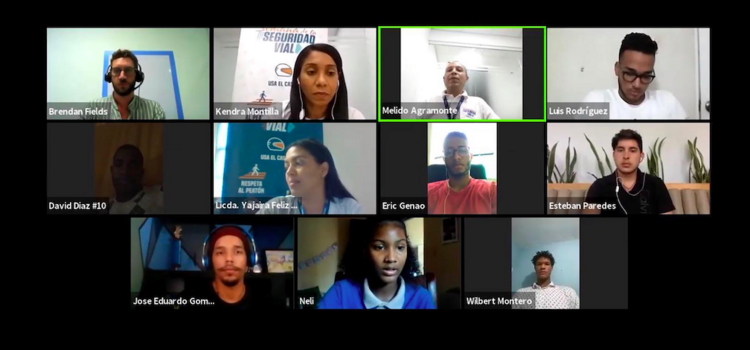
The Instituto Nacional de Tránsito y Transporte Terrestre – Int or National Institute of Traffic and Land Transportation – International joined Road Safety Week in the Dominican Republic by hosting a conversation on road safety, specifically on Las Carreras Ilegales en Motocicletas or Illegal Racing on Motorcycles. 

The intervention was addressed mostly to young men who are or have been involved in motorcycle races which put road users’ lives at risk. “It’s necessary to raise awareness among them and make them part of the change in road safety and mobility areas.”

The online conversation was held last week, 17 November, where road safety leaders came together for Semana de la Seguridadscreen shot 2020 11 23 at 5 12 28 pm Vial. Representatives from the USAID Project, Young Alert, National School of Education, and YOURS – Youth for Road Safety.

The Global Youth Coalition for Road Safety was represented by Youth Advisory Board Member, Esteban Paredes.

During his discussion, Esteban talked about the efforts of YOURS to empower youth and involving them in meaningful participation and gave particular attention to the work YOURS has been doing with youth in South America.

Esteban also raised the necessity of a paradigm shift, pointing out that a new perspective that involves youth will be more effective. 

“We need a paradigm shift. Away from the traditional approach where we blame ‘youth’, towards a system approach that puts young road users in the centre. We need to see youth as assets for development.” 

Esteban talked about the 2nd World Youth Assembly and how youth intervention was key in creating the Global Youth Statement for Road Safety and the Global Youth Coalition for Road Safety. He emphasized how the Coalition is uniting young people from all over the world so that they are supported in their efforts in road safety and sustainable mobility. 

He also mentioned programs in Latin America, such as Fundacion Cavat and Roliev, that can help young people get involved with road safety efforts. 

If you want to join the road safety movement, become a member of the Coalition, or check out the different road safety programs in your area! 

JOIN THE COALITION 

Join us for the World Day of Remembrance live stream Global Commemoration

Join us for the World Day of Remembrance live stream Global Commemoration

The World Day of Remembrance (WDoR) was adopted by the United Nations through Resolution 60/5, otherwise known as Improving Global Road Safety. The WDoR commemorates the victims and the families affected by road crashes. It draws attention to the scale of the emotional and economic devastation caused by road crashes, recognizes the suffering of road crash victims and their families, and appreciates the support and rescue of health services all over the world. 

WDoR is set every third Sunday of November.  

This year, we have teamed up with the World Health Organization (WHO) for a special online livestream for the Global Commemoration of the WDoR this Friday, 13 November, at 2 PM CET. The theme for this year’s WDoR is Remember. Support. Act. It is a call to remember those who have been affected by road crashes and to act so that others do not suffer the same way the victims and their families have. WDoR is set every third Sunday of November.

The livestream will feature road safety testimonies from road safety activists all over the world. Global road safety leaders will also be presenting statements on road crashes and road safety efforts being done to achieve SDG Target 3.6. 

The speakers for the session include Michael Bloomberg – the WHO Global Ambassador for the Non-Communicable Diseases and Injuries, Tedros Adhanom Ghebreyesus – WHO Director-General, Andrew Holnes  – Prime Minister of Jamaica, Zoleka Mandela – Global Ambassador of Child Health Initiative, and Jean Todt – UN Secretary General’s Special Envoy for Road Safety. 

“Year after year, 1.3 million people die on the world’s roads and 50 million more are injured. Join us for World Day of Remembrance on 13 November to Remember. Support. Act,” – Dr. Etienne Krug. 

Catch these road safety activists and leaders in our session by registering today! Remember. Support. Act.


REGISTER TO THE LIVE STREAM HERE 

Global Youth Coalition launches second round of youth consultations

Global Youth Coalition launches second round of youth consultations

The Global Youth Coalition for Road Safety has launched its second round of Global Youth Consultations. With the Global Youth Statement for Road Safety, young people have the tool to lead the road safety revolution and help them take action for safe and sustainable mobility everywhere. The consultations will help young people implement the Global Youth Statement by localizing the challenges, demands, and commitments of young people all over the world.

The youth consultations
The first round of youth consultations was held late in 2018 before the 2nd World Youth Assembly. It collected more than 1,500 youth voices from 54 countries and identified key issues young people were experiencing when it came to road safety in their respective regions.

The first youth consultations culminated into the Global Youth Statement for Road Safety – a document that lists the demands and commitments of youth from all over the world, focusing on issues around safe roads and sustainable mobility.

The second round of consultations is about letting youth know that their voices have been heard and that it is time to start leading the change for a safer world for young people. With the Global Youth Statement, youth can take real action for safe and sustainable mobility everywhere.

The second round of consultations has the following goal; 

  1. Follow-up with all young people who were initially consulted and brief them about how their voices contributed to the creation of the Global Youth Statement for Road Safety
  2. Involve new youth leaders in the process of expressing views, opinions, and experiences about the reality young people face that relate to safe roads and sustainable mobility 
  3. Support youth in designing and implementing local plans reflecting on issues on the ground by localizing the Global Youth Statement 
  4. Track the progress of different actions and plans so that implementations of the Global Youth Statement can be reported to key stakeholders 

Why are the consultations important?
The Global Youth Statement for Road Safety was released during the 2nd WYA for Road Safety, a pre-event for the Global Ministerial Conference for Road Safety. World leaders have begun prioritizing road safety on a global scale.

Earlier this year, the United Nations released a resolution declaring the new Decade of Action because the first decade was not able to meet Sustainable Development Goal Target 3.6 – halving the number of road-related deaths and injuries by the year 2020. The new decade extends the deadline to 2030.

Road crashes kill around 1.35 million people worldwide and injure 20 million to 50 million more. 90% of road crashes occur in low and middle-income countries where young people are the most affected.

“You may not have been part of the decisions made in the past but you have the power to act today and tomorrow. And we, the youth, will also play our part as active citizens in society. We want to be part of the solution as equal partners. Not only informed and consulted but also participate meaningfully in the decision-making process. This will help you shape better policies and services that consider our needs.” – Raquel Barrios

Learn more about the youth consultations by going to the Coalition website! 

VISIT COALITION WEBSITE 

Fighting the biggest killer of youth in the Commonwealth: a live stream

Fighting the biggest killer of youth in the Commonwealth: a live stream

The Commonwealth Action Series featured a sub-session on fighting the biggest killer of young people in the Commonwealth – road crashes – as part of its fourth episode on youth development: inclusive, equitable, and accessible opportunities. The session featured speakers from the road safety sector who talked about the facts surrounding road safety in Commonwealth.  Members of the Coalition led a youth panel to talk about road safety and sustainable mobility in their respective countries. 

Road crashes as a public health threat
The speakers during the session – Professor Agnes Binagwaho, Ph.D., M.D., Vice-Chancellor of the University of Global Health Equity; Jessica Truong, the Vice President of Programs and Asia Pacific Region of Toward Zero Foundation; and Raquel Barrios, Project Manager of YOURS – Youth for Road Safety – talked about road safety as an urgent public health issue in the Commonwealth.

Agnes kicked off the session and discussed how road safety is an issue in equity, economy, sustainability, and accessibility. In her discussion, she emphasized that the burden of road crashes is huge, not only for the Countries in the Commonwealth but for the whole world.

After she emphasized how young people are the most affected when it comes to road crashes, Agnes raised the concern of how youth are less able to bear the costs associated with road-related injuries and disabilities.

In her discussion, Agnes pointed out how the GDP of the countries could reach a 3.6% increase by reducing road traffic deaths by 10%. Long term economic growth would also mean youth development through employment opportunities.

Jessica presented facts and figures that explain why road trauma is an important public health concern. In the Commonwealth, half a million people are killed because of road crashes every year. Jessica identified road crashes as “one of the biggest man-made humanitarian crises that we must address”.

The United Nations Sustainable Development Goals has identified road safety as a “priority action area”, strengthened by the new UN declaration of the new Decade of Action for Road Safety.

“We need more leadership, we need more commitment, and we definitely need more action in road trauma prevention,” – Jessica Truong. 

Youth leading the charge for safer roads and sustainable mobility
Raquel talked about how necessary young people are in the road safety movement. She introduced the Global Youth Coalition for Road Safety, an organization that unites youth from all over the world to lead the movement toward safer roads and sustainable mobility.

“The youth coalition is providing resources, capacity development, and partnerships to young leaders around the world to promote the implementation of evidence-based local actions and innovative strategies for global advocacy that will contribute to the achievement of the global youth statement for road safety,” – Raquel Barrios.

The Commonwealth also featured a youth panel where members of the Coalition participated. The panel had Simon Patrick Obi from Nigeria as moderator and had Olivia Nalwadda from Uganda, Ami Nkumbuye from Rwanda, Grace Willems from Australia, and Alex Ayub from Kenya as panelists.

The panelists talked about the road safety situation in their respective countries. Olivia talked about how dangerous the streets of Uganda are, not only for young people but also for elders who want to enjoy activities like going out for an evening stroll.

“Coming from a low-income country should not be a death sentence,” – Olivia Nalwadda. 

Grace discussed how addressing road safety does not just solve issues surrounding mobility, it also helps create more sustainable cities that contribute to a better standard of living for people in the Commonwealth. “I think that finding solutions to road safety goes hand-in-hand with making progress against many other UN SDGs.”

Ami gave the audience a glimpse of how Rwanda is addressing road safety through advocacy. He talked about key interventions that have to do with promoting and raising awareness when it came to road crash statistics in their community. The promotion advocacy came in three ways; teaching sessions, mass campaigns, and conferences. Ami also raised the importance of connecting with governments and NGOs to tackle road safety so that the medical services are not overwhelmed.

Finally, Alex talked about how the Global Youth Coalition, with the help of the Global Youth Statement for Road Safety, is addressing road crashes locally and globally. He discussed how the Coalition is reaching out to young people and other authorities to implement the youth statement and combat the road crash menace.  

“We are saying that we want roads that lead young people to their dreams and not roads that lead them to their deaths,” – Alex Ayub 

World Bank releases new road safety requirements for road loans

World Bank releases new road safety requirements for road loans

The World Bank’s Transport Global Practice has set a new road safety requirement, which will be applied to billions of dollars of World Bank loans and grants. The requirement is expected to prevent thousands of traffic deaths each year and tens of thousands of serious road injuries. The new policy was backed by members of the Three Star Coalition, which includes YOURS – Youth for Road Safety.

Upgraded roads financed by the World Bank are designed to carry more traffic at faster speeds with corresponding economic benefits. When roads are upgraded without rigorous safety measures, deaths and serious injuries rise as a result of the faster speeds and increased traffic volume.

The significance of the World Bank Transport Practice’s new requirement is that roads to be financed must now include safety measures such that the new road will have no more forecast fatalities than the original road and will often have fewer fatalities as additional road safety opportunities are defined, even though there are more traffic and faster speeds. 

In cases where it is claimed that this standard cannot be reached, there must be a review by the World Bank’s Global Road Safety Lead. If they agree that the standard cannot be reached, they would normally work with the project team to ensure that at least 7% of the project budget is devoted to safety measures that attain the best possible results. 

The Three Star Coalition Mission
Coordinated by the Fund for Global Health, the Three Star Coalition aims to influence policy and engineering practice in multilateral development banks (MDBs), development agencies, and national highway authorities to promote safer road infrastructure design.

Unsafe roads are a major factor that contributes to the number of road-related deaths and injuries. The Three Star Coalition advocates for the design and construction of safer roads in the developing world. The organization and its members advocate for roads in developing countries to be built to a minimum three-star safety standard for all road users.

To assess roads, the World Bank will use the Road Safety Screening and Appraisal Tool (RSSAT) tool which calculates how the new road compares to the old road in terms of the number of traffic deaths. The new policy is expected to prevent thousands of deaths and tens of thousands of injuries at an annual rate.

YOURS is a Three Star Coalition Member
“YOURS is a proud member of the 3-Star Coalition. I would like to congratulate the World Bank for including road safety requirements within their infrastructure loans and grants. In addition, I would like to thank Keith Johnson for leading this Coalition and representing the members while negotiating with the World Bank, well done!” – YOURS Executive Director, Floor Lieshout. 

To continuously raise awareness on the importance of road infrastructure and its role in maintaining road safety, members of the Three Star Coalition will continue to share updates and developments in the organization that relate to road infrastructures and road safety. 


READ THE THREE STAR COALITION PRESS RELEASE  

YOURS and iRAP undertake Year 2 of the Youth Stars Master Trainer programme

YOURS and iRAP undertake Year 2 of the Youth Stars Master Trainer programme

YOURS – Youth for Road Safety and iRAP – International Road Assessment Program teamed up to lead a program that trains young leaders to undertake assessments of the rate zones or roads around schools, universities, and other educational institutions using the new Star Ratings for Schools application. This is a follow up of the first year Youth Stars Program launched in 2019.  

Star Ratings
The iRAP Star Ratings are an objective measure of the likelihood of the occurrence of road crashes and their potential severity. The focus of the star rating system is to identify and record road attributes that influence the most common and severe types of road crashes based on scientific and evidence-based research.

There are six star ratings; 5-star roads, 4-star roads, 3-star roads, 2-star roads, 1-star roads, and no star roads. 5-star roads are the safest, meaning they cater to all road users: pedestrians, cyclists, motorcyclists, vehicles, and public transport occupants.

The goal is to raise the standards of the world’s roads to three stars or higher. Three-star roads are classified by the safety of road users. For pedestrians, these roads have sidewalks and pedestrian refuge with 50km/h traffic. To learn more about the iRap star ratings, go here.

YOURS – Youth for Road Safety and iRAP – International Road Assessment Program teamed up to lead a program that trains young leaders to undertake assessments of the rate zones or roads around schools, universities, and other educational institutions using the new Star Ratings for Schools application. This is a follow up of the first year Youth Stars Program launched in 2019.

Star Ratings
The iRAP Star Ratings are an objective measure of the likelihood of the occurrence of road crashes and their potential severity. The focus of the star rating system is to identify and record road attributes that influence the most common and severe types of road crashes based on scientific and evidence-based research.

There are six star ratings; 5-star roads, 4-star roads, 3-star roads, 2-star roads, 1-star roads, and no star roads. 5-star roads are the safest, meaning they cater to all road users: pedestrians, cyclists, motorcyclists, vehicles, and public transport occupants.

The goal is to raise the standards of the world’s roads to three stars or higher. Three-star roads are classified by the safety of road users. For pedestrians, these roads have sidewalks and pedestrian refuge with 50km/h traffic. To learn more about the iRap star ratings, go here.

YEAR 2: Youth Stars – Master Trainers undertake Training of Trainers
The Youth Stars program focuses on attracting youth organizations that work with or represent youth and students aged 16 to 25 or those still studying in college or university levels to assess roads around educational institutions to make sure that students are safe in their journey to and from school.

The first year saw the creation of the five Master Trainers. YOURS was responsible for recruiting the Master Trainers who were then trained to conduct the Star Ratings for Schools/Universities so that they would be able to train Coalition Partners in the coming year.

The program is presently in its second year. This is the year where Coalition partners will undertake Capacity Development training, assessments, and advocacy. Lead partners and global program partners will be able to lead and manage the star ratings for school assessment projects around the world and provide support for local organizations.

The course will give an introduction to the star rating program and its methodology while also giving trainees the chance to assess road attributes with the star ratings. The assessment planning part of the training will help coalition partners to understand the main steps in structuring a school assessment project and also train them to develop school community engagements plans to help protect students from road crashes.

The Training of Trainers for our Master Trainers was run by iRAPs Rafaela Machado and equips our trainers to be able to train their peers from the Global Youth Coalition for Road Safety.

Action Points
The second year of the program will have the trainers teaching the coalition partners about how to use the star ratings for schools methodology while gathering feedback to contribute to its continued development. Because of the training course, partners will be able to run their own assessments and compile their own data. This will lead to advocacy and recommendations for any two-star roads or lower.

By the end of this second year, Master Trainers will be able to turn the star rating recommendations into advocacy plans that will help address low star rated roads into three-star ones or higher.

The upcoming year will be continued advocacy by partners and future trainers and follow-ups from the trainers and partners. The training program is sponsored by FedEx.

LEARN ABOUT IRAP

LEARN ABOUT GLOBAL ADVOCACY AT YOURS