YOURS presents at the World Road Congress Mexico 2011

YOURS presents at the World Road Congress Mexico 2011

Yesterday, YOURS Director Mr Floor Lieshout presented to an audience of over 500 delegates at the World Road Congress in Mexico City, Mexico. The presentation focused on the global youth and road safety problem and brought attention to young people’s vulnerable position on the road to global road safety stakeholders from around the world.

Mr Floor Lieshout receieved an warm response from the delegates at the World Road Congress as he encourages all delegates to involve young people in road safety. Floor presented alongside Director of the Violence and Injury Prevention and Disability department at the World Health Organization Dr Etienne Krug, who is a longstanding supporter and advocate for YOURS.

A full agenda in Mr Lieshout’s presentation to the World Road Congress.

Floor focused on the key issues pertaining to youth and road safety issues with a focus on the importance of young people’s participation in road safety as a crucial component of improving the road safety situation for young people.

Floor then went on to talk about the key work of YOURS on a global level from awareness tools that are free to download to our faciliation of assemblies, conferences and workshops. There are lots of developments at YOURS that offer an exciting development in the field of global youth and road safety issues.

A key message from the presentation focused on increasing the participation of young people in road safety in a meaningful and impactful way, in a nutshell reasons to involve young people are:

  • Youth have a right to participate in decisions that affects them;
  • Youth are the main victims and can be a big asset in the solution as well;
  • Youth are the next generation of stakeholders (shaping the world of tomorrow where they need to live in);
  • By involving youth you are developing their skills for life.

The conference continues until Friday 30th September. You can view Floor´s presentation in the attachments in the right column.

Spotlight on: Drivers Edge UK – Young people and road safety in the UK

Spotlight on: Drivers Edge UK – Young people and road safety in the UK

YOURS conitues to put the spotlight on organizations who have recently joined our Global Youth Network for Road Safety and shared a high level of information. Drivers Edge UK  and the S.A.M.E Academy was recently introduced to YOURS and the story of Mr Wale Yusuff who translated personal tragedy into a sustainable road safety organization is one of great inspiration. Read about Drivers Edge UK and the S.A.M.E Academy here.

The SAME Academy and Drivers Edge Launch.

The S.A.M.E Academy is a acronym for Safety Awareness Mentoring Education whichare the principles and values that underpin the work of this organization which is powered by Drivers Edge UK.

The Academy began when the founders friend died in a road traffic collision in 2006 which then sparked an interest into road safety and spreading a road safety message with young people.

Overview of Activities:

Young drivers are the most at risk road user with more than 2 of every 5 deaths involving young drivers. Driving is an extremely popular topic within young people aged 14 – 21 and no matter the barriers new drivers are faced with whilst attempting to access motoring, they are still making it onto the roads with approximately 1.4 million them taking their driving tests each year.

Mr Wale Yusuff, founder of the S.A.M.E Academy told YOURS, ‘Our unique academy consists of a programme and interactive workshops & seminars designed to develop the mind sets and attitudes of young drivers and passengers (separate to the novice factor), highlight the key causes of road traffic collisions as well as providing the awareness needed to spot hazardous situations applicable to the young and new drivers’

The seminar typically lasts an hour covering the most relevant of our content within that time frame. On the other hand, the programme consists of 4 sessions typically lasting 50 minutes each with each week covering one aspect of the S.A.M.E acronym, using the remaining 10 or so minutes to have change over time or time for questions.

The SAME Academy workshops with young people.

The Academy engaged through young people throught simple interaction, they told us the key to engaging young people is, ‘Interaction, interaction, interaction. Once interactive and engaged the young people are intrigued and thus listen to the message we’re trying to get across’

In the future the S.A.M.E Academy are  looking into lesson packs, webinars and DVD’s to promote road safety messages more. This will allow them to deliver our seminars & workshops on various platforms.

Mr Wale Yusuff told YOURS, “Road traffic collisions is the single biggest killer of young people in the UK, a young person is killed or seriously injured nearly every day. Let us work together to break the stereotype and promote road safety. Safe is cool”

Find out more at www.sameacademy.co.uk

The Inter-American Developmental Bank – road safety programs

The Inter-American Developmental Bank – road safety programs

YOURS recently partnered with The Inter-American Developmental Bank on the release of the Surreal Poster Series. This partnership saw a massive subscription to the posters in the Americas region and brought much global publicity for this road safety tool. Here we look at the IDB’s efforts for road safety.

The IDB’s Road Safety Initiative is considered groundbreaking in the region. With this effort, the Bank aims to lead a process of change that will promote road safety actions in Latin America and the Caribbean with a view to permanently reduce the region’s high rate of road accidents. 

More than 1.2 million people die each year on the world’s roads, and approximately 50 million suffer nonfatal injuries. The latest surveys of road safety in Latin America and the Caribbean show that the region’s roadway fatality rate is approximately 17 fatalities per 100,000 inhabitants, compared to the average for high-income countries of less than 10 fatalities per 100,000 inhabitants. By 2020, these figures are expected to jump to 24 fatalities per 100,000 inhabitants. Should these estimates and forecasts for 2020 prove accurate, Latin America and the Caribbean as a region will have the highest roadway fatality rate in the world.

To combat these alarming figures, the IDB is taking measures in the area of road safety. These include:

  • Incorporating road safety into all transportation and road infrastructure operations
  • Working closely with governments to design and implement national road-safety plans and/or strategies
  • Securing adequate and stable financing for road-safety measures
  • Promoting public awareness of the major risk factors of road accidents and supporting road-safety education in schools
  • Improving hospital care for road victims and support for disabled people
  • Forming closer partnerships with governments, the private sector, and civil society 

The initiative, furthermore, is built upon five strategic pillars which are consistent with the framework of the recent approved United Nations General Assembly Resolution A/64/L.44, which proclaims the period 2011-2020 the “Decade of Action for Road Safety”.

  • (i) Road safety management capacity
  • (ii) Infrastructure
  • (iii) Vehicle safety
  • (iv) Road user behavior
  • (v) Post-crash care for victims


IDB and and YOURS

IDB partnered with YOURS on the launch of the Surreal Poster Series and also helped with the translation of the posters into Spanish. YOURS also recently attending an IDB event in Calgary, Canada focusing on youth developmental issues to which YOURS brought attention to the global problem of road traffic crashes.

You can download our posters from the IDB website too!

Road safety is a sustainability issue: a thought provoking article

Road safety is a sustainability issue: a thought provoking article

YOURS mentions the overwhelming burden of road traffic crashes throughout this site and we our aim to combat this burden to significantly reduce the amount of young people being killed on the world’s roads. We feel it is important to feature articles that summarize these concerns in a thought provoking manner. Today, we feature an article by Elaine Cohen, a sustainability writer and CSR consultant.

This news story has been adapted from an article written by, Elaine Cohen, the article can be found here.

I was driving home from my Friday morning shopping yesterday, listening to the radio. The news told of a 25 year old girl who, at 0715 am, was crossing a busy road on a pedestrian crossing and was struck by a jeep, thrown around 20 meters and killed instantly by an oncoming car. Doesn’t that make you angry? Senseless loss of life because some driver was too rushed or too careless too distracted to notice a young woman in front of his windscreen. Some young girl whose family is now burdened with a tragedy that will change them forever. A young girl who had yet to make her mark on the world. Who knows how she could have touched our lives?

This young girl is not alone. She is joined by over a million people who lose their lives every year on the world’s roads. Around 50 million others are, arguably, the lucky ones, that is, those who are injured in road traffic accidents but hold onto their lives. However, many of these injuries leave them permanently disabled or cause them to lose their ability to work, communicate, support their family, smile, laugh or dance. Road Safety is a business issue. Road Safety is a Sustainability issue. Road Safety is an Issue. Period.

More people lose their lives in traffic accidents each year, many just like the senseless murder of a 25 year old above, completely avoidable, than those affected by other disasters which make major headlines. 1,836 people died in Hurricane Katrina 3,000 people died in the September 11 attacksUp to 21,000 people died or are unaccounted for after the 2011 Japan earthquake.  316,000 people died in the Haiti Earthquake of 2010. 1,300,000 people die every year in road traffic accidents. This figure is taken from the Global Status of Road Safety report published by the World Health Organization in 2009. The number is possibly higher, by now, in 2011. If current trends continue, road crashes are predicted to become the fifth leading cause of death by 2030. A 2006 paper calls road traffic accidents: The Neglected Epidemic.

I recently published an article on CSRwire.com entitled “Are CSR Managers complicit in 1.3 million deaths per year?” In this article, I make the case for road safety as a corporate responsibility and sustainability issue. Here’s why:

It is the responsibility of companies to ensure the safety of their employees. In terms of road safety, this refers both to employees who are professional drivers for a company, employees who drive a company car or their own car to and from work and employees who are pedestrians. It is the responsibility of companies to ensure that all its employees both understand and act in a way which is safe for themselves and all other road users.

It is the responsibility of companies to do no harm in society. Employees, whether drivers or pedestrians, can cause road accidents. These accidents impact on society resulting in a tragic consequences for individuals, families and sometimes entire communities. Employers must take responsibility to do everything reasonably possible to ensure that their employees, on the job or off, are not creating unnecessary and costly damage to society through unsafe behavior on the road.

Equally, to what extent do cellphone companies share responsibility for the new phenomenon of distracted driving due to cell-phone use in cars? A WHO report published in 2011 addresses the growing risk to drivers and the public of increasing use of cellular phones while driving (both hand-held and hands-free). Are cellular companies part of the problem or should they be part of the solution?

It makes eonomic sense for companies to invest in road safety. The overall economic burden of road traffic accidents is estimated at over $500 billion per year. Just think how this amount of money could be deployed to alleviate poverty, support sustainable development or improve the lives of people (who in turn become managers, employees, consumers and suppliers of businesses). But if that sounds a little too indirect, think of the fact that it costs three times as much as someone’s annual salary to replace them, or the fact that loss of key employees could lead to loss of business continuity and loss of sales, or the fact that insurance premiums are higher when accident rates are higher, or the fact that significant amounts of management time are expended on dealing with the aftermaths of road traffic accidents affecting employees. Why would a business choose to ignore these costs? Wouldn’t an investment in instilling a road safety culture be the more sensible (and moral) option?

Environmental damage due to road traffic accidents is significant. Crashes lead to greater pollution through fuel spills, release of different toxic chemicals into the air and may also affect local road infrastructures and biodiversity. Often, trucks carrying hazardous or harmful chemicals can cause significant environmental destruction. For example, earlier this month, a tank wagon carrying silicon tetrachloride, a strong acid, broke down on the 316 national highway in Gansu province China. The chemical leaked from the vehicle, producing large amounts of white mist after it reacted with rain. The diffused emissions damaged power supply equipment on the nearby line that runs parallel to the highway.

In addition, as a result of accidents, whole cars or parts require replacement which generates additional use of resources. Not to mention the additional resources used in ambulances, police, hospital care and so on. Has anyone calculated the environmental impact of road accidents? I believe that improving road safety would also be a great contribution to environmental stewardship.

Not paying attention to road safety of employees is, I believe, a liability for companies and an abrogation of responsibility. It could even be viewed as complicity in the perpetuation of high numbers of accidents and deaths.

A positive example to follow is Elbit Systems, a global defense electronics manufacturer. In Elbit Systems’ 2010 Sustainability Report, the company describes its actions to embed a road safety culture. This includes participation in a government-led scheme to reduce road accidents with an ongoing Drive Differently at Work campaign. As part of this program, employees undergo road safety and awareness courses and each company vehicle carries a sticker with a hotline number that other motorists can use to complain about Elbit drivers. Recently, Elbit started installing “Green Boxes” in company cars. Like an airplane’s “black box,” this device tracks the driver’s speed, acceleration, zigzagging, brake usage etc., enabling managers to scrutinize employee driving practices for preventive training and also post-accident analysis. In a pilot program, Elbit installed “Green Boxes” in 100 company vehicles and found that the technology quickly proved its worth. Elbit has also installed a high-tech driving simulator, at great expense, for road safety training, similar to flight simulator training for pilots. Simulator training is both fun and highly effective, having been proven to reduce accident rates by up to 45 percent.

This approach by Elbit is a serious demonstration of the responsibility the company accepts for the thousands of its employees who drive company cars as well as the actions of those employees which may affect pedestrians.

In a recent chat with Darrel Rowledge, who has been working in the area of Road Accident Prevention for over 12 years, he told me that research shows that the most significant cause of accidents are “unexpected dangers”, the things that happen while you are driving that you are unprepared for – people walking out into the road, rural collisions with wildlife, lost loads, fog, smoke and other unexpected events which cause accidents of varying degrees of severity. Dr Rowledge has devised a collaborative system which communicates advance warning to drivers – simulations using this system have proven to be effective in preventing collisions. 

However, technology alone will not suffice. Road Safety is the result of comprehensive attention to safety factors such as the state of roads, signage, speed regulations, vehicle safety features, car maintenance and more, requiring concerted efforts by all stakeholders including governments, car and parts manufacturers, companies and people. When it all comes down to it, however, it’s the individual behind the wheel that makes the split-second decision between safety and disaster. A study by Barbara Charbotel in France showed that “road crashes during the course of work are the primary cause of occupational fatalities in most industrialized countries. They represent 20–25 percent of fatal work accidents in the United States  and 30 percent in Canada , and they are associated with significant human and economic costs. In France, nearly 40 percent of fatal work accidents are road crashes.”  In the light of this, surely the time has come for CSR and Human Resources Managers in companies to ensure that they are doing everything they can to contribute to a safer world while protecting their business interests. I say it is their responsibility to do so. 

Finally, if you want to hear more about safety in general and road safety in particular, join me in a webinar  (29th September) and download a free ebook on the subject (including an article by me)

 
Whether you are commuting to or from work, driving around with your family or simply taking the car to the nearest ice-cream parlor, safe driving!
YOURS has selected the CORE Group – we welcome our new group!

YOURS has selected the CORE Group – we welcome our new group!

YOURS is very excited to announce the establishment of our new group; The CORE Group. After nearly two months of applications, selection, interviews and recruitment, we have finally found our CORE Group, the Coordinators of the Regions from around the world who will work with YOURS on our network expansion and bolstering of our global reach.

We are finally here, after months of rigorous selection from a highly competitive group of applicants, YOURS has established its CORE Group of Coordinators of the Regions from around the world. Each Coordinator comes from a highly skilled background and has a wealth of experience in youth and road safety issues along with incredibly strong networking abilities.

Coordinator of the Global Network for Road Safety, Mr Manpreet Darroch said, ‘This group is an exciting opportunity for YOURS to expand its global reach and offers our network the chance to work with their Coordinators to create personalized plans to increase road safety efforts in their regions’. On the recruitment process he said, ‘The calibre of candidates made our job at YOURS extremely difficult, there were many discussions around the final candidates because they were just so experienced and committed but in the end we have found the best of the best’.

Our new CORE group will be kicking off their roles immediately and their first tasks will be to oversee the implementation of our new global awareness campaign to see an increased level of participation from around the world.

YOURS Director, Mr Floor Lieshout said, ‘This group of young people are truly inspirational and are true leaders.They will be a strong part of our global success and we shall see an exponential growth in our network capacity. We are proud that such quality young people are committing themselves to our organizaion and we are excited to work with them’.

They are:

  • Mr Aliou Oumarou – Coordinator of the African Region (French Speaking Countries)
  • Mr Axel Druart – Coordinator of the European Region
  • Ms Jennifer Heatley – Coordinator of the North American Region
  • Mr Joel Tucker – Coordinator of the Western Pacific Region
  • Ms Sheila Atieno – Coordinator of the African Region (English Speaking Countries)


You can meet our CORE Group and read their profiles here.

While we have found our Coordinators for these regions, we are still searching for our CORE Group in Eastern Mediterranean, South East Asia and South and Middle Americas. You can find out more on our vacancies page,

Can you design a poster for Europe? Poster competition from DG Move

Can you design a poster for Europe? Poster competition from DG Move

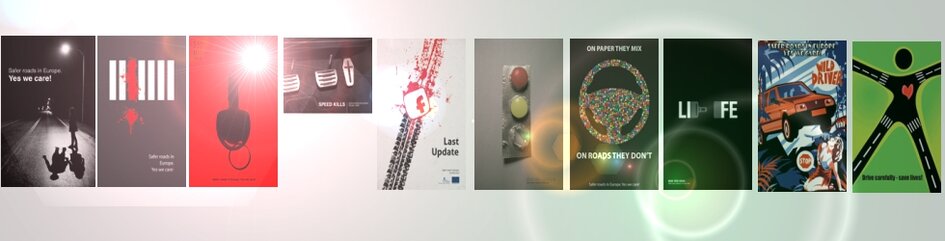
Calling all young graphic designers and graphic design students! Can you design a unique road safety poster aimed at young European drivers? The European Commission wants your creativity to help spread the message about responsible driving among young people, one of the most vulnerable groups on the roads. The winning poster will be translated into the EU’s 23 official languages, distributed in all 27 EU countries and used for a communication campaign in Brussels and possibly for similar campaigns across all 27 EU Member States!


Can I participate?

The competition is aimed at young people with an interest in graphic design. You must be an EU resident and born after 1985. You don’t have to prove your age and residency when you submit your poster, but you will be asked to do so if you get to the finals.

What do I have to do?

Using any technique you like, you should create a poster for use in promoting the EU’s action for road safety in all European countries. Your work should reflect one of the 12 themes listed in the briefing. There’s no imposed slogan, just an imposed ‘baseline’ – Safer roads in Europe. Yes we care! – This must appear somewhere on your work and will be kept in English regardless of the other word’s on the poster. Feel free to interpret one of the 12 themes as you wish. Do be aware though that word puns that work in your own language might not necessarily translate well into other languages, so this is perhaps best avoided. All that remains now is to choose which of the 12 themes your poster will focus on. If your poster does include text, it must be in one of the EU’s 23 official languages (see list here). It would be helpful if you could however provide a translation in English or French, and there’s a place for this on the entry form. Your work must conform to the A2 paper standard (420 × 594mm). The winning poster will eventually be printed with the EU logo – a small EU flag and the words ’The European Union’ – and the Road Safety logo “ON THE MOVE – for safer roads in Europe” at the bottom. You don’t have to include the logo but you may wish to take it into account when creating your poster.

How do I submit my poster?

It’s easy. Just send your work electronically (via the competition website) before midnight Brussels time on 21 October 2011. You can use JPG or GIF format, but if you reach the final 10 stage you will be asked to send your project in PDF and InDesign format so that high-definition prints can be made. The file must be no larger than 3MB (megabytes). You must provide your name, address, telephone number, date of birth and e-mail address. The contest complies with EU provisions on user privacy.

How will my work be evaluated?

10 finalists will be chosen by representatives from DG MOVE, the coordinator of the European Youth Forum for Road Safety and an expert Art Director from EURESIN. Apart from originality and artistic quality, jurors will be looking at how well your work represents the themes and whether it will also appeal to your fellow European citizens. From 31 October to 18 November the 10 pre-selected posters will be put to an online public vote (via the competition website) and anyone will have the opportunity to vote (just once though!)

When will the winner be selected?

The 10 finalists will be selected between 21 and 28 October and will receive a letter to that effect. The online public vote will be held from 31 October to 18 November. The winner will be invited to Brussels for an award ceremony on 24 November at the European Youth Forum for Road Safety. The two runners-up will be notified by post of their prize.

What happens if I win?

The winning design will be used for a communication campaign in Brussels and possibly for similar campaigns across all 27 EU Member States by the European Commission.

The winner will receive €2 000 and will be invited for an award ceremony to Brussels at the European Youth Forum for Road Safety on 24 November. The two runners-up will each receive €1 000 and will be notified by post of their prize. The 10 finalists’ posters may also be used in exhibitions organised by the European Commission or EU representatives in EU countries and in promotional material (i.e. mouse pads, postcards, etc.).

Find out more here!