
Are teens mentally prepared to drive? A study from NOYS

Are teens mentally prepared to drive? A study from NOYS

The National Organization for Youth Safety (NOYS) regularly update us with the latest activities for youth and road safety issues in North America. Being the leading organization for youth safety; campaigns activities and studies, NOYS have published an article focusing on the cognitive abilities of teenagers to drive. Are teens mentally prepared to drive?

The teen brain – are they mentally prepared to drive?
An article by NOYS.

During the ages 12 and 25, the brain undergoes a massive reorganization. It undergoes extensive remodeling, resembling a network and wiring upgrade. Compared with adults, teens tend to make less use of brain regions that monitor performance, spot errors, plan, and stay focused – areas the adults seemed to bring online automatically. This lets the adults use a variety of brain resources and better resist temptation, while the teens used those areas less often and more readily gave in to the impulse – just as they’re more likely to look away from the road to read a text message.

Seeking Sensation

Seeking sensation isn’t necessarily impulsive. Teens might plan a sensation-seeking experience (a skydive or a fast drive) quite deliberately. Impulsivity generally drops throughout life, starting at about age 10, but this love of the thrill peaks at around age 15.

Also peaking during adolescence is risk-taking.

“In the brain, one chemical called dopamine stimulates needs and desires for excitement, and one called serotonin alerts the body to risk and prompts defensive actions.  In the brains of teens, dopamine far outweighs serotonin.  As one doctor has explained, dopamine is “the gas” and serotonin is “the brakes,” and teens are mostly gas and very little brake.” 
– Tim Hollister – There Is No Such Thing As A Safe Teen Driver

In research labs, teens take more chances in controlled experiments involving everything from card games to simulated driving. And it shows in real life, where the period from roughly age 15 to 25 brings peaks in all sorts of risky ventures, with 14- to 17-year-olds being the biggest risk takers. This age group dies of incidents of almost every sort at high rates. Most long-term drug or alcohol abuse starts during adolescence, and even people who later drink responsibly often drink too much as teens. Especially in cultures where teenage driving is common, this takes a gory toll: In the U.S., car crashes are the number one killer of teens.

Responding Strongly to Social Rewards
Teens take more risks not because they don’t understand the dangers but because they weigh risk versus reward differently. In situations where risk can get them something they want, they value the reward more heavily than adults do. With a still-immature ability to control impulses and the intensity of dopamine-enhanced feel-good emotions, teenagers frequently have an imbalanced risk/reward context. That results in bad decisions and foolish mistakes. Often, their decisions seemed right at the time, even if later, after something bad happens, they understand exactly why it was a bad decision.

A Challenge, but also an Opportunity

Many look at teens as the problems because of their irregular and irrational behavior and decision-making, but there is also an opportunity to reach teens during these difficult years. Understanding their own brain behavior at work may help the analytical side of their thinking put the brakes on dangerous driving.*

Parents can influence their teens in many ways and help deviate them from making dangerous decisions on the road. Parents should:

  • Start the conversation early and talk to their teens BEFORE they get their license.
  • Create a driving agreement that includes Graduated Driver’s Licensing (GDL) laws but is not limited to GDL laws.
  • Make sure the vehicle their teen is driving is safe and that their teen understands how to maintain the vehicle.
  • Apply distracted driving prevention technology to the car/phone.
  • Monitor their teen’s driving on a daily basis, especially during the first year.

Get dozens of FREE safe teen driving resources from reputable resources all from one place at the UnderYOURInfluence Parent Toolkit!

Sources Derived from:  
National Geographic 
FYIDriving 
Adolescent Brains are Works in Progress

What are you views?
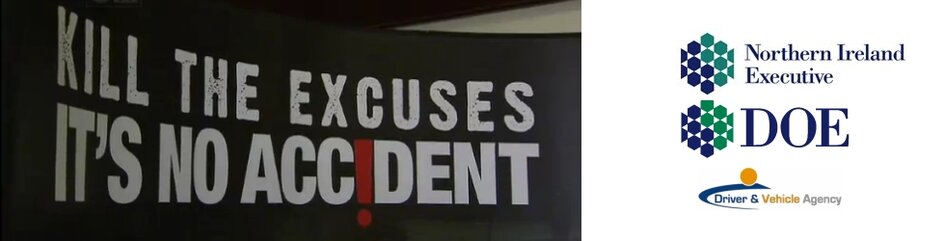
95% of all crashes are human errors not accidents – Northern Ireland

95% of all crashes are human errors not accidents – Northern Ireland

A new road safety campaign has been launched in Northern Ireland that focuses on the reality of road crashes; 95% of crashes in Northern Ireland are caused by human error and therefore could have been avoided. This challenges the notion that most crashes are ‘accidents’ that were unavoidable.


The ‘Excuses’ advert highlights that over 95% of collisions where someone is killed or seriously injured are the result of human error. The advert does not concentrate on speeding or drink driving, like previous campaigns.

“A crash is not fate; it is a man-made tragedy that cannot be denied by excuses. Crashes are preventable and we are all responsible. By treating the road as a shared space, we can reduce the risks of being involved in a collision,” said Northern Ireland Minister Alex Attwood.

The main causes of crashes are speeding, drink driving and driver carelessness and the advert also warns pedestrians, cyclists and motorcyclists not to take risks. Casualties are at their lowest point since 1931in Northern Ireland, with 28 people killed on our roads so far this year, but Chief Superintendent Peter Farrar said it is possible to further cut numbers.

“If everyone slowed down, did not drive after taking drink or drugs, wore a seatbelt and drove with more care and attention then the number of deaths and injuries will reduce,” he said.

The advert challenges the belief that crashes most crashes are accidents and unavoidable. This adverts explains that most crashes are caused by human error that were avoidable.

“Occasionally there will be times when something outside our control happens, like a flat tyre or a puncture, a dog walks out in front of the car; but 95% of the time it’s caused by human error.

“So I think all of us, if we look back, if we were in a collision, with hindsight would say well, actually there’s something I would do differently.”

Road Safety is no Accident – The theme of the World Youth Assembly 2007
The World Youth Assembly (WYA) that initatied the global youth movement for road safety brought together over 400 young people from over 100 countries to put road safety on the global agenda. This event operated under the banner of ‘road safety is no accident’.

Communications Officer, Manpreet Darroch said, ‘Calling avoidable crashes “accidents” gives the impression that the crash was not caused by human error but was rather fate. However, we know that if you are texting and driving, drink driving or undertaking other risky behaviour, a crash that is caused by this is not an accident. It is almost like proclaiming getting drunk was an accident while a person has been drinking all day’.

YOURS supports this campaign and urges drivers to challenge their own risky behaviour and be road safety models. There are no excuses to road safety and road safety is no accident.

View reactions to the advert at UTV Northern Ireland.

Take a Pledge for the #ItCanWait Campaign from AT&T and NOYS

Take a Pledge for the #ItCanWait Campaign from AT&T and NOYS

Over in North America, the campaign trail to stop texting and driving amongst young people is hotting up. The issue has become a major cause for concern in the United States and beyond and has been given national attention by ministers and governments in recent years. Now, AT&T the global mobile phone network has teamed up with NOYS (National Organization for Youth Safety) to promote

For every pledge, AT&T will donate $2 to NOYS to support their life-saving driving education programmes.

Texting while driving is no neglected issue in the United States and North America, lots of initatives here have potentially saved thousands of lives as well as preventing crashes and injuries. In recent news on the ‘anti-texting and driving’ pressure campaigns focused on young people, AT&T, the mobile network company have teamed up with NOYS to present the ‘It can wait’ campaign that calls on young people around the United States and beyond to pledge to never text and drive.

The It Can Wait website is dedicated uncovering the facts about texting and driving and urging people to pledge to never text and drive!

In addition to the pledge to stop texting behind the wheel, the campaign has equipped young people with a ‘Activation Kit’ which inlcudes statistics, research, tips and infographics such as the one below.

TEXTING TIPS
AT&T wants to inform all wireless users that safety comes first when you’re in the driver’s seat. Help keep all drivers safe on the road by following the tips:

  • Be Smart. Don’t text and drive. No text message is worth a life.
  • Be in control. Remember it’s your phone. You decide if and when to send and read texts so take control. Download AT&T DriveModeTM – an app designed to curb the urge to text and drive.*
  • Be Caring. Don’t send a text when you know your family member, friend or co-worker is driving.
  • Be Focused. Never use your phone to take pictures, send and read messages, record video, or watch TV while driving.
  • lol. cul8r. @wrk. ttyl. Texting has its own language. We use that language as a life line to connect to our friends, family and co-workers. We send pictures. We chat. We text.Be an Example. A recent survey2 found that 77 percent of teens say adults tell them not to text and drive – yet do it themselves “all the time.” Still, 89 percent of those teens said their own parents are good role models in terms of not texting while driving, so please lead by example.
  • Be Proactive. Take the pledge and commit to never text and drive: www.itcanwait.com.
  • Be Aware. If you have teens, some wireless companies offer parents an easy way to manage their teen’s phone functionality, such as the time of day the phone can be used for messaging, Web browsing or outbound calling. However, 911 calls are always allowed and parents can also set up “allowed numbers” that the teens can call as parents or others deem appropriate.
‘Designated texter’ enters the automobile

‘Designated texter’ enters the automobile

After growing up during a campaign against drunken driving, many teenagers say they’ve embraced the notion of a designated driver. Coming of age amid condemnation of distracted driving, some say they use a ‘designated texter’; when driving with friends.

Despite that, a new study shows that about a third of them admit to sending and reading text messages while behind the wheel. The report was consistent with federal research this year, which showed that teens and drivers under the age of 25 are much more likely to text than older drivers.

Source: By Ashley Halsey III, Published: August 28 2012, The Washington Post

Crashes are the leading cause of teenage deaths, and teens are more likely to die in them than any age group other than those over 80.

The good news in a report released Tuesday by State Farm Insurance was a greater awareness among teenagers of the risk posed by using mobile devices to text or talk while driving.

“It was very promising to see so many teens voice their concerns about this issue and see that the drivers listened to them and took action,” said research director Chris Mullen. “Research tells us that texting while driving can be just as dangerous as drinking and driving. More education and conversations need to occur so teens understand that no one can handle driving distracted.”

A federal survey done in December found that 11 percent of drivers age 18 to 20 said they were sending or receiving text messages when they crashed. But the federal report also discovered that drivers in that age group were more likely to recognize the risk than those age 21 to 24.

The new State Farm report said that four out of five teen passengers said they scolded a driver for texting. One Pennsylvania teen, Navea Frazier, told the insurance carrier: “When I’m in a car with my friends or family, I say, ‘Hey, don’t do that. I’ll text for you.’ I’m the designated texter.”

Use of cellphones by novice drivers has been banned in the District and 31 states, including Maryland and Virginia. But distracted driving was cited as a possible factor this year when preliminary data showed that teen highway deaths appeared to be creeping up after years of decline.

U.S. Transportation Secretary Ray LaHood and the National Transportation Safety Board are pushing for laws against texting and cellphone use while driving. But state lawmakers have moved cautiously for fear of voter backlash.

The National Safety Council has estimated that a quarter of all crashes are the result of distracted driving. 

Our position on distracted driving
YOURS believes that not only ‘texting and driving’ is a risk behind the wheel, using your phone ‘hands-free’ is also risky. A human brain can only do one ‘cognitive demanding’ action at a time. Simplified: if your brain is at the phone call or a text message, you are not able to focus on the road. A good example is if you are watching your favorite television show or movie and you are really engaged with it, can you talk to someone on the phone at the same time?

David Teater, senior director of Transportation Initiatives at the National Safety Council, explains more on multitasking and distracted driving in the videos at the upper right of this page.

Direct link to the Washington Post article: 
http://www.washingtonpost.com/local/trafficandcommuting/designated-texter-enters-the-automobile/2012/08/28/de237ff8-f115-11e1-adc6-87dfa8eff430_story.html?hpid=z5 

New trainers run their first road safety sessions in Kenya

New trainers run their first road safety sessions in Kenya

Late last year, YOURS initiated the Embrace Life Campaign. This unique photography competition illustrated how young people from over 50 countries are ’embracing life’ and consequently commit to road safety to preserve it. The winners of the competition won a small grant to implement a road safety project in their neighborhood. Nine months later a Training of Trainers has been implemented on the ground and the first wave of trainers ran their first road safety sessions. We are pleased to report back on this first success.

A freshly trained trainer in action in Kenya

Objectives of this call for proposals
Road crashes are still the biggest cause of death and disability for young people, in both the world and Europe. 19% of road fatalities in the EU in 2010 affected young people aged between 18-25 years old (although this age group comprises only 10% of the total population). This means that those aged between 18-25 face almost twice as high a risk of dying in traffic accidents.

In April 2007 within the framework of the European Road Safety day, a first Youth Forum was organized to support the continuous effort by the European Commission to reduce fatalities of youngsters on the roads. Up to now, this event was organised 4 times in Brussels by the European Commission.

The objective of the present call for proposals is:

  1. To promote the establishment of an EU-wide network of youth organisations by pooling resources with a view to maximise the impact of the road safety Youth Forum at local, regional and European level.
  2. To perpetuate the youth forum by opting for an approach which involves directly youngsters and organisations active in the area of the fight against the causes of accidents among this category of road users from the planning to the implementation of the event.
  3. To involve young people as ambassadors in the fight against road fatalities using the European youth networks and to give them the opportunity to be active players in improving road safety.
  4. To trigger and promote dialogue between young people from different cultures, youth organisations, enforcement bodies, policy makers and practitioners, in relation to road safety and young road users.


Budget

The estimated total amount is € 150 000. The European Union co-funding will be up to 50% of the total eligible costs. The closing date for submissions of applications is 31.10.2012.

For more information please visit the website of the EC: http://ec.europa.eu/transport/grants/2012_10_31_en.htm.

Good luck to all of you who will apply!

Peter Amos running a See and Be Seen session at a community centre in Tanzania

Sheila how did you find the training?
I thought it was very informative, engaging and encompassing. Did you enjoy it too? Very much. We had new ideas of engaging the children on road safety and by the fact that we had practical sessions to emphasize further made it a full package.

And Peter how was it working with young children in Kenya and seeing the newly trained facilitators in action?
The young children in Kenya were very attentive and enthusiastic to learn about how they should keep themselves safe on the road. They asked many questions and participated widely.

It was great to see the newly-trained road safety instructors teaching pupils independently. Towards the end of the training they needed little to no supervision and had brought their own talent, ideas and enthusiasm to the project, making the lessons fit the cultural and national context in Kenya.

Sheila, what is next now that you are a trainer of the See and Be Seen program? The ‘next’ is a rather a late question because we have already started spreading the ‘See be seen’ program. Members of the YOURS-Kenya team visited a children center which is also an education center to pupils of around 200 in population. We engaged 50 pupils in the ‘See be seen ‘program. I would like to share a  remark of the Executive Director for Hamomi, Sussie Marks  “I do not know how best to thank you but the smile on my children’s face will tell you how wonderful and useful your program is to our children. Please come back again to engage us more in road safety”.

Back to Peter, what are some of the things young people can/should do to improve road safety in Africa?
Young people should take precautions when it comes to road safety by practicing safe and responsible behavior when using the road or when they are near the road. For example older youth can take leadership by helping children to cross and use the road safely. An older youth might hold the hand of a child while walking across the road, or might instruct a child to use the road more safely. Lastly, older youth could engage in peer to peer education to spread their knowledge and skill set with one another.

To you both, what are your views of the ‘Embrace Life’ campaign that initiated this project? Should we do more of them?.
Peter: 
The Embrace Life Campaign gives young people the opportunity to share the problems they face concerning road safety in their locality and raise their awareness as far as road safety is concerned. Amend is very supportive in campaigning and advocating for, and promoting increased awareness and action on road safety. We believe that initiatives such as the Embrace Life Campaign should be spread throughout Africa.

Sheila: It was a unifying campaign, engaging, fun and most importantly passed the message of road safety. For my 26 years of life, I have never participated in such an interesting campaign. The only challenge was that it could have limited those who could not access internet, low internet to upload their photos, no cameras and language barriers. My suggestion for this would be that YOURS provides an alternative, like send through the post office or some central place by liaise with road safety organizations within respective countries safety to be the central collection point of items like photos to send or even upload for them. 

On the question if YOURS should run more international awareness campaigns: definitely, yes! The international campaigns give people a platform to participate in road safety even if they are already engaged in other sectors. It spreads the news of road safety to the wider audience and identifies issues of road safety in different parts of the world.

Do you want to organise the next EU Youth Forum for Road Safety?

Do you want to organise the next EU Youth Forum for Road Safety?

The European Commission (EC) published a call for proposals for the organisation of the next EU Youth Forum for Road Safety. The EC intends to award a grant to reduce road casualties among young people. This action is part of a campaign to sensitise to the causes of road crashes and to their prevention by mobilising young road users, as a group particularly at risk, to take action.

Objectives of this call for proposals
Road crashes are still the biggest cause of death and disability for young people, in both the world and Europe. 19% of road fatalities in the EU in 2010 affected young people aged between 18-25 years old (although this age group comprises only 10% of the total population). This means that those aged between 18-25 face almost twice as high a risk of dying in traffic accidents.

In April 2007 within the framework of the European Road Safety day, a first Youth Forum was organized to support the continuous effort by the European Commission to reduce fatalities of youngsters on the roads. Up to now, this event was organised 4 times in Brussels by the European Commission.

The objective of the present call for proposals is:

  1. To promote the establishment of an EU-wide network of youth organisations by pooling resources with a view to maximise the impact of the road safety Youth Forum at local, regional and European level.
  2. To perpetuate the youth forum by opting for an approach which involves directly youngsters and organisations active in the area of the fight against the causes of accidents among this category of road users from the planning to the implementation of the event.
  3. To involve young people as ambassadors in the fight against road fatalities using the European youth networks and to give them the opportunity to be active players in improving road safety.
  4. To trigger and promote dialogue between young people from different cultures, youth organisations, enforcement bodies, policy makers and practitioners, in relation to road safety and young road users. 


Budget

The estimated total amount is € 150 000. The European Union co-funding will be up to 50% of the total eligible costs. The closing date for submissions of applications is 31.10.2012.

For more information please visit the website of the EC: http://ec.europa.eu/transport/grants/2012_10_31_en.htm.

Good luck to all of you who will apply!