‘The Knock On Effect’ of speeding – a powerful new road safety advert

‘The Knock On Effect’ of speeding – a powerful new road safety advert

In a 2006 study, The Organisation for Economic Co-operation and Development (OECD) and the European Council of Transport Ministers determined that excessive or inappropriate speed was the full or partial cause in approximately one third (33%) of all fatal crashes. Put another way, SPEED KILLS. There are a lot of misconceptions about the role that speed plays in crashes. Protect yourself and your loved ones by getting the facts.

Road safety issues, including speeding, have been subjected to scientific analysis for nearly one hundred years and a vast body of research has been developed. The consensus in road safety  best practice is:

  • The faster you drive, the worse the crash will be if you get in one because of the greater force involved
  • The faster you drive, the more likely you will be in a crash because you will have less time to react to unexpected hazards.
  • Even small decreases in mean speed travelled equal many lives saved.


Know the Difference

“Speeding” is driving above the speed limit whilst “excessive speed” is driving way above the speed limit, and you can be arrested for it. This applies at 30 km/h or more in an urban area and 40 km/h or more outside an urban area or on a freeway. Under Sections 35 and 36 of the National Road Traffic Act, 93 of 1996 your driver’s licence will be suspended if you are convicted of excessive speed


“Inappropriate speed” is driving too fast for the conditions; for example, driving at the speed limit in heavy rain.


Why Speed Kills

Speed has two main relationships with road safety

  1. The most direct link is aggravation of severity: greater collision speeds mean more force unleashed on the victims and thus speed directly influences the likelihood of death or serious injury. This is particularly so when vulnerable road users such as pedestrians, cyclists and motorcyclists are involved in a collision with another vehicle. 
  2. The second relationship, a bit more complex, is the causal role of speed in a road trauma incident. The higher the speed at the point where a crash becomes likely, the less time there is for the driver to react, and the increased chances of skidding or other events influencing loss of control. So higher speeds play a very significant role in causing crashes.

The powerful video illustrates the impact of a speeding crash not only on the person in the crash but also the immediate family, a stark reminder that speeding has a wider impact.

Our Communications Officer, Manpreet Darroch said, “This advert is a great reminder of the human element of road safety. Lots of road safety film makers focus on blood, guts and shock tactics, its powerful to see the wider impact of a crash, such as the family who really would go through the crash with you in terms of grief and family trauma“.

READ MORE ABOUT SAFELY HOME

NGOs to Lead Development of Road Safety Initiatives by NGOs in 15 Countries

NGOs to Lead Development of Road Safety Initiatives by NGOs in 15 Countries

We are currently in Memphis, Tenessee in the United States of America to work with the Global Alliance of NGOs for Road Safety in its flagship program, the Alliance Advocates. During this programme, we will be training 15 advocates from 15 countries in global road safety advocacy alongside the Alliance and sponsored by FedEx.

Today, the Global Alliance of NGOs for Road Safety (the Alliance) launched its second Alliance Advocate Training Program at FedEx Express World Headquarters in Memphis. A group of 15 road safety professionals from 15 countries on five continents will gather for an intensive two-week program that will strengthen their professional skills in advocacy, communications, project management, strategic planning, and more.

Prior to the training, each advocate identified a key road safety issue in their home country, which, if addressed, could have a measurable effect on the number of road crashes that currently take 1.25 million lives around the world each year. Issue

Alliance Advocates meet at the FedEx World Technology Campus in Memphis, USA.

During the training, each advocate will create an evidence-based, measurable action plan that they will implement in the coming months. With delegates attending from a diverse range of high-, medium-, and low-income countries, and with widely different cultural, economic, and political challenges, the training is highly tailored to be applied in different environments.


The Alliance advocates were selected through a highly-competitive selection process, and represent an elite group within the Alliance, which represents more than 190 road safety NGOs (non-governmental organizations) in more than 80 countries. Much is expected from the advocates upon completion of the training.

Graduates of last year’s program are already making their mark on global road safety, confirming the value of the program. Impacts include implementation of a national seat belt law in Tunisia, which saw road deaths fall within the first month, and a new law in the Philippines requiring children to wear helmets on motorcycles.

The Alliance Advocates training is part of the Alliance Empowerment Program, a capacity-building initiative, launched in 2016, which aims to improve the ability NGOs working in road safety around the world.  FedEx Corp. (NYSE: FDX) sponsors and supports the Empowerment Program, not only through funding, but also by providing expertise and resources to grow the potential of Alliance member NGOs.

lotte.jpg

“This is an important initiative for the Alliance,” said Lotte Brondum, administrative director of the Global Alliance of NGOs for Road Safety. 

The Alliance Advocates face a lot of road safety challenges in their home countries. We know from the 2016 cohort of advocates how much can be achieved following the training and we look forward to a challenging and fruitful two weeks.”

“Road Safety is a top priority at FedEx,” said Neil Gibson, vice president, Corporate Communications, FedEx. “As part of our FedEx Cares commitment to invest $200 million in 200 communities worldwide by 2020, we are dedicated to saving lives and developing solutions that responsibly and sustainably make roads safer.  We are delighted to sponsor the Alliance Empowerment Program and Alliance Advocate training and to be able to use our expertise to empower road safety organizations around the world.”


READ MORE ABOUT THE ALLIANCE ADVOCATES PROGRAMME

Fatigue and driving infographic – have you driven tired?

Fatigue and driving infographic – have you driven tired?

Studies have shown that drivers don’t fall asleep without warning. Drivers who fall asleep at the wheel have often tried to fight off drowsiness by opening a window, or by turning up the radio. This doesn’t work for long. Sleep-related accidents are more likely than others to result in a fatality or serious injury. Peak times for accidents are in the early hours and after lunch

Infographic credits: www.mattressonline.co.uk

More tips to avoid fatigued driving:

  • Plan your journey to include a 15-minute break every two hours.
  • Don’t start a long trip if you’re already tired.
  • Remember the risks if you have to get up unusually early to start a long drive.
  • Try to avoid long trips between midnight and 6am when you’re likely to feel sleepy anyway.
  • If you start to feel sleepy, find a safe place to stop – not the hardshoulder of a motorway. Drink two cups of coffee or a high-caffeine drink and have a rest for 10 to 15 minutes to allow time for the caffeine to kick in.
  • Remember, the only real cure for sleepiness is proper sleep. A caffeine drink or a nap is a short-term solution that will only allow you to keep driving for a short time.

CHECK OUT UK CAMPAIGN THINK! SLEEP POSTER

Donate to road safety research in Uganda – by Brian Bilal Mwebaze

Donate to road safety research in Uganda – by Brian Bilal Mwebaze

You all know Brian by now! Our monthly columnist, our Regional Champion for Anglophone Africa, a trained facilitator, long term champion of YOURS as well as a life long road safety protagonist. Alongside all of his road safety activity, Brian is champioining some pioneering research into the use helmets for Boda-Boda drivers (also known as motorcycle taxis) in Uganda. We support his efforts and ask you to also invest in his research. This is one of the first crowd sourced road safety research campaigns in history, lets make history together and make young riders in Uganda safer. More from Brian below.

I became interested in Road Safety in 1998 after my father was involved in a road traffic crash. At the time, I was only 12. While my father survived, he has lived with permanent injuries. It was then that I realized and experienced the significant damage caused to the victim and the families both economically and psychologically. Since my father’s traffic crash, I have been passionate about raising awareness on road safety issues in my local community and identifying effective means of making Uganda’s roads safer for everyone.

Many people don’t realize this but in Sub-Saharan Africa, Road Traffic Crashes are the leading cause of death and disability for people between the ages of 15-29.

In Uganda, motorcycle taxis called Boda Bodas have been nicknamed killing machines. According to the Uganda Police Force accident records for 2013, there were 6,831 reported Boda Boda accidents, killing 1,098 people and injuring 6,578.

Looking beyond the numbers, Boda Boda drivers are young men seeking to make a living for themselves and their families by transporting people on the back of their motorbikes. It’s a dangerous job, but also a lucrative one in an economy that struggles with high unemployment. When a driver is in a Boda Boda accident, his death or his injuries have a severe impact on the wellbeing of his family.

This study wants to see if there is a way to save the lives of Boda Boda drivers by scientifically testing the effectiveness of an intervention that seeks to increase helmet usage. While helmets are required by law, there is low enforcement and few drivers wear helmets.

The study will be conducted as part of the World Health Organization’s (WHO) Mentor – Violence Injury Prevention Program Fellowship.


Ugandan Boda-Boda Riders

In the field of road safety, evidence is needed on simple cost effective measure that change people’s behavior. In Uganda and other parts of Sub-Saharan Africa there is a lack of evidence and evaluations of interventions to improve road safety but so often the funding prevents this. As a researcher, I am fortunate to have been given a platform from WHO, but I won’t be able to move forward without the funding.

Floor Lieshout YOURS Executive Director said, “Brian is one of our leading youth road safety campaigners in Africa and continues to work tirelessly for the cause. We wholeheartedly support his initiative to find evidence-based solutions to the boda-boda issue in Uganda”.

Thank you for any amount you can contribute to this vital effort to save Ugandan lives and improve the safety of our roads.

READ MORE AND DONATE HERE

European Road Safety Tunes – engaging youth in road safety creativity

European Road Safety Tunes – engaging youth in road safety creativity

We were recently involved in the European Road Safety Tunes final conference that took place in Warsaw, Poland. The conference brought together participants from all participating countries to showcase all the positive outcomes of the project, which saw youth all around Europe using creativity to engage in road safety. The result being an array of colourful outputs, with youth using their imaginations to convey road safety messages.

Results of the European Project European Road Safety Tunes were presented to 91 conference-participants in Warsawa at the premises of Motor Transport Institute (ITS). The coordinator of the project Elke Weiss from Austrian Mobility Research, Mr. Konrad Romik, secretary of the polish national Road Safety Council in the Ministry of Infrastructure and Construction and Marcin Slezak, the general director of the Motor Transport Institute, welcomed the participants.

Participants to the conference heard about the how young people engaged with road safety.

The project “European Road Safety Tunes” – From idea to realization, Elke Weiss, FGM-AMOR
The coordinator presented the reason for the project and its main objectives. The aim of the project is to improve road safety by reducing accidents, injuries and fatalities of young drivers by raising awareness for a responsible and social behaviour in traffic, through attractive youth oriented workshops and actions. The Safety Tunes methodology combines a peer approach, an emotive know-how transfer and social art with road safety. A practical and creative “feeling and understanding” of risky behavior should lead to a changing in attitudes and behavior.

The methodology was presented by Hannelore Depypere (Mobiel21) in interaction with the audience. The modules feel it – know it – do it – spread it were explained and examples from each module were shown.

Presentation of outputs of the project from students and partners
The focus of the conference was the presentation of the creative results of vocational students from the participating countries Austria, Belgium, Czech Republic, Hungary, Poland, Slovenia, Spain and the Netherlands.

Informal exchange round of experts, Discussion round
After Lunch, Tina Panian (FGM) moderated a discussion round with experts from Hungary (Edina Fóris, teacher), Czech Republic (Ivo Rusak, traffic and transport expert and Jaroslav Heinrich, HBH), Slovenia (Marta Novak, national road safety expert for kindergarten, primary school and high school level, National Education Institute Slovenia), Spain (Daniel Macenlle, police officer), Belgium (Hannelore Depypere, Mobiel 21), England (Manpreet Darroch, YOURS) and Hungary (Maria Bognar, GRSP Association Hungary).

Experience in working with young people in road traffic safety and the implementation of safety tunes were exchanged and the safety tunes methodology and the transfer to other countries were discussed. All the participants in the expert round agreed that it would be useful to continue the methodology of safety tunes after the end of the project. The students also took part in the discussion and confirmed the impact of the SafetyTunes method on their behavior in road traffic. The conclusion that emerged in the discussion with the students was: “Let’s make road safety sexy”.

manpreet thumb

Our YOURS communications director Manpreet Darroch said, “European Road Safety Tunes is a brilliant way of engaging young people in road safety in Europe. YOURS is a big fan of creativity in road safety as young people are inherent creators. They are at the forefront of technology innovation and finding new ways to do things better, easier, more efficiently but also finding the element of fun. I think European Road Safety Tunes is a great example of how young people can create unique road safety messages that speak to other young people”.

READ MORE ABOUT EUROPEAN ROAD SAFETY TUNES

Youth Ambassadors for Road Safety trained in Limpopo Province, South Africa

Youth Ambassadors for Road Safety trained in Limpopo Province, South Africa

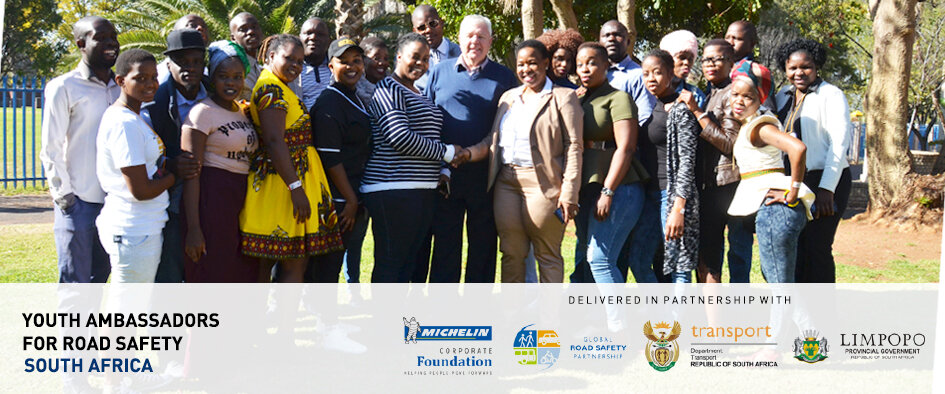
Last week, our team was in the beautiful province of Limpopo in South Africa to train 20 youth leaders in road safety. The project, funded by the Michelin Corporate Foundation and conducted in partnership with the Global Road Safety Partnership South Africa (GRSP ZA), the Department for Transport and Provincial Government of Limpopo took place from 17-21st July 2017. The trained Youth Ambassadors are the first of their kind in South Africa who have been set the mission to reach out to their communities with road safety messaging.

As being one of our favourite continents in the world to train, you can be sure that our recent training in Limpopo, South Africa was vibrant, engaging, energetic, informative and fun! From 17-21 July 2017 we delivered our first Youth Ambassador for Road Safety Training in the country.

The programme was initiated in 2015 by the previous South African Minister for Transport Dipuo Peters who envisaged a National Youth Structure to involve young people in road safety. This was formed around the principles of YOURS, to empower young people to be part of the road safety solution by building their capacities (skills, knowledge, attitudes and intentional behaviour) to improve the situation of youth on the road.

Since then, the Global Road Safety Partnership South Africa (GRSP ZA) and our long standing founding member Michelin (through the Michelin Corporate Foundation) formed a strategy to educate and activate the elected youth in the National Youth Structure for Road Safety. This was realized in the First Youth Ambassadors Training initially focused on the Province of Limpopo.

“I’ve never attended a training of this calibre…I learned a lot, for the first time I sat throught a whole training and never felt bored, we will take what we have learned as ambassadors for road safety back to our communities”.

Lesidi, Youth Ambassador for Road Safety

20 young leaders selected from Limpopo underwent a 5 day intensive training on road safety theory using YOURS’ unique training methodology that couples active, youth friendly learning with key road safety knowledge. Participants were trained on the following topics:

  1. Peer Education
  2. Scope of the Road Safety Problem – in the world and in South Africa
  3. Youth and Road Traffic Injuries
  4. Distracted Driving
  5. Speeding
  6. Seatbelts
  7. Drink and Drug Driving
  8. Facilitation Skills
  9. Presentation Skills
  10. Developing a Youth and Road Safety Workshop
  11. Spreading the Message
  12. Action Planning

The Youth Ambassadors, having learned a whole range of road safety topics and methods to engage their peers in their communities, will go back and filter our road safety messages using their own creativitiy and language contexts. Every youth participant pledged to take robust action to play their part in reducing road traffic crashes in Limpopo, a province with a particularly high rate of road crashes amongst young people.

“The YOURS Youth Ambassadors Training really exceeded my expectations, it was wonderful to see how the youth participated…the knowledge they have gained and the enthusiasm they will leave with, we look forward to the implementation phase”.

Dr. Pieter Venter, GRSP South Africa

The next phase of the training will see the Youth Ambassadors implement road safety communcations in their community and connect their learning to road safety interventions. The Ambassadors will be training young people in Grade 11-12 in Limpopo on the risks of the road through creative methods as well as campaign for road safety on a national level.

Peer education is an especially suited modality because it provides the opportunity for youth to work together cooperatively and collaboratively, and to support each other in making wise choices.  In addition, when peers have first-hand, authentic experience of the issues being addressed, they are more credible role models than adults, who may appear as though they are preaching.  Such a modality usually encourages high participation and continued long term motivation, especially so among young males, who are more significantly influenced by role models who understand their issues from a personal perspective.

Watch our video from the training: