Mark the World Day of Remembrance – 19th November 2017

Mark the World Day of Remembrance – 19th November 2017

The World Day of Remembrance for Road Traffic Victims (WDR) is commemorated on the third Sunday of November each year – to remember the many millions killed and injured on the world’s roads, together with their families, friends and many others who are also affected. It is also a Day on which we thank the emergency services and reflect on the tremendous burden and cost of this daily continuing disaster to families, communities and countries, and on ways to halt it.

Road deaths and injuries are sudden, violent, traumatic events. Their impact is long-lasting, often permanent. Each year, millions of newly injured and bereaved people from every corner of the world are added to the countless millions who already suffer. The cumulative toll is truly tremendous.


The grief and distress experienced by this huge number of people is all the greater because many of the victims are young, because many of the crashes could and should have been prevented and because governments’ and society’s response to road death and injury and to bereaved and injured victims is often inadequate, unsympathetic, and inappropriate to a loss of life or quality of life.

This special Remembrance Day is therefore intended to respond to the great need of road crash victims for public recognition of their loss and suffering. It has also become an important tool for governments and those who work to prevent crashes or respond to the aftermath, since it offers the opportunity to demonstrate the enormous scale and impact of road deaths and injuries and the urgent need for action.

Many varied commemorative events are held on each World Day, or on the days before or after.

Theme for 2017: From Global Remembrance to Global Action across the Decade
2020 Target: reduce road fatalities AND serious injuries by 50%*
Let’s make 2011-2020 a Decade to remember!

* Sustainable Development Goal 3.6: Reduce fatalities & serious injuries by 50% by 2020

This theme is based on Pillar 1 of the Global Plan for the Decade of Action – Road Safety Management.

One of the five indicators for which information is being collected under Pillar 1 is the “No of countries with time-based road safety targets. Targets provide a means to monitor the extent of progres and monitoring of progress is vital in achieving the ultimate goal of the Decade – reducing the forecasted number of road traffic deaths and injuries globally by 2020.”

The 50% target for both deaths and serious injuries (the latter had mostly been ignored until now) has been chosen because this target is part of the Sustainable Development Goal adopted by the UN General Assembly.

DOWNLOAD THE GLOBAL ALLIANCE’S TOOLKIT FOR #WDOR2017

VISIT THE #WDOR2017 WEBSITE

One by One – a song for the World Day of Remembrance by iRAP

One by One – a song for the World Day of Remembrance by iRAP

The World Day of Remembrance for Road Traffic Victims is held on the third Sunday of November. This day is dedicated to remembering the many millions killed or injured in road crashes and their families and communities. 

We also pay tribute to the dedicated emergency crews, police and medical professionals who deal with the traumatic aftermath of road death and injury on a daily basis.

One by One has been a volunteer effort by iRAP and they are thankful to all who have contributed their talent and time.

The World Day of Remembrance for Road Traffic Victims is held on the third Sunday of November. This day is dedicated to remembering the many millions killed or injured in road crashes and their families and communities.

One by one, the lives are lost

One by one, we mourn their loss

One by one, we count the cost

One by one is one too many

Music:  Simon Barlow and Aaron Schultz
Lyrics:  Rob McInerney, Simon Barlow and Aaron Schultz
Video Editing:  Jake Ryan
Inspiration & Images: Brigitte Chaudhry, Jeannot Mersch, Peter Frazer
Images:  Paul Wenham-Clarke (http://www.whenlivescollide.co.uk/)
Crash Footage:  TAC, Clemenger BBDO
Publicity:  Judy Williams & Briarlea Green

The song is a reminder of all the lives lost on the road. Sometimes crashes are presented as numbers, that we need to halve all road crashes by 2020. This means halving the 1.24 million people killed every day on the road. 1.24 million is not ust a number, it is an individual life lost in its own right; a unique tragedy that befalls family, loved ones, friends and communities. As its expressed in the song, one by on is one too many.

Join us to share the song with your networks.

About iRAP
iRAP (the International Road Assessment Programme) is the umbrella programme for Road Assessment Programmes (RAPs) worldwide that are working to save lives.  Like many life-saving charities working in the public health arena, we use a robust, evidence-based approach to prevent unnecessary deaths and suffering.

READ MORE ABOUT IRAP

Brian’s Column: What makes a good road “good”? Reflections after Delft

Brian’s Column: What makes a good road “good”? Reflections after Delft

After successfully graduating from Delft Road Safety Course, a cooperation between Delft University of Technology, SWOV Institute for Road Safety Research, Delft Post Graduate Education and Road Safety for All, Our monthly columnist Brian Kanaahe Mwebaze dares to explore what makes a good road good in Africa.

That’s right folks! With support from YOURS, FIA Foundation and Delft University, I finally graduated from the Delft Road Safety Course:-an annual Road Safety capacity building course for road safety professionals in low and middle income countries (LMICs).

I have pregnant post-course actions and like my favorite (retired) Wrestler Dwayne Johnson-The Rock would say, “If you smell what The Rock is cooking?”.

During the lifecycle of the said course that took place at Delft University in the Netherlands, there were several road safety delicacies to eat and reflect on which I managed to put in the refrigerator under this link “Midway reflections from @DelftRoadSafety Course 2017 #DRSC2017.

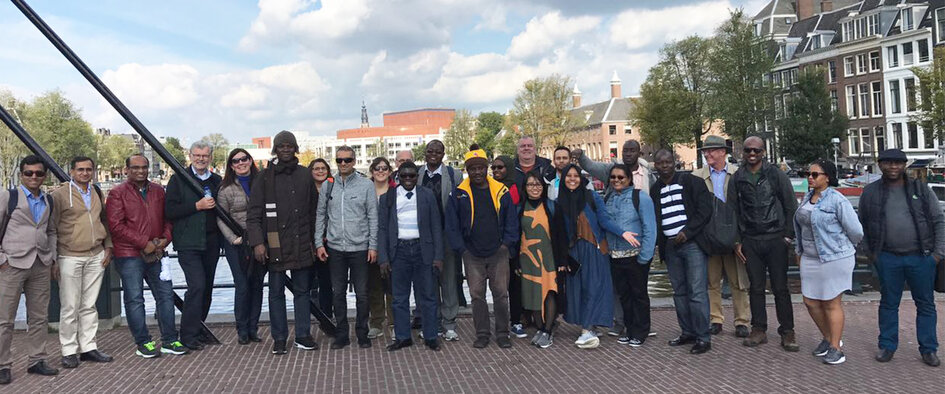
There’s a lot that was posted by over 25 participants under the hashtag #DRSC2017 on twitter so throw an eye over there. Perhaps, the most finger-licking experience came when we took an out of class session visiting local communities around Delft, learning about road designs and road user behavior that reminded me of how, back at home we define a good road.

You see, to a 95% confidence interval, our case definition of a good road is justified by 2 indicators, make a road with no potholes, make it wide to accommodate 2 way traffic on each side and we shall love you till River Nile dries! (it’s beginning to loose water volumes though).

Learning session at SWOV

Hold on a sec…humans and animals use roads, so shouldn’t we be defining the goodness of our roads by how safe we’re while using them? If a road could literally deliver zero crashes, zero deaths by protecting pedestrians, passengers and vehicle from skidding, turning multiple times off the road, wouldn’t this be the ideal road? The Dutch, Swedish (and most other countries) are defining their roads using these indicators.

As a result, they have consistently invested in sustainable road engineering, education and enforcement. They have strengthened preparedness and response before the crash, during the crash and post-crash so deep that if an ambulance arrives 10minutes after the crash:-someone could resign for not doing their job right.

A typical ‘Good’ road in Uganda

It’s envious to see a folk waiting for the green traffic light even when there’s no cop looking at them: people jogging on clearly marked pedestrian walkways (I did this for a fact), Cyclists doing their businesses in cyclist lanes, drivers negotiating double roundabouts and roads as old as 20 years without being re-furnished. Seeing all this is terrifying to acknowledge the fact that we’re always flirting with and cheating death (literally by the hair of our butts) while on our roads.

Is this all possible in our neighbors? Prof. Weigmann (Our course leader) would say “It requires sheer commitment from your governments and impatient generation of communities demanding for safer roads. You will have to adapt what you see here to your local contexts…and never forget the value of road safety data whatever you do”.

Stay safe!

Road Safety Annual Report 2017 focuses on serious action needed

Road Safety Annual Report 2017 focuses on serious action needed

The IRTAD Road Safety Annual Report 2017 provides an overview of road safety performance for 2015 in 40 countries, with preliminary data for 2016, and detailed reports for each country. It includes tables with cross country comparisons on key safety indicators.

The report outlines the most recent safety data in IRTAD countries, including detailed analysis by road user, age group and type of road. It describes the crash data collection process in IRTAD countries, the road safety strategies and targets in place, and information on recent trends in speeding, drink-driving and other aspects of road user behaviour. The 2017 edition of the IRTAD Road Safety Annual Report puts special emphasis on road safety for an ageing population, which represents a growing concern in many countries.

Executive Summary

Background – Road Safety Annual Report 2017

Road crashes kill about 1.3 million people worldwide every year and severely injure an estimated 50 million. Out of ten lives lost in traffic, nine are lost in low- and middle- income countries. But the number of road deaths is on the rise again even in some countries with impressive road safety improvements. The increasing share of vulnerable road users such as seniors, pedestrian, cyclists and motorcyclists that become victims of road traffic raises particular concerns.

Reliable data on traffic crashes is crucial for effective action on road safety. Without hard facts about the scale of the problem, the exposure to crash risks and the effectiveness of policies the problems cannot be addressed at the core. The International Traffic Safety Data and Analysis Group (IRTAD) of the International Transport Forum (ITF) brings together transport ministries, road safety agencies, research institutes, industry and non-governmental organisations to ensure co-operation around improving the collection and analysis of data, understanding trends and shaping better road safety policies. Common reporting standards allow benchmarking of performance across IRTAD membership. The 2017 Road Safety Annual Report provides the most recent road safety data for member countries, including provisional data for 2016 and an overview of road safety strategies in each country.

The visibility of the tragedy on the world’s roads and the sense of urgency to achieve significant reductions in the number of road deaths globally has been much strengthened by inclusion of road safety targets in the UN Sustainable Development Goals (SDGs). SDG 3.2 aspires to reduce global road traffic deaths and injuries by 50% by the year 2020, compared to their 2010 levels. SDG 11.2 calls to “provide access to safe, affordable, accessible and sustainable transport systems for all, improving road safety, notably by expanding public transport, with special attention to the needs of those in vulnerable situations, women, children, persons with disabilities and older persons” by 2030. Today, most countries have national road safety strategies in place, often with ambitious targets. Still, the aspiration set out in the SDGs requires countries to further intensify efforts, and strengthening the capacity to collect and analyse road safety data will have to be among these.

Road safety by age group

Since 1990, the reduction in fatalities has benefited all age groups, but the most impressive reduction concerns children aged 0 to 14 years (by almost 83%), as well as the groups of young people aged 15-17 and 18-20 (more than 76% and 83%, respectively). Despite substantial reductions, young people aged 18-24 are still a high-risk group, with a fatality rate nearly twice as high as that of the general population. Improvements were weaker for the senior population of those 65 years and older, with a reduction of only 45% when compared to 1990.

Since 2000, the situation has improved for all age groups, except for those 85 and over. However, since 2010 the situation has deteriorated for the over 65s (except a small decrease for the 75-84).

The analysis of developments since 2010 shows an improvement in youth mortality.


Findings

The positive trend over the last few years of reduced road fatalities did not continue in 2015 and 2016. The 31 IRTAD member countries for which data are consistently available registered a 3.3% increase in road fatalities in 2015 compared to 2014. In 2015, the number of road deaths increased in 21 countries compared to 2014. In 2016, the number of fatalities increased in 14 countries. Ten countries registered more road deaths for two consecutive years, i.e. in both 2015 and 2016.

Looking at the longer-term developments since 2010, the number of road deaths has decreased in all but three countries with validated data. Thirteen countries form a group of relatively well-performing countries with mortality rates per 100 000 inhabitants of five or less. Three of these had in 2015 mortality rate of three or less. Yet data for some IRTAD accession and observer countries suggest much higher rates, with more than 20 deaths per 100 000 inhabitants. These can be taken as an indicator for the situation in the many low and middle income countries not included in this report.

Recent statistics from the 2015 Global Status Report on Road Safety, World Health Organization

Road safety for an ageing population is a growing concern in nearly all countries. Older people are the world’s fastest-growing age group, and the share of people aged 60 or above is expected to reach 21% of the world population by 2050, up from 9% in 1994. At the same time, senior citizens have become more mobile than in the past and therefore more exposed to traffic risk.

This creates significant challenges for road safety. The share of old people killed in traffic is already larger than their share in the total population, and it is growing. Seniors have not benefited from improved road safety at the same pace as the general population in past years. While the number of road deaths declined by 6.5% overall between 2010 and 2015 across IRTAD countries, that of senior citizens killed in crashes increased by 3.4%. More than half of the road fatalities among seniors above 65 falls into the vulnerable road users category, i.e. concern older pedestrians, cyclists and motorcyclists.

READ THE REPORT HERE

Safety 2018 World Conference – Call for abstracts

Safety 2018 World Conference – Call for abstracts

Injuries and violence are a major public health burden across the globe. The 13th World Conference on Injury Prevention and Safety Promotion (Safety 2018) will bring together over 1000 of the world’s leading researchers, practitioners, policy-makers and activists to share information and experiences and to discuss solutions. Conference major theme is “Advancing injury and violence prevention towards SDGs”

Conference Objectives

Inspired by the SDG commitments, WORLD CONFERENCE ON INJURY PREVENTON AND SAFETY PROMOTION 2018 (called “Safety 2018”) is convened in November 5-7, 2018 in Bangkok with the following objectives.

  1. To share knowledge, experience, good practices, successful and non-successful stories, challenges of injury prevention and safety promotion in responses to SDGs.
  2. To promote safety and non-violence in all policies, and advocate effective multi-sectoral actions for safety and non-violence.
  3. To build and strengthen a global community of practice in order to promote safety and prevention of violence agenda worldwide.

Safety 2018 will take place on November 5-7, 2018 in Bangkok, Thailand. The Conference will be hosted by Thailand’s Ministry of Public Health, and co-hosted by the World Health Organization (WHO), the National Institute for Emergency Medicine (NIEM) and the Thai Health Promotion Foundation.

Participants will primarily include researchers, practitioners, advocates and policy-makers in the field of injury prevention and safety promotion.

CALL FOR ABSTRACTS

Submit now until 15 January 2018 (GMT+7)

ABSTRACTS

The abstract should contain no more than 300 words that illustrate original research, synthesis, reviews, debates or documenting experience from the field on the subjects which have never been presented at any international conference.

The abstract can be either structured or unstructured format. Structured abstract should contain the following: Background, objective, methods, findings, conclusion and policy implications. Unstructured abstract should contain essential elements for which the international reviewers can judge the merits of the works.

Essential fields in the abstract cover the following

1. Title of the abstract
2. Name, position, affiliation institute, country of all author;
3. Specify which author is a co-responding author and which author will be the presenter if abstract is qualified and selected
4. Indicate needs for funding support or not [see detail in funding opportunities]
5. Main body of abstract, not beyond 300 words
6. Please indicate which sub-themes and key word(s) most related to your abstract


SUB-THEME 1: CROSS-CUTTING ISSUES (RELEVANT TO UNINTENTIONAL INJURY AND VIOLENCE)

1.1 Safety and non-violence in all policies
1.2 Injury surveillance and injury prevention research
1.3 Law, legislation and regulatory capacities
1.4 Policies and implementation on injury prevention and safety promotion
1.5 Multi-sectoral actions supporting injury prevention and safety promotion
1.6 Evidence for policies, data and statistics
1.7 Prevention, pre-hospital emergency medical services, services provisions (Accident and Emergency, trauma and critical care systems), psychosocial support and rehabilitation
1.8 Human right protection
1.9 Capacity building
1.10 Advocacy
1.11 Safety culture and risk management
1.12 Safety and injury in different settings e.g. occupational, labour, workplace, schools, home, leisure, disasters and mass emergencies, sport, transport safety, communities and public areas
1.13 Gender inequality
1.14 Alcohol related domestic violence, traffic injuries, self-harm and harms to others.
1.15 Preparedness and resilience (e.g. disaster, mass causalities, civil protection)

SUB-THEME 2: UNINTENTIONAL INJURY

2.1 Road traffic injury
2.2 Occupational safety
2.3 Burns and Fire Prevention;
2.4 Child and adolescent safety;
2.5 Consumer product safety and safety of services;
2.6 Falls in older people;
2.7 Home safety;
2.8 Prevention of intoxications;
2.9 Sport and recreation;
2.10 Safe Communities
2.11 Water safety and drowning prevention;
2.12 Other unintentional injuries

SUB-THEME 3: VIOLENCE

3.1 Violence-related injury: all types
3.2 Violence against women, female genital mutilation
3.3 Child maltreatment, implementation of Convention on Child Right
3.4 Youth violence
3.5 Abuse of elderly, person with disability, children, women, and other vulnerable population
3.6 Intimate partner violence
3.7 Sexual violence
3.8 Self-harm, suicide and effective suicide preventions
3.9 Implementation of Convention on Elimination of Discrimination Against Women
3.10 Self-inflicted violence
3.11 Collective violence


SUBMISSION INSTRUCTION

The closing date for submission of abstracts is 15 January 2018 (midnight, Bangkok Time)

All abstracts must be submitted electronically at the Safety 2018 Conference website: www.worldsafety2018.org Please follow the instructions indicated in the online submission system.

ABSTRACT GUIDELINES

All submitted abstracts will be reviewed by independent international experts based on the criteria which were approved by the 2018 Safety International Scientific Committee. The authors of the accepted abstracts will be invited to participate in the Safety 2018 Conference during 5th – 7th November 2018 in Bangkok, Thailand either as presenters in sessions or poster presentation.

For abstracts selected for oral presentation in Conference sessions, the author may be required to adjust the scope of their presentation to fit with the session objectives, content and format.

For abstracts selected for poster presentation, the secretariat will inform the guidelines for preparing the poster.

CONTACT CONGRESS SCIENTIFIC SECRETARIAT

If you have any question or comment, please contact the organizing committee at secretariat@worldsafety2018.org


VISIT THE SAFETY 2018 WEBSITE FOR MORE INFO

Child Health Initiative Declaration – London conference calls for action

Child Health Initiative Declaration – London conference calls for action

Global action is urgently required to prevent the needless deaths of thousands of children worldwide, where young lives are cut short or seriously impaired due to toxic air and unsafe streets, the Mayors of London and Accra, alongside international agencies and global experts said at the Child Health Initiative’s ‘Every Journey, Every Child’ conference at London City Hall.

The Child Health Initiative (CHI), convened by the FIA Foundation, issued the Declaration of Every Child’s Right to Safe and Healthy Streets which comprises six articles focused on protecting children from traffic-related toxic air pollution and road traffic injury.

The Declaration calls for global leaders to sign up and commit to the protection of children who are currently using the world’s most dangerous streets, to ensure they are not breathing the polluted air that is especially damaging to growing lungs, and to provide a safe and healthy journey to school for every child worldwide.

We signed the declaration for #EveryLife

Mayor of London Sadiq Khan joined the call for action and opened the Every Journey, Every Child conference, held at London City Hall on 4th October, commending the FIA Foundation on organising the event and for “doing so much to champion the cause of sustainable transport.”

He said: “It’s sickening to know that not a single area of London meets World Health Organisation health standards, but even worse than that, nearly 95% of the capital is exceeding these guidelines by at least 50% We should be ashamed that our young people – the next generation of Londoners – are being exposed to these tiny particles of toxic dust that are seriously damaging their lungs and shortening their life expectancy. Air pollution and climate change transcend national borders and city boundaries. In this interconnected world, the fates of cities like London and Accra are intertwined and the only way to respond to these global problems is with global solutions.”

Children take a moment to participate in a conference ‘song’.

Children from Townsend School in Southwark, London joined the Mayor and the other high-level participants at the conference. They performed a rap, calling for action on air pollution to protect their health. The school has been working with the FIA Foundation and the London Sustainability Exchange on air quality testing and schools based initiatives.

In a first contribution to the Declaration’s agenda, Mayor Khan, Mayor of Accra Mohammed Adjei Sowah, and FIA Foundation Chairman Lord Robertson signed up to the Breathe Life campaign. Breathe Life, a campaign of WHO, UN Environment and Climate and Clean Air Coalition aim to mobilize cities and individuals to protect public health and the planet from the effects of air pollution. The CHI Declaration supports ‘Breathe Life’ in its call to achieve safe air quality levels by 2030. The FIA Foundation is contributing to the campaign through its coordination of the Real Urban Emissions Initiative (TRUE – www.trueinitiative.org) which is measuring the real emissions of vehicles in London and Paris to inform policymakers and consumers.

Lord Robertson of Port Ellen, Chairman, FIA Foundation, said: “We’re facing a global public health emergency for our children. It’s taking place right in front of us, on our streets. Yet the international community is failing to respond with anything like sufficient urgency. Here, in London, we have a mayor who is listening to children and intervening to protect their health, working to curb toxic emissions and ensure social justice for every child. The FIA Foundation urges every city to take action to tackle the twin epidemics of road traffic injury and air pollution.”

Zoleka Mandela, Global Ambassador for the Child Health Initiative addressed the conference following Mayor Sadiq Khan. She said:

“Worldwide, these fundamental children’s rights are being violated every single day. Put simply, as we send our children out on their daily journey to school we are risking their lives. They are trying to access education and we are killing them – with toxic pollution, with dangerous traffic. In the 21st century, this cannot be allowed to happen. We have the solutions, we can save lives on our streets. Our leaders must step up and act. For every child, for every life.”

Also on the opening panel was UN Special Envoy for Road Safety Jean Todt. He said: “Let us not forget that at the heart of this issue are children. Children who have a basic right to step out of their front door and travel to school or to meet their friends safe from injury, safe from harm.”

Based on the Convention of the Right of the Child, the six articles of the Declaration calls for policymakers at all levels to support and implement the following priorities for every child:

  • Action to ensure every child has a safe and healthy journey to school by 2030.

  • Ensuring every child breathes clean air which a minimum meets WHO guidelines. The Declaration supports the ‘Breathe Life’ campaign to achieve safe air quality levels by 2030.
  • Upholding every child’s right to an education without risk or injury.
  • Promoting healthy streets. Prioritising people not cars. Encouraging walking, cycling and outdoor play to combat non-communicable diseases.
  • Protection from violence both intended and unintended. Reducing urban traffic speeds to levels proven safe for children must be deployed as a priority action for child and adolescent health.
  • Every child has a right to be heard. Their voices demanding the basic right to a safe environment must be acted upon globally.

Founding members of the Child Health Initiative alongside the FIA Foundation are UNICEF, UN Environment, Save the Children, Overseas Development Institute and the World Resources Institute. A range of international agencies, NGOs, experts and policymakers participated in the conference.

DOWNLOAD THE DECLARATION

See our tweets from the conference

Read the original article here.