World Bank releases new road safety requirements for road loans

World Bank releases new road safety requirements for road loans

The World Bank’s Transport Global Practice has set a new road safety requirement, which will be applied to billions of dollars of World Bank loans and grants. The requirement is expected to prevent thousands of traffic deaths each year and tens of thousands of serious road injuries. The new policy was backed by members of the Three Star Coalition, which includes YOURS – Youth for Road Safety.

Upgraded roads financed by the World Bank are designed to carry more traffic at faster speeds with corresponding economic benefits. When roads are upgraded without rigorous safety measures, deaths and serious injuries rise as a result of the faster speeds and increased traffic volume.

The significance of the World Bank Transport Practice’s new requirement is that roads to be financed must now include safety measures such that the new road will have no more forecast fatalities than the original road and will often have fewer fatalities as additional road safety opportunities are defined, even though there are more traffic and faster speeds. 

In cases where it is claimed that this standard cannot be reached, there must be a review by the World Bank’s Global Road Safety Lead. If they agree that the standard cannot be reached, they would normally work with the project team to ensure that at least 7% of the project budget is devoted to safety measures that attain the best possible results. 

The Three Star Coalition Mission
Coordinated by the Fund for Global Health, the Three Star Coalition aims to influence policy and engineering practice in multilateral development banks (MDBs), development agencies, and national highway authorities to promote safer road infrastructure design.

Unsafe roads are a major factor that contributes to the number of road-related deaths and injuries. The Three Star Coalition advocates for the design and construction of safer roads in the developing world. The organization and its members advocate for roads in developing countries to be built to a minimum three-star safety standard for all road users.

To assess roads, the World Bank will use the Road Safety Screening and Appraisal Tool (RSSAT) tool which calculates how the new road compares to the old road in terms of the number of traffic deaths. The new policy is expected to prevent thousands of deaths and tens of thousands of injuries at an annual rate.

YOURS is a Three Star Coalition Member
“YOURS is a proud member of the 3-Star Coalition. I would like to congratulate the World Bank for including road safety requirements within their infrastructure loans and grants. In addition, I would like to thank Keith Johnson for leading this Coalition and representing the members while negotiating with the World Bank, well done!” – YOURS Executive Director, Floor Lieshout. 

To continuously raise awareness on the importance of road infrastructure and its role in maintaining road safety, members of the Three Star Coalition will continue to share updates and developments in the organization that relate to road infrastructures and road safety. 

READ THE THREE STAR COALITION PRESS RELEASE  

YOURS and iRAP undertake Year 2 of the Youth Stars Master Trainer programme

YOURS and iRAP undertake Year 2 of the Youth Stars Master Trainer programme

YOURS – Youth for Road Safety and iRAP – International Road Assessment Program teamed up to lead a program that trains young leaders to undertake assessments of the rate zones or roads around schools, universities, and other educational institutions using the new Star Ratings for Schools application. This is a follow up of the first year Youth Stars Program launched in 2019.  

Star Ratings
The iRAP Star Ratings are an objective measure of the likelihood of the occurrence of road crashes and their potential severity. The focus of the star rating system is to identify and record road attributes that influence the most common and severe types of road crashes based on scientific and evidence-based research.

There are six star ratings; 5-star roads, 4-star roads, 3-star roads, 2-star roads, 1-star roads, and no star roads. 5-star roads are the safest, meaning they cater to all road users: pedestrians, cyclists, motorcyclists, vehicles, and public transport occupants.

The goal is to raise the standards of the world’s roads to three stars or higher. Three-star roads are classified by the safety of road users. For pedestrians, these roads have sidewalks and pedestrian refuge with 50km/h traffic. To learn more about the iRap star ratings, go here.

YOURS – Youth for Road Safety and iRAP – International Road Assessment Program teamed up to lead a program that trains young leaders to undertake assessments of the rate zones or roads around schools, universities, and other educational institutions using the new Star Ratings for Schools application. This is a follow up of the first year Youth Stars Program launched in 2019.

Star Ratings
The iRAP Star Ratings are an objective measure of the likelihood of the occurrence of road crashes and their potential severity. The focus of the star rating system is to identify and record road attributes that influence the most common and severe types of road crashes based on scientific and evidence-based research.

There are six star ratings; 5-star roads, 4-star roads, 3-star roads, 2-star roads, 1-star roads, and no star roads. 5-star roads are the safest, meaning they cater to all road users: pedestrians, cyclists, motorcyclists, vehicles, and public transport occupants.

The goal is to raise the standards of the world’s roads to three stars or higher. Three-star roads are classified by the safety of road users. For pedestrians, these roads have sidewalks and pedestrian refuge with 50km/h traffic. To learn more about the iRap star ratings, go here.

YEAR 2: Youth Stars – Master Trainers undertake Training of Trainers
The Youth Stars program focuses on attracting youth organizations that work with or represent youth and students aged 16 to 25 or those still studying in college or university levels to assess roads around educational institutions to make sure that students are safe in their journey to and from school.

The first year saw the creation of the five Master Trainers. YOURS was responsible for recruiting the Master Trainers who were then trained to conduct the Star Ratings for Schools/Universities so that they would be able to train Coalition Partners in the coming year.

The program is presently in its second year. This is the year where Coalition partners will undertake Capacity Development training, assessments, and advocacy. Lead partners and global program partners will be able to lead and manage the star ratings for school assessment projects around the world and provide support for local organizations.

The course will give an introduction to the star rating program and its methodology while also giving trainees the chance to assess road attributes with the star ratings. The assessment planning part of the training will help coalition partners to understand the main steps in structuring a school assessment project and also train them to develop school community engagements plans to help protect students from road crashes.

The Training of Trainers for our Master Trainers was run by iRAPs Rafaela Machado and equips our trainers to be able to train their peers from the Global Youth Coalition for Road Safety.

Action Points
The second year of the program will have the trainers teaching the coalition partners about how to use the star ratings for schools methodology while gathering feedback to contribute to its continued development. Because of the training course, partners will be able to run their own assessments and compile their own data. This will lead to advocacy and recommendations for any two-star roads or lower.

By the end of this second year, Master Trainers will be able to turn the star rating recommendations into advocacy plans that will help address low star rated roads into three-star ones or higher.

The upcoming year will be continued advocacy by partners and future trainers and follow-ups from the trainers and partners. The training program is sponsored by FedEx.

LEARN ABOUT IRAP

LEARN ABOUT GLOBAL ADVOCACY AT YOURS

NOW HIRING: The YOURS team is looking for an Advocacy Director

NOW HIRING: The YOURS team is looking for an Advocacy Director

YOURS – Youth for Road Safety is looking for an Advocacy Director to be responsible for the development and implementation of our advocacy strategy and work plan. The Advocacy Director will be working in collaboration with the YOURS team in accordance with our organizational principles, vision, and mission.

CLOSING DATE: 5 NOVEMBER 2020

About Our Work

YOURS is a global organization that acts to make the world’s roads safe for youth. We are experts in youth and road safety issues and advocate for sustainable mobility at the highest levels of decision-making. We believe in meaningful youth participation as a key strategy to change these statistics.

With strategic global advocacy and empowering youth locally, we will unlock a global revolution for road safety and make this generation the last one facing this massive public health threat.

We are a small team with big ideas and powerful allies. We are proud of our work and have loads of fun while doing it. The Advocacy Director is a new exciting role within the leading global organization on youth and road safety issues. We need you to be pro-active, organised, self-managing, a self-starter and ready to take our global advocacy work to the next level. 

Roles and Responsibilities of the Advocacy Director

The Advocacy Director provides leadership and strategic direction for YOURS’ advocacy work and is responsible for the development and implementation of its long-term strategy and work plan.

The Advocacy Director assumes a leadership role in partnering with, building and maintaining relationships with all relevant stakeholders, such as foundations, businesses, universities, multilaterals, governments, youth leaders, other non-profits, and supporters with the mission of expanding youth voices and experiences on road safety and safe mobility in decision-making spaces. The Advocacy Director oversees all advocacy elements of each project and ensures it is strategically focused and connected.

CLOSING DATE: 5 NOVEMBER 2020

LEARN MORE ABOUT THE POSITION

Global Youth Coalition to hold first capacity development session this October

Global Youth Coalition to hold first capacity development session this October

YOURS – Youth for Road Safety, Dr. Etienne Krug – Director for Social Determinants of the World Health Organization will partner with the Global Youth Coalition for Road Safety to hold the first series of Coalition Capacity Development Sessions. The session is set to happen on the 30th of October, Friday, at 3 pm CET.

Providing Members with Updated Road Safety Information
The session will provide members of the Global Youth Coalition with knowledge and information about the main theories and concepts around road safety. It will also tackle road crashes as the leading cause of death for youth aged 15 to 29 worldwide.

By the end of the session, participants will be able to; identify key issues surrounding road safety – such as the main statistics and risk factors, identify regional trends in road safety across the world, identify key risk factors facing youth, and understand the safe systems approach and other evidence-based solutions.

martijn baudoin e8 teaizh2u unsplashThe capacity development series will use creative and interactive online and offline sessions where the Coalition members will strengthen their core knowledge on the road safety crisis facing the youth.

The session will help young leaders start thinking about creating and implementing evidence-based local actions and innovation strategies for global advocacy. It will discuss road safety and its connection with different areas such as health, education, inequalities, sustainable cities, and climate action.

The series is available for members of the Global Youth Coalition.


The First Capacity Development Series
The first series is an introduction to road safety. It will first assess the initial knowledge the members have on topics around safe roads and sustainable mobility.

The session will talk about the global situation that young people face all over the world. It will update members on statistics from regional and global stats on road-related deaths and injuries and how these affect young people. A discussion on key road safety risk factors and key road safety interventions with evidence-based results will also be tackled.

The session will be the first of multiple series focusing on different aspects of road safety.

Get the chance to join this session and future ones by joining the Global Youth Coalition for Road Safety.

Register to join the Commonwealth Action Series live session on road safety

Register to join the Commonwealth Action Series live session on road safety

The Commonwealth has released a virtual event called the Commonwealth Action Series for young people to have a louder voice in policy decisions affecting them. The series will run from July to December featuring six episodes; (1) Taking Charge of Our Future, (2) Trade, Entrepreneurship, and Employment, (3) Technology and Innovation, (4) Youth Development, (5) Governance and Rule of Law, and (6) Environment. The themes of each episode will focus on the Commonwealth Heads of Government Meeting (CHOGM) pillars. 

Engaging Youth through CHOGM Pillars

The series will engage youth from 54 countries and discuss issues and solutions that would have been presented to Commonwealth leaders at the CHOGM that was set to take place at Kigali, Rwanda earlier this June 2020. However, it was postponed because of the COVID-19 Pandemic.

commonwealth webinar teaser 1The pandemic has limited movement on a global scale. It has exposed young people’s need for spaces where they can meet and discuss the challenges they face while finding and creating solutions that use their ingenuity and resources.

Social media and the internet been effective tools and engaging youth and providing them with a platform to share and discuss their opinions with fellow youth from all over the world.

The Commonwealth is using these tools to reach young people everywhere so that an inclusive and equitable strategy can be applied in building back better.

Commonwealth Secretary-General, Patricia Scotland, shares that “young people are active in the fight against COVID-19”, adding that youth are showing leadership and are making ‘vital efforts’ in their communities.

It is important for all young people, regardless of their background, to have opportunities that foster an inclusive and equitable society to drive transformative change in local and global settings. There is an urgent need to ensure society’s most vulnerable groups are not left behind.

oliva nalwadda quoteYouth Development: Inclusive, Equitable, and Accessible Opportunitie

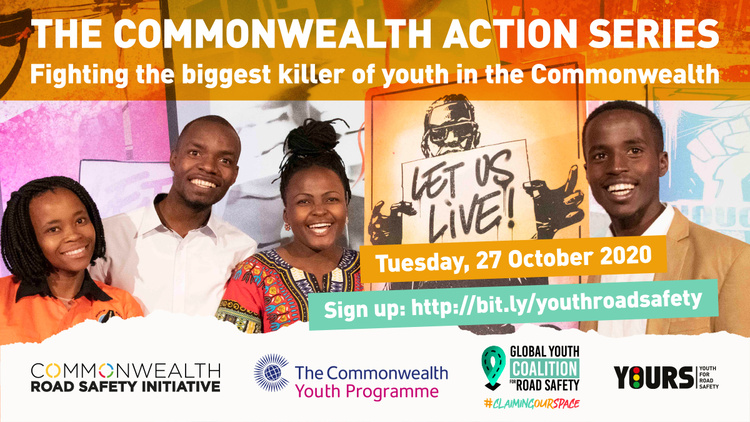
The first three episodes of the Commonwealth Action Series were held from July to September. Theme Four, Youth Development, will be launched this 27 October 2020. The session will talk about youth development in terms of Inclusive, Equitable, and Accessible Opportunities. 

Episode 4 will feature a sub-session that focuses on road crashes, highlighting it as the “biggest killer of youth in the Commonwealth”.

The session focuses on reasserting the potential of young people across the Commonwealth in shaping the future. Young people are responsible, capable, and energized in charting their future. Young people do not just aspire for a better world, they act and deliver tangible solutions.

The fourth episode of the Commonwealth Youth Action Series will feature members of the Global Youth Coalition for Road Safety. The youth panelists will dive into issues surrounding safer roads and sustainable mobility, highlighting the fact that more than a thousand young people lose their lives to the world’s roads on a daily basis.

The Commonwealth, with 60% of its population under the age of 30, faces the growing threat of a failing and unsustainable mobility system.

Join youth and road safety activists, through the Global Youth Coalition, in taking local and global action to fight road crashes as one of the global killers of youth. Register today! 


REGISTER HERE

Tackling road safety and sustainable mobility during International Risk Reduction Day

Tackling road safety and sustainable mobility during International Risk Reduction Day

International Risk Reduction Day is observed every year on the 13th of August. The day represents a global call to governments and organizations from all over the world to work toward a culture of risk-awareness and disaster reduction. Risk reduction is multi-sectoral; it links policies on land use, building codes, public health, education, environmental protection, and climate change adaptability. Road crashes are among the major risks for the health of the general population, especially among the youth, worldwide. 

Road Crashes as a Risk
Road crashes continue to injure and take the lives of people from all over the world. There are several risk factors, most of which can be based on the five pillars of road safety, that contribute to the severe effects of road crashes.

Improper road safety management, unsafe roads, unsafe vehicles, unsafe road users, and inadequate post-crash response could increase the risk of people getting injured, handicapped, or killed on the road.

matt chesin zi vwzbbwj8 unsplash

Improper road safety management means problems and setbacks in the strategy, targets, and funding in programs and projects for creating safer roads and more sustainable mobility. Leadership affects the push for road safety in local, regional, and global settings.

Unsafe infrastructure, unsafe vehicles, and unsafe road users are factors that everyone lives with and are exposed to every day. Roads that have deteriorated or have low systems can result in drivers losing control of their vehicles or of vehicles getting more worn and unsafe.

Post-crash care is also an important factor to consider when discussing the risk. Good post-crash responses would mean an improved ability of health through appropriate emergency treatment and long-term rehabilitation but a poor one could mean dying or living with a permanent disability.

Speeding is also important to consider in road crash risks. The National Safety Council, speeding reduces the amount of time the driver has to react to dangerous situations to avoid road crash. It records that speeding was a factor in 26% of all traffic fatalities, killing an average of 25 people per day.

Road crashes are the leading killer of young people aged 15-29 worldwide.

Reducing the Risk
International Day of Risk Reduction celebrates how people and communities around the world are reducing their exposure to disasters and raising awareness on the importance of reigning in the risks that they face.

Recently, the United Nations has released a resolution declaring the new Decade of Action for Road Safety. The document commends member states and organizations that have made significant efforts to promote road safety and provide sustainable mobility for the community.

pexels neosiam 618116The UN Road Safety Trust Fund is one of the global road safety initiatives used to help achieve SDG Target 3.6 – halving the number of road-related deaths and injuries by the year 2030 – and SDG Target 11.2 – provide access to safe, affordable, accessible, and sustainable transport systems for all, improving road safety, notably by expanding public transport, with special attention to the needs of those in vulnerable situations, women, children, persons with disabilities and older persons.

Head of UNECE, Olga Algayeriva explains that the Road Safety Trust Fund “will serve as a catalyst for much-needed progress towards the road safety targets of the Sustainable Development Goals”.

Another key initiative is Vision Zero, which is designed to eliminate traffic accident fatalities completely. The programs under Vision Zero are specific to preventing the death of vulnerable road users like pedestrians and cyclists while others are described as “more expansive”.

Multiple road safety initiatives have been created but there is still more work to be done.

YOURS and its Mission to Make the World’s Road for Youth
YOURS believes that youth play a vital role in the road safety revolution. The best way to reduce the risk of road crashes is to eliminate them completely by engaging and involving youth in global road safety development efforts.

Earlier this year, in July, the Global Youth Coalition for Road Safety was launched. The Coalition united individual youth and organizations and guides and prepares them to take action on road safety and safe mobility issues. The Coalition champions meaningful youth participation in road safety and beyond.

“We need a revolution for action on road safety. Surely we must look to young people to lead and energize this revolution.” Floor Lieshout

Research has shown that young people are “assets” in disaster and risk management. Young people aged 15 to 24 make up 1.2 billion of the world’s population, coming up to 16%. It only makes sense to involve such a huge part of the population in creating solutions for global issues, including road crashes.

Be part of the road safety movement!

JOIN THE COALITION