Last Friday, June 11, YOURS – Youth for Road Safety with iRAP – International Road Assessment Programme and the Global Youth Coalition for Road Safety held a celebration event for the passers of the Youth Stars Programme. A total of 21 members of the Coalition were able to pass the month-long programme and were certified to use the Star Rating for Schools (SR4S) methodology to rate roads in their local schools and universities.
The Youth Stars Programme In 2019, YOURS – Youth for Road Safety partnered with iRAP to create the Youth Stars Programme – a tool that equips young people to use the Star Rating for Schools Methodology as a road safety approach to ensure the safety of students on their way to schools.
The Youth Stars Programme supports the demands of young people listed in the Global Youth Statement for Road Safety, specifically the demand for “roads that do not kill our dreams”.
The programme began that same year where YOURS and iRAP, supported with sponsorship from FedEx, began training five young people from around the world known as Master Trainers with the skills to rate school zones through the SR4S methodology. These Master Trainers include Alex Ayub from Kenya, Daniel Cano from Colombia, Jacob Smith from the United States, Minh Vo from Vietnam, and Shantel Jacobs from Belize.
The second phase of the programme, which happened this year, focused on the Master Trainers working with other young people to train them on using the SR4S methodology and web tools, passing along tips to help them become youth stars.
Connecting with the Coalition For phase two of the youth stars programme, the Master Trainers trained members of the Global Youth Coalition for Road Safety in a month-long session that discussed the methodology by introducing the principles of the programme and the methodology, understanding the SR4S project structure, procedure of data gathering, and answering frequently asked questions related to the star rating programme.
The sessions were hosted by YOURS – Youth for Road Safety Communications Officer Manpreet Darroch and were led by Master Trainers Alex Ayub, Daniel Cano, Minh Vo, and Shantel Jacobs. Star Rating for School Global Project Coordinator Rafaela Machado and FedEx representative Shane O’Connor joined the Coalition members for the sessions to elaborate on the methodologies and goals of the programme.
The members of the Coalition participated in interactive sessions where they were able to ask the master trainers about everything related to the methodology. Each session ended with assignments that can help the members better experience the SR4S methodology and help practice its application.
The sessions ran every Monday for four weeks from March 15 to April 5.
Celebration event During the celebration event, Rafaela Machado from iRAP, Shane O’Connor from FedEx, and Floor Lieshout from YOURS – Youth for Road Safety congratulated the passers on the beginning of their journey to rate schools resulting in safer journeys for students around the world.
“You guys are like firemen and firewomen and the building is burning. We’re losing 500 children every day around the world. You guys have the fire extinguishers to run into the burning building and to put out the fire.” – Shane O’Connor
Sharing his congratulations, Floor Lieshout added that the youth stars is a great opportunity to create more leaders. “To the youth stars, that will be your role in the upcoming years – to create more leaders. Share your knowledge, share your skills, and create more leaders that believe in this system”
Passers also shared their experiences throughout the sessions and their learnings from interacting with the SR4S tools and methodology.
Mariam Kukava from Georgia said that the process of learning was interesting, especially the practical lessons of rating a school zone in her area to increase the quality of safety. “The training has convinced me that the Star Rating for School is the best evidence-based tool for measuring, managing, and communicating the risks children are exposed to on their journey to school.
The end of the Youth Stars Programme is not the final phase of the programme. For the third phase, the newly certified youth stars will engage and reach out to organizations to support them in their assessments as well as to create more youth leaders trained in the SR4S methodology.
“This is just the beginning of your journey and now, I expect you to see you engage local partners, local organizations, and local authorities, pushing for activities around schools.” – Rafaela Machado
Last Tuesday to Friday, June 1 to 4, independent and non-profit organization Movin’ On launched the Movin’ On Summit with the theme “from ambition to action”. The goal of the summit is to inspire, connect, and engage mobility stakeholders in collective action to create and implement concrete solutions for more mobility with less dangerous impacts on the environment, society, and community.
Movin’ On Summit The session was a “phygital experience” that featured both live and streamed content from 250 public and private organizations and 80 world-class speakers. The summit was held in Montreal, Paris, and Singapore and was streamed live through three formats; live television, satellites, and capsules.
The session featured a number of road safety leaders like Omar Abbosh, Oscar de Bok, JeanLaurent Bonnafé, Xavier Huillard, Ilham Kadri, Patrick Koller, Florent Menegauz, Luca de Meo, Rodolphe Saadé, and Julie Sweet.
The speakers and participants during the Summit talked about how to solve the “burning mobility issues” the global community faces. The ultimate goal is to preserve global resources, produce zero emissions, and achieve universal and multimodal mobility.
YOURS – Youth for Road Safety Executive Director, Floor Lieshout, also spoke during the summit to talk about ensuring road safety through policies and meaningful youth involvement.
“Put low-speed streets at the heart of our communities. We are calling for a paradigm shift.” – Floor Lieshout.
Youth Challenge Hackathon The summit featured three international challenges; the Movin’ On Startup Booster, the Movin’ On Challenge Design, and the Movin’ On Youth Challenge.
Global Youth Coalition regional leader, Sana’ Khasawneh, led the Youth Challenge Hackathon. The Youth Challenge highlights the importance of engaging young people in the thought process and leadership roles in efforts toward sustainable mobility and climate action.
“Movin’ On is committed to ensuring that we include young people in the conversation and the journey towards tackling some of the world’s biggest mobility issues as defined by the 2021 Summit’s five combats.”
During the summit, Sana’ and her team created a plan that presents the future of mobility. Their plans took into account different factors like government policies, financing, the social responsibilities of the private sector, mobility platforms for young people, and youth-led approaches and innovation programs.
They presented their ideas to the global jury who will assess the different proposals from the different youth groups.
“The spirit of the Movin’ On Summit is to address together issues and topics from different points of view and reach collective conclusions and actions!” – Florent Menegaux
Last August 2020, the United Nations adopted resolution 74/299 “Improving global road safety”, proclaiming the Decade of Action for Road Safety 2021-2030. The plan highlights how governments and member states can take action in order to achieve Sustainable Development Goal (SDG) Target 3.6 – halving the number of road-related deaths and injuries by the year 2030.
In the same resolution, the UN General Assembly requested WHO and the UN Regional Commissions, in cooperation with other partners in the UN Road Safety Collaboration and other stakeholders, to prepare a plan of action of the Second Decade as a guiding document to support the implementation of the Decade’s objective.
However, it has come to the Coalition’s attention that the plan does little to recognize Youth as stakeholders to fight their own #1 leading cause of death and to help shape their own future around sustainable mobility.
After carefully reviewing, it has come to the Coalition’s attention that the Plan does not recognize youth as stakeholders to fight their own leading cause of death and to help shape their own future around sustainable mobility.
By ignoring Youth as stakeholders, the Global Plan is also failing to consider best practices around meaningful youth engagement guidelines to member states, set by the UN and WHO, respectively through the UN Youth Strategy 2030 and WHO Global Accelerated Action for the Health of Adolescents (AA-HA!)
The Coalition, through the Youth Advisory Board, is demanding the developers of the Plan to recognize Youth as equal partners in developing and implementing the global plan and a driving force to help deliver the Global Goals, including its road safety targets.
In 2020, promises were made to young people during the 3rd Global Ministerial Conference on Road Safety in Sweden. We cannot afford to have the new Decade of Action for Road Safety without Youth. They have every right to be part of it.
As a result, the Coalition is demanding to have young people involved in the global plan by submitting a plan where young people are at the center of the Global Plan of Action.
We are very proud to share the Youth Submission for the new Decade of Action (DoA) for Road Safety which has gained support from all sectors and shows that many stakeholders are ready to work together with young people. This strengthens us in our call to amend the Plan.
Last Thursday, May 20, YOURS – Youth for Road Safety Head of Communications, Manpreet Darroch, joined the Jamaica National Road Safety Council webinar for the 6th UN Global Road Safety Week. The session tackled the importance of addressing road crashes in Jamaica. Dr. Lucien Jones, Vice Chairman of the National Road Safety Council, led the session.
Road safety and the Decade of Action
The session was opened by the Most Honorable Andrew Holness, ON, MP – the Prime Minister of Jamaica and the Chairman of the National Road Safety Council. During his opening remarks, PM Holness, showed support for the goals set in the new Decade of Action for Road Safety.
“In Jamaica, we will be playing our part to ensure the successful design and implementation of a holistic plan to make our roadways streets for life” – Most Honorable Andrew Holness, ON, MP
The session included speakers; Hon. Earl Jarett, OJ, CD, JP from the Jamaica National Group, Zoleka Mandela from Child Health Initiative, Dr. Parris Lyew-Ayee Jnr. from the Mona Geoinfomatics Institute, Dr. Etienne Krug from the World Health Organization, Saul Billingsley from the Federation Internationale de L’Automobile, Julio Urzua from iRAP – International Road Assessment Programme, Avi Silverman from the Federation Internationale de L’Automobile, and Manpreet Darroch from YOURS – Youth for Road Safety.
Each of the road safety leaders talked about how important low-speed streets are in the achievement of the new Decade of Action for Road Safety. Julio Urzua emphasized that, apart from achieving the goals in the new Decade of Action, addressing issues around road safety could also meet the targets in the Sustainable Development Goals.
Dr. Etienne also pointed out how important following up on statements is as important as sharing commitments. This task falls on all stakeholders.
“Be more vocal and bolder. We can’t continue having, even discussions like this, where we have high-level political leaders join us and state their commitment and do not see the results. We have to be more demanding, we have to be more pushy and make sure that these political statements lead to real action” – Dr. Etienne Krug
The role of youth During his discussion, Manpreet talked about how important young people are to advocate for low-speed streets and implement road safety projects and initiatives.
Manpreet talked about how YOURS and the Coalition have gathered young people from around the world who are extremely committed to making streets safer for their peers.
“Too many young have seen their peers being killed on the road and the tragic effects that it has on communities around the world. So we, as the young people, are stepping up and claiming our space” – Manpreet Darroch
Manpreet also emphasized that, apart from giving young people a voice, it is also important to provide them with support and opportunities to energize the global road safety movement so they can move forward and take the fight for road safety forward with them.
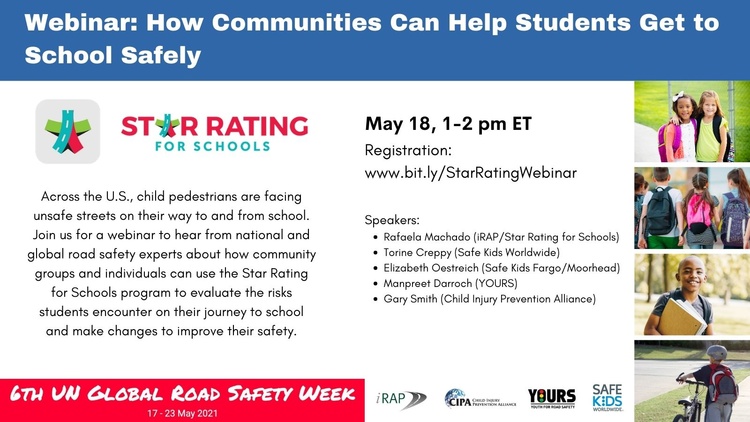
On May 18, the Child Injury Prevention Alliance (CIPA) led a webinar to talk about ensuring safer journeys for students around the world through a webinar entitled How Communities Can Help Students Get to School Safely. This is part of the global programs for the 6th UN Global Road Safety Week that focuses on advocating for 30 km/h (20 mp/h) streets through the Streets for Life campaign.
The session was moderated by Gary Smith from CIPA and featured road safety leaders from around the world. The webinar’s panel included Rafaela Machado from iRAP – International Road Assessment Programme, Torine Creppy from Safe Kids Worldwide, Elizabeth Oestreich from Safe Kids Fargo, and Manpreet Darroch from YOURS – Youth for Road Safety.
The session began with Rafaela Machado, Star Rating for Schools Global Programme Coordinator of iRAP. She talked about how iRAP, through the Star rating for Schools (SR4S) Methodology, is working toward a world free of high-risk roads. iRAP assesses roads through the SR4S methodology and provides evidence-based data that will lobby for three-star roads or higher.
Building on the importance of keeping children and students safe, the President of Safe Kids Worldwide – Torine Creppy – talked about Safe Kids’ mission to keep all kids safe from preventable injuries such as road crashes. To achieve this mission, Torine elaborated on the networks, members, and teams behind Safe Kids that range from nurses, doctors, firefighters, paramedics, and more.
“As part of the Safe Kids Walk This Way program, the Safe School Zone grant program was created by Safe Kids Worldwide and FedEx to focus on improving child pedestrian safety in school zones.” – Torine Creppy
Elizabeth Oestreich from Safe Kids Fargo provided a deeper insight on how Safe Kids utilizes the Star Rating for Schools Methodology to help make positive changes in school zones and other elements of urban design and development. During her discussion, Elizabeth shared how Safe Kids assessed elementary schools around Fargo to make them safer for the students.
Offering a youth perspective, Manpreet Darroch from YOURS – Youth for Road Safety talked about how YOURS, through the Global Youth Coalition for Road Safety is using the SR4S methodology to empower young people to take action in their communities.
Manpreet talked about the importance of including young people in road safety efforts in the community in all stages, elaborating through the three-lens model that empowers young people and equips them to engage with governments, communities, and other partners.
Across the world, child pedestrians are facing unsafe streets on their way to and from school. The webinar focused on how powerful the SR4S methodology is to help improve journeys to school and to make changes to improve their safety.
About the Child Injury Prevention Alliance The Child Injury Prevention Alliance (CIPA) is dedicated to the prevention of injuries to children and adolescents in the United States and around the world. CIPA achieves its goal through scientific research, translating research findings into programs and policies, providing leadership in injury prevention initiatives and advocacy, and fostering national and global collaboration in injury research and prevention.
As an organization with a global focus, individuals from around the world serve on CIPA’s board of directors and advisory board. Information about these individuals can be found on our Leadership page.
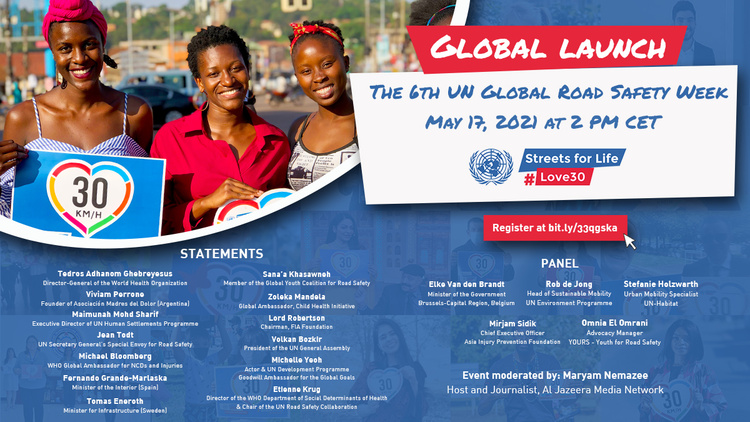
Last Monday, May 17, the 6th UN Global Road Safety Week was launched on behalf of the UN Road Safety Collaboration. The theme for this year’s UNGRSW is Streets for Life and it raises awareness on the importance of 30 km/h streets. The global launch gathered global road safety leaders and representatives to talk about why low-speed streets are important in road safety and urban design.
Last Monday, May 17, the 6th UN Global Road Safety Week was launched on behalf of the UN Road Safety Collaboration. The theme for this year’s UNGRSW is Streets for Life and it raises awareness on the importance of 30 km/h streets. The global launch gathered global road safety leaders and representatives to talk about why low-speed streets are important in road safety and urban design.
Sana’a joined leaders like Tedros Adhanom Ghebreyesus – Director-General of the World Health Organization, Maimuna Mohd Sharif – Executive Director of the UN Human Rights Settlements Programme, Jean Todt – the UN Secretary General’s Envoy for Road Safety, Michael Bloomberg – the WHO Global Ambassador for NCDs and Injuries, and more.
She spoke about why low-speed streets are important for young people as well as the efforts the Coalition is doing to make sure that road safety is prioritized in the global agenda.
“We are claiming our space and joining Streets for Life campaign to demand lowering speed limits to 30 km/h. We want streets that are safe and dynamic for living. We, the youth, are part of the solution” – Sana’a Khsawneh
Omnia joined a panel that also had leaders like Eike Van den Brandt – Minister of the Government in Brussels, Rob de Jong – Head of Sustainable Mobility from the UN Environment Programme, Stefanie Holzwarth – Urban Mobility Specialist from UN-Habitat, and Mirjam Sidik – Asia Injury Prevention Foundation.
During the panel, Omnia raised awareness on why road safety and the topic of low-speed streets are important for young people. She talked about how young people are often “under-represented” despite being the most affected when it comes to road crashes.
We need the re-orientation of the decision-making table by prime ministers to provide a sustainable mechanism, not only for youth participation but also the emergence and implementation of youth-led solutions.” – Omnia el Omrani
The 6th UN Global Road Safety Week runs from May 17 until May 23. You can still get involved by joining the Coalition activities and other global events.