New European road safety report gives focus on youth road deaths

New European road safety report gives focus on youth road deaths

Yesterday, the Road Safety Performance Index (PIN) part of the European Transport Safety Council (ETSC) published their 6th report. The publication entitled ‘A Challenging Start towards the EU 2020 Road Safety Target’ places a focus on three areas of road safety; the progress of countries in road safety across the EU27, recommendations for national road safety changes and the road safety problem facing young people.

This 6th PIN Report provides an overview of European countries’ performance in three areas of road safety. It builds on the five previous Road Safety PIN Reports published in June 2007, 2008, 2009, 2010 and 2011. The report compares developments in the numbers of road deaths, during the first year of the 2020 EU road safety target, and estimates the cost benefit to society. It also sets these one-year developments in the context of the reduction in road deaths observed since 2001, the starting point of the first EU road safety target.

The new reports places youth and road safety issues high on the agenda in Europe. Its three main areas of focus are:

  • Mixed results in the first year of the 2020 target – reduction in deaths slows down
  • Institutional Setups Fit to deliver Road Safety (Road Safety Management)
  • Reducing road deaths among young people aged 15 to 30

For us, the report’s focus on young people offers organizations working for youth and road safety issues up-to-date and cutting edge data on the latest road safety situation relating to young people across Europe. The report also offers clear recommendations on improving road safety for young people across Europe through the road safety managment approach, that is, addressing all areas of road safety – awareness, education, infrastructure, appropriate laws, enforcement and policy.

Key findings from the PIN Report

Around 140,000 young people aged 15 to 30 were killed in road collisions in the EU27 over the past ten years. In 2010, 9,150 young people aged 15 to 30 were killed in road collisions, compared with 18,670 in 2001. Deaths among this age group decreased by 44% between 2001 and 2010, compared with 36% reduction in total deaths over the same period. Young people aged 15 to 30 represent 20% of the total EU population but 30% of all road deaths and this share has been reduced only slightly since 2001.

Young people, especially males, continue to have the highest number of road deaths per million population of any age group  Males account for 81% of all young people aged15 to 30 killed on the roads in the EU. 

View the PIN Report in the attachments

Young people continue to experience particularly high risk on the roads, especially young males. On average, the road mortality rate is 69% higher for young people than the corresponding risk for the rest of the population (Fig. 16). For young males, mortality is 168% higher than for the rest of the population. Approximately one in four young people who dies in the EU does so as the result of a road collision, about twice as many as die from suicide.

Collisions involving a young driver or rider account for 37% of total road traffic deaths. For each young driver killed there are 1.2 passengers or other road users killed in the same collisions. Young drivers, especially males, are not just a danger to themselves; they also pose a greater risk to their passengers and other road users than other drivers do.

While young people must gain experience in order to use the roads safely, the process of gaining that experience exposes them and others to high risk. Governments and road safety actors must find the right balance between the need to tackle the overrepresentation of young people in road collisions and encouraging young people’s access to experience and mobility.

Member States must make the fight against road deaths among young people a priority if they want to achieve the EU 2020 road safety target and their national targets. The share of young people’s deaths among total deaths will increase as road safety of the rest of the population increases unless young people’s safety is similarly improved.

The country comparison shows that the differences between countries are large. Curbing deaths among young people therefore requires general road safety measures, coupled with specific measures, for example targeting young drivers and powered two-wheeler riders, in particular males, in countries where reductions in young people’s deaths on the road are lower than the EU average reduction. 

Over the coming weeks, YOURS will focus on the areas of recommendation and study in the PIN report in separate news story spotlights. Some of these topics include:

  • The safety of young people compared to the rest of the population.
  • Safety is a greater challenge for young males than for young females
  • Enforcement, in particular against the three main killers.
  • Safer infrastructure and safer vehicles 58
  • Licensing
  • Technologies to support enforcement
  • Training and education

You can read more about PIN here. You can download the full report in the attachments.

Enjoying the football? Don’t let drink driving ruin the fun

Enjoying the football? Don’t let drink driving ruin the fun

Often referred as the ‘beautiful game’, football is truly on the radar around the world as people young and old sit back and enjoy the Euro 2012 football tournament. Whether you’re from Europe or not, scores of young people around the world are gripped by the tournament. This footballing extravaganza gives friends and families the chance to get together in their local pubs, clubs and venues to enjoy the moment with some drinks, but beware, drink driving is always a danger!

Drinking and football have become an integral affair but we should still stick to sober driving.

It is no secret that Europeans are passionate football supporters and when a national team is playing, a country is gripped by footballing mania with young people colouring themselves in their national football-kit colours. It is also no secret that Europe, just like many other continents, couple football with alcohol. Unfortunately, during these times, football and alcohol often leads to alcohol and driving. This occurrence has been the motivation behind recent road safety campaigns that coincide with the Euro 2012 to warn drivers of the dangers of drink driving. 

In the UK,  organizations have stepped up their road safety awareness of drink driving during the football sporting periods. The police also increase their patrols of drink drivers.

On page 16-17 of our Youth and Road Safety Action Kit, we place an important focus on one of the key risk factor leading to many road crashes; alcohol:

Even a small quantity of alcohol can have the following effects:

  • Poor coordination: trouble doing more than one thing at a time, difficulty steering the car.
  • Longer reaction time: reacting more slowly when something unexpected happens (a car approaching you from the side, people crossing the street).
  • Poor judgment: trouble judging your and other people’s behaviour (including speed, distances, movement) and estimating risks.
  • Reduction in concentration, memory, vision and hearing: focusing only on the road ahead, losing track of what is taking place in your peripheral vision area, missing out on things you see and hear.
  • False sense of confidence and overestimation of abilities: feeling more confident and taking risks that you would not usually take.


This combination of reduced ability and more risk taking is a dangerous mix!

Why does alcohol have this effect?
Alcohol is a nervous system depressant or a ‘downer’. It has a numbing effect on the brain making it slower and less able to concentrate.

How much can I drink?
To stay safe do not drink at all when you will be driving. Research shows that a single drink increases the risk of death or serious injury by five times12. You do not have to be drunk for alcohol to affect your driving. Your driving abilities will be reduced even if you feel perfectly normal. If you are awake and can hold a conversation with your friends it does not mean that you can drive safely.

What can help reduce the concentration of alcohol in my blood?
The only remedy to alcohol is time, allowing your body to break down the alcohol. The liver breaks down alcohol at a rate of approximately one standard drink per hour. A standard drink is a drink which contains about 10 grams of alcohol. Restaurants usually serve alcohol in standard drink size glasses. Wine, however, is normally sold in 140 ml or 200 ml glasses. One 200 ml glass of wine contains approximately two standard drinks. Glasses used at home are likely to be bigger than the standard drink size. The labels on alcoholic drink bottles and cans sometimes show the number of standard drinks they contain.

Exercising, drinking coffee, taking cold showers, vomiting, fresh air, and other things can make you feel more alert but will not reduce your blood alcohol concentration.

Can I drink and drive as long as my breath doesn’t smell of alcohol?
No. Alcohol is actually odourless. It has no smell. What you think is the smell of alcohol is the odour of things that are added to alcoholic beverages. So if your breath doesn’t smell of alcohol it does not mean you have no alcohol in your body and that you are safe.

Enjoy the Euros but stay sober when driving, for everyone’s sake.

We understand that alcohol is often intertwined with football but as young people, we must advocate zero alcohol and driving because the truth is; alcohol and driving just do not mix! Drink driving crashes destroy lives and while we do not want to dampen the footballing spirit, it is crucial that as young people, we stick to this simple message to enjoy the contest spirit without unnecessary road injuries and fatalities. 

  • If you drive to an event and drink, take a taxi home, you can always pick up your car when you have fully recovered (is it worth the risk? The answer will always be no). Be aware that in most places, the police will be on patrol because of the higher risk of drink drivers, not only do you risk legal penalties but also risk a crash that could kill you or others.
  • If you are going out with friends, choose a designated driver who won’t drink at all and will drive you home at the end.
  • You could even watch the match at home so you don’t have to travel in a car at all.


After all, why would you let good times go bad with drink driving? Keep safe and enjoy the football (if you are that way inclined!).

Let’s follow the example of those footballers who support road safety and keep safe on the road:

A wake up call for Europe – reducing road deaths slowed in 2011

A wake up call for Europe – reducing road deaths slowed in 2011

The European Commission has issued a press release that calls for immediate action on the amount of road deaths in Europe in 2011. Last year, across Europe the amount of lives saved on slowed to 2% compared with a promosing EU-wide reduction of road deaths throughout the last ten years which was around 6% reduction of road deaths on average. What does this mean for young people?

Progress in cutting road fatalities significantly slowed last year (to -2%) compared with a very promising EU-wide reduction throughout the last decade (on average -6%), according to new figures published today by the European Commission. Worse still, some EU Member States, like Germany and Sweden, who have very strong safety records, now show a significant increase in deaths. In other Member States, like Poland and Belgium – already lagging behind in road safety – the number of deaths went up. The problem of motorcycles – where fatalities have still not fallen after more than a decade – still persists.

Vice-President Siim Kallas, with responsibility for transport, said“These figures are a wake-up call.

Vice-President Siim Kallas, with responsibility for transport, said“These figures are a wake-up call. This is the slowest decrease in road deaths in a decade. 85 people still die on Europe’s roads every day. This is unacceptable. We will need to sharply intensify efforts at EU and national level to reach our goal of cutting road fatalities in half again by 2020. I am writing to ministers in all Member States to ask for information about national road safety enforcement plans for 2012. I want to be reassured that even in tough economic times this important work, which is so central to road safety, is not being scaled back. At EU level, I intend also to target specifically fatalities on motorcycles in 2012, we need to see the current trend reversed and these deaths start to fall.”

The table – “road fatalities per country” – shows progress since 2001, with EU-wide figures and a breakdown per country. It includes the most recent figures for 2011. Over the last decade, under the Road Safety Action Plan 2001-2011, major progress has been achieved. Road fatalities were cut by almost 45% and more than 125,000 lives were saved. EU road deaths decreased by on average 6% each year. And in some years the decrease has been as much as 11% (2010).

EU road safety action plan 2011-2020
In July 2010 the Commission adopted challenging plans to reduce the number of deaths on Europe’s roads by half in the next 10 years. Initiatives proposed in the “European Road Safety Policy Orientations 2011-2020” range from setting higher standards for vehicle safety, to improving the training of road users, and increasing the enforcement of road rules. The Commission is working closely with Member States to implement this programme. The road safety action plan sets out a mix of initiatives focussing on making improvements to vehicles, infrastructure and road users’ behaviour.

There are seven strategic objectives:

  • Improved safety measures for trucks and cars
  • Building safer roads
  • Developing intelligent vehicles
  • Strengthening licensing and training
  • Better enforcement
  • Targeting injuries
  • A new focus on motorcyclists.

Detailed measures for each strategic objective are listed in MEMO/10/343. See also: MEMO/11/483

What happens next?
The work to implement the EU’s Road Safety Action Plan 2011-2020 will intensify. In addition, Vice-President Kallas announced his intention to intensify efforts relating to national enforcement and to vulnerable road users using motorcycles.

What does this mean for young people?
As we know, road traffic crashes are the biggest killer of young people across the world and it is no different in Europe. The slowing of the reduction of road crashes mean more young people are dying on Europe’s roads. The positive news is that we as young people, united in Europe are doing something about this. As is the motivation behind the European Youth Forum for Road Safety and the relentless actions of youth and road safety organizations around Europe.

Additionally, this report places an important focus on next month’s Fourth European Road Safety Day which has a special focus on Young People’s Involvement in Road Safety. The youth network for road safety in Europe is dedicated to changing the statistics in the European Commission’s warning and we continue to do our part to engage our peers in road safety and work to reduce deaths amongst young people on Europe’s roads.

Spotlight On: Slovenian Traffic Safety Agency – the road traffic system

Spotlight On: Slovenian Traffic Safety Agency – the road traffic system

As part of the benefits from learning from one another’s road safety projects via the YOURS global youth network for road safety, we like to periodically feature members of our network in a special Spotlight Feature. This time, we put the spotlight on the Slovenian Traffic Agency who work on all levels of road safety illustrating a road traffic system in action. We thought this spotlight would put this concept into a visible example.

Slovenian Traffic Safety Agency (AVP) is a legal organization of public law in the field of road safety established on 1st September 2010. The agency performs regulatory, developmental, technical and other tasks regarding drivers and vehicles, analytical and research work in the field of road safety, prevention, education and training. It also performs independent investigation of the factors and causes of traffic fatalities and provides expert work for preparation and implementation of national program on traffic safety.

The agency assess, within its jurisdiction, road infrastructure safety, provides education and raises public awareness about new technical standards, solutions and other measures which contribute to a greater safety of all road users. Regarding these areas, the agency is involved in bilateral relations and various international organizations.

The Haddon Matrix

On page 12 of the Youth and Road Safety Action Kit we focus on the Haddon Matrix, which covers the above elements of road safety in a ‘Pre-Crash, Crash and Post-Crash’ phase. The Matrix is a basic way to understand the factors that contribute to the number and outcome of road traffic crashes and we can use it to think how fatalities and injuries can be reduced.

The Slovenian Traffic Safety Agency approaches this system with a clear focus on the first two areas of the Matrix while the post-crash area is addressed via emergency service agencies.

Its Mission:
Slovenian Traffic Safety Agency is the central institution for traffic safety. Its mission is to reduce the worst consequences of crashes (fatalities and injuries). Its mission and goals will be achieved by the effective implementation of legislative measures, by the national program and other acts and by encouraging road users to a more responsible behavior, respect for rules and awareness about the road safety importance, the provision of safer vehicles and road infrastructure.

Alongside its meticulous research and road safety investigative operations, the Agency also run preventative campaigns targeting young people and drivers across the age spectrum as well as the PSA featured in the right column!

The Surreal Poster Series: Key Risk Factors – Part Five: Visibility

The Surreal Poster Series: Key Risk Factors – Part Five: Visibility

The Surreal Poster Series series has been a program that was highly subscribed to. Delegates are able to download the poster series for free, featuring five posters focusing on the five key risk factors in road safety. Now, YOURS is featuring a focus on each poster explaining the risk factor behind each theme. This week, we focus on visibility….

It is unlikely that we can prevent road crashes if we cannot see the road ahead and what is on it. This might be so very basic and even simplistic but in fact visibility can be a challenge in many countries with insufficient road lighting and vehicles with malfunctioning lights.

So, if you are a pedestrian, make sure you:

  • Wear white or light colors so you are more visible

  • Wear retro-reflective strips on your clothes, backpack, or anything your are carrying

  • Walk only where there is good lighting;

And walk facing oncoming traffic.And if you are on bicycle do not forget to use:

  • Front, rear and wheel reflectors;
  • Bicycle lamps;
  • And retro-reflective jackets or vests, if possible.

Be seen on the road: Download the Surreal Poster Series

An interview with lead author of the Youth and Road Safety Action Kit

An interview with lead author of the Youth and Road Safety Action Kit

On April 16th 2012, YOURS officially launched the Youth and Road Safety Action Kit. Since then, there has been unprecedented interest in our work and the background of the kit. We are incredibly proud of the finished project which kick starts our capacity development program across the world. In this article, we take a few moments to catch up with Ms Nellie Ghusayni, lead author of the kit and her journey in writing it, seeing it mapped in creative design to the finished product!

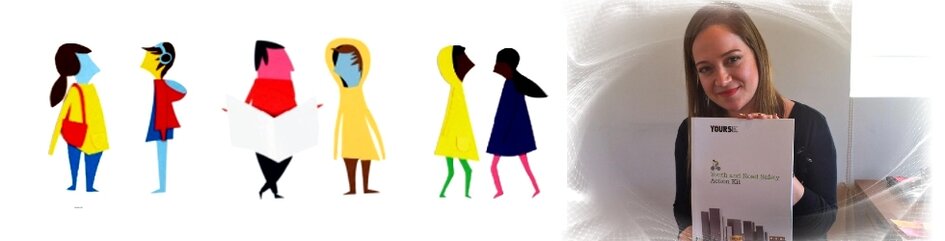
Lead author of the Kit, Ms Nellie Ghusayni takes a picture holding the kit that she authored.

On April 16, 2012, YOURS launched its first-ever road safety toolkit.  Targeting young people all over the world. The kit aims to introduce road safety in a concise, yet clear and appealing way. In order to know more about that kit, we interviewed our Programs Officer, Ms Nellie Ghusayni, who is the leader author of the Youth and Road Safety Action Kit! You can also read behind the scenes of the design process in an interview YOURS ran with lead designer at Airspace Studio Mr Mark Woodwood.

Q: Why did you decide to write the kit?

The Centers for Disease Control and Prevention approached us offering a small grant to develop a document for young people through the capacity development programme they have with the International Union for Health Promotion and Education. It started out as a 10-15 pages simple document with basic information that will benefit young people. There is a lot of information on road safety available but it is not very accessible to youth, the language is not youth “friendly” and the content can be too technical, and not all young people can access the internet to find what they want.

Q: Why and how is this kit unique?

I think the Kit is unique for three reasons. The first is its content. The content is what we believe, through our consultation with youth from different parts of the world, young people need to know about road safety and creating their own projects. It’s the bottom line, the essentials, the basics.

The second reason is the writing style used. As you know, road safety is not a very exciting or entertaining topic for young people. Information on road safety can be very dry and “unfriendly” to young people. We worked with Kate Brown, an experienced editor for youth publications to make the writing as friendly as we can without it being too informal or even patronizing. We tried to use humor, sarcasm, every day words to make reading the Kit more enjoyable.

The final reason is the design and layout. The Kit had to be different. It had to be attractive. It had to stand out. It had to look and feel like a document young people might want to pick up. AirSpace Studio came up with the concept of designing 3D models so everything that you see in the Kit was actually built and then photographed. I think Mark told you more about the design in your interview with him.

Q: How did you go about researching the topics?

The first thing we did when we decided to write the document is get in touch with our youth network with questions on what they would like to know more about, what would benefit other youth in their country- even those not currently involved in road safety, what can help get more youth active and things like that.

We had a group of youth from all regions putting their ideas and thoughts forward. After this brainstorm that gave enough ideas for many publications, we focused on the purpose of the document. Why are we writing it? What are the main things we want to achieve? Then we went back and created an initial list of topics that will be addressed. with time more topics were added and others were removed, all with consultation with members of the youth network and experts.

You can imagine there was a lot of back and forth and changes before we settled on what we have now. Our main references were the World report on road traffic injury prevention, the series of good practice manuals produced by the UN Road Safety Collaboration and other key documents all cited in the Kit.

Q: What was the most enjoyable part of the authoring and creation?

Definitely the design process. Until Mark started showing us what it would actually look like it was just a very long Word document for me, a document I have been working on for months and can hardly look at anymore. The design process made it come to life. It made me believe that eventually the document will actually be published.

Turning the document of the Kit into a real life designed piece ready for the publication really brought the whole process of authoring a publication to life.

Q: What was the most challenging part to writing this publication?

It is very difficult to think of the most challenging part, there are many! As I mentioned we started with a 10-15 pages document that we thought we can finish in a couple of months. I have not written anything like this before so I had no idea of what was coming. The main challenges were in deciding what information to include and what to exclude.

There is a lot of knowledge, we need to learn a lot, and the needs of youth even in the same country vary. Integrating the feedback of experts and youth when they reviewed Kit was also difficult. As you know, the Kit was reviewed by young people from many countries and from experts and we wanted to integrate as much of their thoughts and suggestions to make the document as useful as possible. Perhaps most challenging of all was deciding to stop making changes and edits.

Q: How was the experience of turning your writing into a designed piece?

This is the best part by far. The design process is incredibly exciting, especially when you are working with a very creative team. I couldn’t wait to see the first concepts Mark created, the pagination, the typography, imagery, everything. and after every presentation I would get even more excited. It is amazing to see how text can be transformed and how much a good design can bring to an otherwise lifeless document.

Q: How do you feel about the end result?

I am thrilled with the end result- although part of me still does not believe that it has been published. In a way what we have now is even better than what we had imagined. YOURS is a very young organization, officially we are 2 years old, and this is our very first attempt at producing a road safety publication.

Q: Any final comments?

The Youth and Road Safety Action Kit is only a tool- a tool to provide youth with information on road safety and help them get involved. Its success, and our success, is its use. If young people do not pick it up and read it and if some of them do not decide to take action then we did not really do much. So we have to get the document to the youth, in their languages, in their countries and communities, and we have to show them how they can use it.

Finally, I would like to thank all the people who supported the development of the Kit whether by financial contribution, technical assistance, expert reviews, personal advice, or listening to me talk about it. The list is very long so I will not mention names but a heartfelt “thank you” goes out to everyone who has contributed in any way. You know who you are. Thank you!

Q: Where do we find the action kit and how should it be used?

The YOURS action kit is available online for free download here and can also be used as a training tool. We already trained trainers in Oman for example last month, before it was actually printed, and it was a great success.

You can also read an interview run by GRSP with Nellie Ghusayni about the Kit!