Brian’s Column: A road safety experience in South Africa

Brian’s Column: A road safety experience in South Africa

Brian recently took it upon himself to put youth and road safety on the agenda at the 2nd Southern Africa Conference on Road Safety which took place on the 23rd-24th October 2012. During his journey in South Africa, Brian reflected on the many messages picked up from various organizations, initiatives and delegates at the event and beyond. This poignant account illustrates the power of youth in making a difference in road safety. Check it out now!

Hoooooray! It’s been long since we last communicated, really long indeed. I know lots of stuff has been happening regarding road safety in Africa. Much love and respects to the Francophone colleagues who kick started the ‘Youth Caravane’ and the Africa Youth Declaration on Road Safety. You can read (if you haven’t) more information about these awesome road safety initiatives here. Big shout outs there!

Back to me, Africa decision makers, public, and private organizations seem to have found their glasses and realized that they need to put young people in the driving seat of road safety programmes, they have realized that this is the way to go! In this release, I share my experience following a not-for-tourism trip to South Africa.

Ok, here we go…so, I was accepted by the government of South Africa through the South African Road Safety Federation (SARF) to attend and present my paper on ‘Prehospital Emergency Care-Why young people are a magic pill’ at the 2nd Southern Africa Conference on Road Safety (23rd-24th October 2012) that was held in the handsome (sorry girls) city of Johannesburg-Birchwood Conference Centre to be precise. There, I give you yet another way of finding your way into must-to-attend conferences! lol

Opening ceremony of the conference and Brian with Ryan Duly who presented the good practices of  GRSP of the RS10 project.

In my presentation, I highlighted the need for empowering young leaders with ‘pre-hospital skill care’ in a developing continent where response time is above 10 minutes. Young people are heavily hit by road crashes (note that it’s no longer called road accidents) and to build a generation of young road safety advocates- YOURS was born (2007) and so did the African Youth Network on Road Safety formed (2011)

This conference reflected a sheer touch of representation, effective participation and passion southern African countries have with regards to all the pillars of road safety as stated in the UN Decade of action. Speaking at the opening of the conference, the acting CEO of Road Traffic Management Corporation (who represented the Minister of Transport) Collins Letsoalo offered a rather cautious comment to delegates stating ‘…if you have come here like some sort of vacation, break from office, then you should go back home before we start’, a statement that eased the mood in the conference room.

To me, it showed how committed and important this conference was. He continued, “Southern Africans are not doing the simplest of things, like wearing a seatbelt and they don’t see it as a problem. It has been proven that if we can increase our seatbelt wearing rate to double what we have now, we would have a 30 percent reduction in road fatalities,” While presenting to conference delegates South Africa’s strategy to reduce road fatalities by 20 percent a year, Mr. Letsoalo said in November, the strategy will be released for public comment. He also said other countries had done the simplest of things to reduce road crashes and that was to give focus to drunk driving and seatbelt usage. Speeding, drunk driving, and failure to wear seatbelts and helmets remained a critical challenge for South African authorities.

Collins Letsoalo, the acting CEO of Road Traffic Management Corporationsaid South Africa was losing between 280 and 350 people to road crashes every week. About 40 percent of those killed were pedestrians. At present, 14 000 people a year died on South Africa’s roads, with accidents reportedly costing the economy R307 billion a year.

The issue of road safety could no longer be left to government authorities alone. “We have reached that stage now where we are calling on society to work with us; it can’t be a government thing. People need to understand that if they behave this way and continue to do so, they are likely to lose their lives.” Communities, Letsoalo said, needed to understand that “today it can be me and you and tomorrow it will be somebody else.” 

Brian at previous conferences.

I compare this conference against a number of conferences that have been characterized by trademark hell of presentations from ‘technocrats’ and less discussions from the ‘community’. This was a different one! The South African Road Safety Federation struggled so hard to ensure that they fixed me (a youth representative from outside South Africa) to present at this conference. There were also young people from different disciplines of Engineering, Communications, Business and Management from a number of NGOs, Universities and Research Institutions. When I interacted with them, they told me that they had been enabled to be at this conference thanks to their respective organizations. One told me ‘We asked our CEO why we wouldn’t be at the conference, and the CEO asked us why we didn’t want to go…he paid the registration fee and we couldn’t wait to be here’.

Now, that’s liver-touching! Its hardcore dedication! Its passion. Finally, we are coming to see a generation public private partners coming out and ready to support organized groups of young people! There were insightful separate discussions which gave birth to new ideas, best practices especially in behavioral road safety. One big lesson learnt was the need for implementing bodies to ensure ‘Smarter communications’ between themselves, the beneficiaries and the government to avoid duplication of work and effective planning.

The AGM of GRSP and Brian with young delegates at the road safety conference.

I compare this conference against a number of conferences that have been characterized by trademark hell of presentations from ‘technocrats’ and less discussions from the ‘community’. This was a different one! The South African Road Safety Federation struggled so hard to ensure that they fixed me (a youth representative from outside South Africa) to present at this conference. There were also young people from different disciplines of Engineering, Communications, Business and Management from a number of NGOs, Universities and Research Institutions. When I interacted with them, they told me that they had been enabled to be at this conference thanks to their respective organizations. One told me ‘We asked our CEO why we wouldn’t be at the conference, and the CEO asked us why we didn’t want to go…he paid the registration fee and we couldn’t wait to be here’.

Now, that’s liver-touching! Its hardcore dedication! Its passion. Finally, we are coming to see a generation public private partners coming out and ready to support organized groups of young people! There were insightful separate discussions which gave birth to new ideas, best practices especially in behavioral road safety. One big lesson learnt was the need for implementing bodies to ensure ‘Smarter communications’ between themselves, the beneficiaries and the government to avoid duplication of work and effective planning.

Brian’s experience with the drama group in South Africa delivering road safety messages with young people through creative means.

At this event, you could see that corporate organizations can do even more because they are most trusted by the community and road users. I had a chance to share my experience of ‘almost’ loosing my father to a road traffic crash as an 11 year old first born, at a crucial time when I was doing my final examinations for primary education, the economic implications of what it would have meant to my family. I was greatly impressed with the talent of using drama to influence behavior of road users and there is no doubt that young people love it! I saw that, road safety rap would be more ideal for the ‘modern trendy young person’.

Like the CEO of Bakwena said, ‘Young people are our past, our present and our future. They are however the most hit bracket when it comes to road traffic crashes. It remains only ethical for us as NGOs, government, decision makers and cooperate bodies to make a contribution in saving our children. Road traffic crashes don’t segregate, today it’s your son, tomorrow it’s my daughter!’ Now, that’s one clear message. Isn’t it? Oh, wait…did I say that, I also had a chance to visit a cultural museum, seeing around, but that’s another story haha!

Till next time…Stay Safe!

Behaviour change essential for road safety in Kenya – an opinion piece

Behaviour change essential for road safety in Kenya – an opinion piece

YOURS has its major project in Kenya coming shortly and as we fast approach our capacity development workshop, which will be run in Nairobi in late November, the stories of Kenyan road safety initatives are on our radar. In an opinion piece by Daily Nation’s Bob Collymore, a focus on road safety on Kenya’s roads is featured here.

More than 3,000 people die every year in traffic crashes on Kenyan roads. That number could double by 2020 if nothing is done now to stop the carnage.The majority of road crashes on our roads are preventable. Poor road safety culture and failure to strictly enforce traffic rules are chiefly to blame for the high accident casualty rate.

Statistics indicate that Kenya has some of the highest road crash fatality rates globally. In 2009, for instance, Kenya recorded 10 deaths in road accidents for every 100,000 people, with 3,760 Kenyans perishing on our roads that year. Compare this to 3.2 deaths for every 100,000 people in Nigeria and Rwanda the same year.

Our biggest contribution to our Embrace Life Campaign last year was seen from Kenya. We include their messages in this news story.

Kenya recorded fewer deaths than Botswana and Thailand, which recorded 25 deaths per 100,000, Brazil (18.3) and US (13.9). But it was still ranked among countries with the most dangerous roads.The International Federation of Red Cross and Red Crescent Societies estimates that more than 1.3 million people die in road crashes each year and more than 50 million injured. Globally, 3,500 people die in road crashes every day. The total cost of is $500 billion annually. (Sh40 trillion)

World Health Organisation figures reveal that 90 per cent of the road fatalities occur in low- and middle-income countries, home to less than half of the world’s registered vehicles. The number of road fatalities is set to double by 2020 globally. Road  crashes kill more people than tuberculosis and malaria in developing nations. They are the leading cause of death among young people aged 15-29, killing more youths than HIV/Aids in developing countries like Kenya.

WHO has singled out road accidents as a major public health problem in developing nations. Essentially, this means that the fatalities are no longer regarded as mere government statistics, but a serious public health and development challenge requiring urgent concerted global action.

A majority of the accidents involve matatus and now, increasingly, motor cycles popularly known as ‘boda bodas’. Incidentally, many Kenyan hospitals have now reserved special wards dedicated to patients nursing injuries from accidents involving ‘boda bodas’.

The fact is, many Kenyans rely on matatus and boda bodas to commute, hence the need for more energy and resources to be focused on enhancing safety in the public road transport system. 

In May last year, the Decade of Action for Road Safety 2011-2020 was launched in more than 100 countries under the auspices of the United Nations. The ultimate goal of this campaign is to cut road traffic deaths globally by 50 per cent by 2020.The Action Plan requires governments to implement road safety activities in each of the five pillars of the Global Plan for the Decade: road safety management; safer roads and mobility; safer vehicles; safer road users; and enhanced post-crash response.

It also calls for closer collaboration among governments, civil society organisations, academia, and the private sector in dealing with the road safety crisis.In Kenya’s case, we could go a few steps further by seeking to change our road culture. Improving road safety has to start with the individual. Attitudinal shifts are required to instil in Kenyans a culture of safe road usage.

It entails observing speed limits, proper vehicle maintenance, and respecting other road-users including cyclists and pedestrians.Leading the way, several private sector players have partnered with the government to launch a nationwide campaign on road safety. They have formed the National Road Safety Trust to spearhead countrywide initiatives with a view to reducing the alarmingly high rates of fatalities in Kenya.

At a stakeholders workshop held recently to chart a roadmap for the Trust, participants advocated for a change in road safety behaviour as well as advanced educational programmes targeting motorists especially in the public transport industry.

YOURS will aim to change attitudes with Kenyan young people through the Capacity Development Program

In late November 2012 – YOURS will run its first full-programme Capacity Development Programme over a period of two-weeks. The training is geared towards a ‘Training of Facilitators’ and derives its information from the Youth and Road Safety Action Kit to engage young people in road safety as we did in Oman’s Muscat Youth Summit and more recently, in our peer-education workshop in Niger.

You can see videos from these events in the right column along with a testimonial from our Kenya based African Coordinator (Anglophone) Ms Sheila Atieno.

Updates from the Caravane – Benin – The journey continues!

Updates from the Caravane – Benin – The journey continues!

From the 20th-25th October, the second leg of the Caravane journey took place as the road safety vehicle entered Benin and continued to greet thousands of young Africans. The updates from Benin came in thick and fast displaying some fantastic actions across the country including the first even African Night Without Accident emulating the Europe wide action! Read more about the activities in Benin’s journey of the Caravane here.

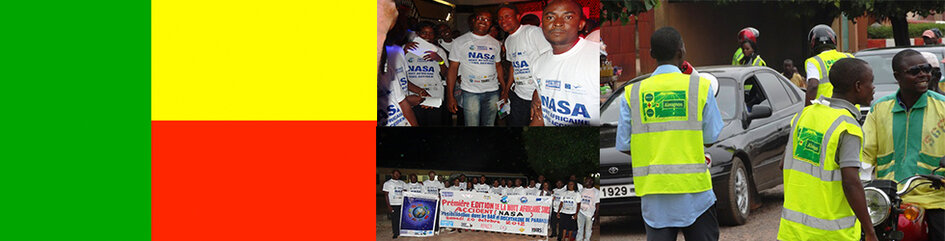
On the 20th of October 2012, BENIN welcomed the young volunteers of the Caravane in Parakou, thanks to the NGO ALINAGNON.

The Caravane volunteers arrive in Benin welcomed by Beninese delgates.

It was the opportunity for the authorities and government to send a delegation to meet the volunteers from Benin and Niger who gave the African Youth Declaration for Road Safety to the main transport and youth education stakeholders. The activities, coordinated by the members of ALINAGNON, started at the Guy RIOBE Centre, with a welcoming ceremony and several road safety awareness tools’ demonstrations.

On the morning of Sunday 21st of October 2012, a big awareness activity took place on the main Y crossroad of the city of Parakou (in Benin). This awareness action was really successful, since we could sensitize more than 8.000 road users (very crowded area), on several road safety topics: seatbelt, helmet, visibility, impaired driving, etc.

Young volunteers in Benin undertaking awareness activities!

In total, about 60 youngsters (caravanners and employees of ALINAGNON) were dressed with fluorescent jackets in order to be visible and cover all the streets surrounding the Y crossroad.

The event reached almost 8000 young people in a busy area of Benin!

As well, reflective stickers mentioning “TOGETHER, WE’LL MAKE OUR ROADS SAFER” (created during the European Youth Forum for Road Safety) were also stuck on the back of all vehicles (including 2-wheelers and bikes) passing by, with a satisfied welcoming smile from all drivers. Numerous posters and flyers were of course also distributed. On the 21st afternoon, a study visit has been organized after the awareness activities in the textile factory of Benin (COTEB). In the evening, the volunteers could relax a bit and visit the beautiful city of Parakou. 

On Tuesday 23rd of October 2012, a Press-Conference was organized in the Civil Society Hall (MdSC) with the delivery of the African Youth Declaration for Road Safety to main concerned stakeholders. The audience could benefit from the presence of the Coordinator of Handicap International (HI) in Benin, the President of the Steering Committee of the Decade of Action for Road Safety, the Director of the Ministry of Transport and the Public Work (MTTP), the members of ALINAGNON, the young caravanners, the media (Press & TV), and several other delegations from the authorities and government services.

After some welcoming words of Handicap International, the coordinator of the NGO ALINAGNON and M. TCHAFFA, representing the Ministry of Health, the representative of the caravanners read the Youth Declaration, then handled it to the director of the MTTP representing the government. The later kindly thanked the caravanners and committed. A family picture was finally taking before heading to a cocktail party to close the ceremony. 

After handing the Youth Declaration, the caravanners attended a special road safety “train-the-trainers” training, called SafetyPack organized by the coordinators of the NGO ALINAGNON, M. Casimir MIGAN and Souleymane ALTINE, from the Nigerian NGO FONDEI MA BORI, head-leader of the Caravane of the NGO. This adapted training, based on an European good practice (from Responsible Young Drivers), consists in using various awareness tools to imitate the behaviour of drivers, hence better understanding dangerous conditions (e.g. an impaired person behind the steering wheel), on the port of the helmet, then analyse their consequences and give some simple tricks to apply and advice for a better road safety behaviour.

This training was put into practice with the pupils of the catholic middle school of the Sacred-Heart, with the presence of the director and all the professors. It was very successful as we could reach about  1200 students.

On Wednesday 24th, the NGO ALINAGNON organized a Caravane-Parade with a podium-truck which went through 3 cities: Sèmè-Kpodji, Cotonou and Abomey-Calavi.

More than 150 young people participated in this huge activity. Posters and flyers were distributed. The Caravane-Podium-Truck purposely stopped in the big crossroads to sensitize road users. A particular attention was set on Taxi-motorcycle drivers, so-called “Zémidjan”. Other various topics were also broached: The wear of the helmet, the seatbelt, the Courtesy on the road, the respect for the traffic lanes, the drink-driving issue, etc. With music on board, the caravanners surely danced for safer roads in Africa.

On Thursday 25th of October, last day of the Caravane in Benin, the caravanners competed in a football game versus the team of AKPAKPA. A game which ended with a score of 3 – 2 in favour of the Akpakpans.

 Each player of the winning team won a helmet as a reward, but the Cup of the Youth Caravan for Road Safety in the UEMOA was given to the caravanners who will transport it to Senegal, the last stage of the Caravane. This activity was the last one in Benin.

You can see more photos of the events in Benin in the photo album on the right column! The Caravane now heads into Togo!

Read more about Caravane here.

Updates from the Caravane – Niger – The road safety journey begins!

Updates from the Caravane – Niger – The road safety journey begins!

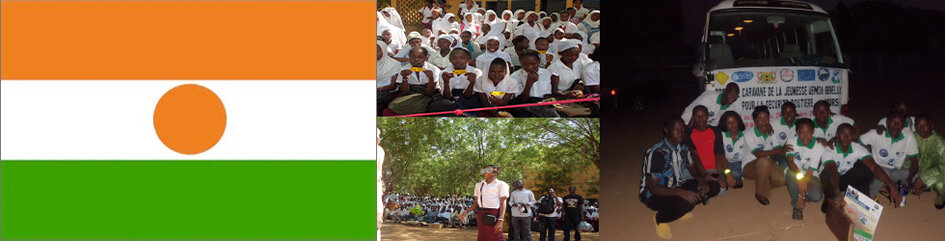
Since its launch on the 15th October 2012, the Carvane project has been travelling, so far, through two countries in West Africa. The journey began in Niamey, Niger and over its five day tour of the country, was greeted by thousands of young people amidst key road safety actions. The beginning of the Caravane journey in Niger illustrated successful road safety actions

From the 15th till the 19th of October 2012, The Youth Caravane for Road Safety (initiated by youngsters from Africa, in collaboration with European youngsters) travelled all around Niamey to sensitize a maximum of youngsters on the importance of taking their responsibilities on the road, as much as when car drivers, than on a motorbike, a bike or as simple pedestrians. 

On its journey, the Caravane used a range of road safety tools to educate young people on road safety including the alcovision goggles pictured here.

The Launch of the Caravane, held in Niamey on Monday 15th of October, gathered all main transport, youth and education stakeholders, and draw the attention of numerous media who ensured a strong visibility for the forthcoming days of awareness actions.

See the picture from the Niger action in the photo albums on the right column.

Awareness tools (AlcoVision Goggles, Distract-A-Match Game, reflective stickers, egg’s helmet, etc.) were therefore used on the streets, in schools and university, in several recreational setting in order to make youngsters aware of the dangers on the roads, since road crashes (which however are almost utterly avoidable) kill more people than Aids and Malaria. A successful Caravane Journey in Niamey, before leaving with 10 Nigerian young volunteers to Benin (and the next 5 countries), to convince their peer neighbours to be more careful on the road.

Read more about the Caravane here.

Youth and Road Safety conference to take place in Lyon – France

Youth and Road Safety conference to take place in Lyon – France

Next month on the 20th and 21st November 2012, a conference is taking place dedicated to the topic of Youth and Road Safety with perspectives of effective road safety action from countries including Belgium, Senegal and Niger with a focus on the Cooperation between Quebec and France. The event will be a follow up to some of the action points made during the 4th European Road Safety which took place in Nicosia, Cyprus in July.

In the framework of the 25th “Entretiens Jacques Cartier” and of the 63rd Permanent Commission of cooperation between Quebec and France, both countries joined by Belgium organise on 20th and 21st of November 2012 in Lyon, a Conference dedicated to the topic of “Youth and Road Safety”.

At global level road safety is an issue for young adolescents and young adults. This Conference will be an opportunity of sharing experiences, good practices and solutions to be implemented.  As a follow-up of the European Road Safety Day organised in Cyprus in July 2012 it will also be the moment to listen to young people associations and to accompany them in the actions they are developping.You can find the programme and you can register on the website links in the attachment.

Representing YOURS at the conference will be two of our CORE Group Members, Mr Aliou Oumarou, Coordinator of the African Region (Francophone Countries) and Mr Axl Druart, Coorindator of the European Region. You can read about their CORE Group Roles here and watch interviews about their plans for their regions in terms of youth and road safety action!

Read the application form to attend the conference and also the programme available in French.

Our Future Mobility Now – youth discussion on road safety

Our Future Mobility Now – youth discussion on road safety

Recently, the VOLVO Group enabled a roundtable discussion on the future of mobility. There is no doubt that our mobility has advanced over the past decades, maybe beyond recognition. Long gone are the days of mobility on for the wealthy in most of the world with most people travelling around in a contemporary society with some ease. However, this advancement in mobility also poses challenges, that of road safety, urban development and is interconnected to a range of social issues.

The VOLVO Group brought together a diverse group of young minds to tackle the issues of urban mobility in a modern world. The discussion took on the panel, bringing road safety to the mobility agenda, YOURS Director Mr Floor Lieshout.

The first topic of discussion focused on youth and road traffic injuries, bringing attention to the primary cause of death for young people; road traffic crashes. This starter discussion presented mobility in a unique perspective. While our future mobility will mean getting around quicker, easier and offering routes of transport for young people; it also has a serious consequence; road deaths. Floor began the discussion by asking the group how we can get young people involved in road safety?

Floor highlighted the importance of a safe road safety system; safe vehicles, safe infrastructure and safe road users. He also stated, ‘Young people are the biggest victims but we can also be part of the solution’.

The discussion continued by mapping ways in which young people can be involved in road safety such as through urban transport planning project alongside engineers to understand their projects.  Next, there was a focus on road safety campaigns and the impact of raising road safety awareness. The discussion touched on several areas of road safety offering an interesting insight into youth involvement in road safety.

The discussion can be viewed in the right column.