Road safety through the vibrancy of a carnival – Vida Urgente

Road safety through the vibrancy of a carnival – Vida Urgente

The colours of the Brazillian Carnival are a great metaphor for young people around the world. The carnival depicts diversity, vibrancy, energy, positivity and fun! So approaching this event with a road safety message through the same rainbow of colour and energy has been a successful method in engaging young people in a road safety message. Read more about it here!

Vida Urgente, translated as  ‘Urgent Life’ employs a host of life promotion messages to encourage young people to make healthy decisions and embrace the life they live in positive ways. Vida Urgente are a longstanding member and supporter of YOURS and were part of the taskforce that shaped the foundations of the organization. They also helped to launch YOURS in Moscow in 2009.

Continuing their dissemination of road safety messages in Brazil and wider South America, the organization recently took a road safety message to the vibrancy of the Brazilian Carnival. The auspicious Brazillian Carnival has been well documented around the world bringing together bright colours, samba dancing, outrageous and jaw dropping outfits and an overall feeling of positivity. Porto Alegre city – Brazil was the backdrop for a great carnival experience.

Vida Urgente told us:

“As you may know the Carnival in Brazil is a very huge event, mobilizing thousands of people, where the risk of accidents on roads increase considerably, so we developed this campaign in outdoors format and folders, that will be delivered into stations tolls roads, to thousands of drivers who will be traveling due to the Holiday”.

The campaign was run in major newspapers across the country. Each folder contains in the front, an art allusive to Samba School’s flags, where the names of school are replaced to “Empire of the driver’s time”,” Academics of Safe Driving “and ” United Taxi Tour.” Beside these flags, a Carnival message for Vida Urgente : “Abre Alas para a Vida. Dirija com segurança neste Carnaval” something like “Open area to life. Drive safely in this Carnival. “
 
The back of the brochure brings the messages “Boarding into the revelry of Carnival  and be parto of life’s block,” followed by tips on transit: – Speed limits, Use of seat belts, Car review, Using mobile while driving, Kids in the back seat with chairs and Sleeping at the wheel.
 
Also part of the campaign for the carnival, Vida Urgente already started running an exclusive campaign road safety jingle on radios across Brazil. This unique jingle focuses on;

A radio jingle for the holiday, which blends traditional drumming Carnival sounds with traffic accidents sounds, and in the end, the voiceover says: “Unfortunately this has been the beat of Carnival for many young people. Make party, but if driving do not drink” 

You can listen to the radio spot here. To finalize our Carnival campaigns, like here in Brazil this season is summer, we put in more than 300 power poles, in more than 15 cities, an adhesive-size, in the shape of a boy and a girl, that simulate a hug on the pole where you can read writing on the back: “It has something much better for you to embrace this summer. If driving, do not drink”. (attached)

Finally, our friends at Vida Urgente didn’t forget to add a global element to their campaign by taking part in the YOURS edition of the Long Short Walk! They submitted a slection of photos against the backdrop of the Carnival which we will publish soon! You can also take part in the Long Short Walk here.

President Obama calls for a repairing of road infrastructure across US

President Obama calls for a repairing of road infrastructure across US

Reparing infrastructure is important to get people to work, an efficient transport system means that people get travel easily and get to where they need to go without hinderance. However, a good road infrastructure system also means safer roads as long as safety is put on the agenda when repairing roads.

In his State of the Union address, President Obama launched a “Fix-It-First” program to repair aging infrastructure and put people to work. Obama has proposed infrastructure investment many times before, and always with a heavy tilt toward repair and maintenance, but never such an explicit mandate to “fix it first.” By keeping existing transportation infrastructure in good condition, officials can save the public from the expense of unnecessary road expansion projects.

There is no doubt that road infrastructure plays a role in the prevention of road crashes. In the United States alone road crashes are said to cost $300bn a year. Fixing roads for safe travel contributes towards road safety but must come hand in hand with a wider road safety systems approach. It must put road safety firmly on the agenda and ensure that commuters are safe on the road.

The road traffic system consists of three parts: the road and wider environment, the vehicle, and the individual (road user).

The characteristics of these components and the interaction between them affect road traffic crashes and the resulting injuries. For example, a person who is driving on a road that is unlit, in a car that has bad brakes, or without wearing a seatbelt is more likely to be seriously injured than someone who is driving on a well-lit road, in a car that is in good condition, and is buckled up.

Human errors are responsible for most traffic crashes, and human errors cannot be completely eliminated. Humans will make mistakes. The other parts of the road traffic system, the vehicle and the road and environment, need to be designed and managed in a way that minimises the risk of injury and death if a crash occurs. For example, crashes that happen on a road where appropriate speed limits are set and enforced are less likely to result in serious injuries.

The Haddon Matrix explains the important of all factors working together to prevent road crashes.

It also helps to look at road traffic injuries using a timeframe lens: before (pre-crash), during, and after a crash (post-crash). For example, in the before-the-crash phase we might think about a person who has fastened a seatbelt or worn a helmet, a vehicle that is in good condition, and roads that follow safety standards. In the during-the-crash phase, the crash-protective design of the vehicle might prevent serious injuries or death. After the crash, the availability of quality emergency medical services might save a person’s life.
If we combine the timeline with the parts of the road traffic system, we get the Haddon Matrix above.

The Matrix is a basic way to understand the factors that contribute to the number and outcome of road traffic crashes and we can use it to think about how fatalities and injuries can be reduced. For example, in addition to telling a child not to run across the road on the way to school (addressing human behaviour in the pre-crash phase), we can work to slow traffic down so much around schools (addressing road environment in the pre-crash phase) so if a child does get hit, the injuries will be less serious.

Happy Valentines Day – Don’t forget to keep your loved one safe!

Happy Valentines Day – Don’t forget to keep your loved one safe!

Many argue that Valentine’s day is just an over commercialized profit driven event but for youngsters around the world, its often a time for them to do something special amidst the turmoil of exams, school, university and other pressures of young life. The premise behind it is to take a bit of time out to make an extra special effort for your loved ones, or if your single, to enjoy it with other singletons! On this day, don’t forget to keep each other safe on the road by following simple road safety steps.

Many organizations around the world have formulated targeted road safety messages for Valentine’s day. It is indeed a day of red roses, card giving, chocolates and dinners but for young people, it can also be a tragic loss of life when couples don’t observe basic road safety!

It goes without saying that showing your love and appreciation for your loved one should not be limited to Valentine’s Day, this also applies for road safety.

The facts are clear, road crashes are the single biggest killer of young people worldwide and in those figures, young men are most likely to be implicated not only in the cause of these deaths but also as victims of these crashes.

As young men all around the world gear up to arrange something special for their girlfriends, wives, fiances, they may decide to buy a bottle of wine, or better still, a bottle of champagne! They may even need a glass or two before the night starts to shake of the nerves of taking their long term crush out for a date. However, in a modern world, we are all to aware of the dangers of drinking and driving. Its therefore crucial that we observe road safety today on Valentine’s day to keep our loved safe but also beyond Valentine’s day.

We urge you, our peers, young people in our global community to embrace to these road safety commitments:

Examples of Valentine’s Day road safety campaigns around the world include targeted radio spots for road safety. In the UK, Star Radio in partnership with Camridgeshire and Peterborough Road Safety Partnerhsip, ran a special competition to engage young people in road safety by designing the script of their own Valentine’s road safey advert.

I didn’t mean to kill you. I was driving too fast. I really miss you. ‘For My Girlfriend’ targets young male drivers, for example those aged between 17-24 years old, who are sadly over represented in the crash statistics. Tragically, there were a total of 72 KSIs (killed or seriously injured) for young people aged 17 – 24 in Cambridgeshire in 2008, and the majority of these were young male drivers. In addition, more girls die as passengers in cars.

Research into young drivers’ attitudes and behaviour revealed that the prospect of killing or maiming someone they loved, such as their girlfriend, was a key issue that may produce a change of attitude towards driving too fast.

The winning advert script was written by Ellie Powels and is a powerful auditory advert:

“Katie: Thanks for tonight babe I really en….

SFX – scream

SFX – crash

SFX – ambulance siren

SFX – Heart beat

Matt: I’m so sorry, I didn’t mean tonight to end like this I just wanted to make you happy I just hope you can hear me as I didn’t get to tell you earlier I really enjoyed tonight too…..I should have known that extra pint wasn’t worth it. It was a stupid mistake if only I could change what I’ve done, you no Katie I would of done any thing for my girlfriend.

SFX- cry

Matt:……..Katie I love you.

SFX – heart monitor stops

Narrator: Make sure you don’t lose the one you love this valentines. Think. Don’t drink and drive.”

We wish you a happy and safe Valentine’s Day!

Are you ready for the Second UN Global Road Safety week?

Are you ready for the Second UN Global Road Safety week?

The Second UN Global Road Safety Week takes place on 6-12 May 2013. It is a great opportunity to call for action on its theme; pedestrian safety. As well as taking part in the Long Short Walk, this year’s YOURS campaign iniated by the Zenani Mandela Campaign, you can take part in a range of activities to promote the week and call for pedestrian safety.

The Second UN Global Road Safety Week to be held 6-12 May 2013 is dedicated to pedestrian safety.

Requested by the UN General Assembly, the Week will draw attention to the urgent need to better protect pedestrians worldwide, generate action on the measures needed to do so, and contribute to achieving the goal of the Decade of Action for Road Safety 2011-2020 to save 5 million lives.

The Week will contribute to:

  • drawing attention to the need for pedestrian safety;
  • generating action on measures which work to increase pedestrian safety; and
  • achieving the goal of the Decade of Action for Road Safety 2011-2020 to save 5 million lives.

Governments, with support from civil society, academia, the private sector and the international community, are all encouraged to plan and host national and local events during the Second UN Global Road Safety Week.

This milestone event on the Decade calendar is a unique opportunity to make progress on saving lives, and we hope that you will join in ensuring its success.

As you may know, the first United Nations Road Safety Week had the theme of ‘young road users’. This culminated in the First Global Youth Assembly for Road Safety and subsequently the birth of YOURS! Just after the five year anniversary, WHO have organized the Second UN Road Safety Week.

This year, bolstering the call for safer roads for pedestrians globally, the Long Short Walk is a great way for you to do something for th week. Take part in our unique youth competition as easy as a click of a camera button! Find out how to take part here.

Other ways you can contribute to the week is by organizing an event; you can find out more in the attached flyer. The flyer is available in other languages here.

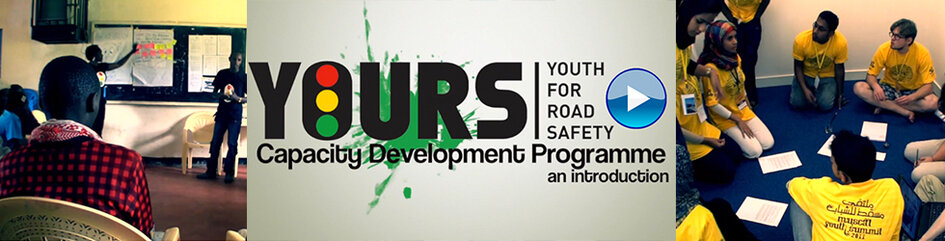
An introduction to our Capacity Development Programme – new video!

An introduction to our Capacity Development Programme – new video!

We are always looking for news ways to simplify information and make it easier to capture our work. With this in mind, YOURS has just finished the production of a new video explaining the Capacity Development Programme! It takes a moment to explain our training programme and includes testimonials from our training participants. See if a training could benefit your organization.

Here at YOURS, we pride ourselves at being different. We use unique methodology to engage young people in becoming active in road safety all around. Our capacity development programme is not just about turning young people into road safety advocates, its about giving young people the skills and knowledge needed to run their own road safety projects, to make an impact on the ground; with their peers and the community. It is about providing young people with life long transferrable skills that they can use for the rest of their lives. Its to empower young people to know that they can be agents of change and to mobilize a road safety conscious generation to combat the biggest killer of young people; road crashes.

Last year, significant milestones for road safety were reached. We launched the first ever Youth and Road Safety Action Kit, a comprehensive introduction to road safety for young people all around the world. Designed with young people in mind and equipped with the information needed to give young people a starting point in road safety, the kit condesed the sphere of technical road safety reports into an accessible format for young people to use.  

Our new video highlights the Capacity Development Programme in its entirity including its aims, objectives and content. It also includes testimonials from our participants who provided a candid expression of their experience during the full Training of Facilitators Programme in Kenya (December 2012).

It focuses on the methodology of the programme including its unique features. The video also includes testimonials with our key partners on the ground during our Kenya training.

The ultimate aim of this video is to introduce the wider road safety community to our trainings, a unique oppornuity to invest in a future generation of road safety campaigners, policy-makers, advocates and socially active young people. If you’re interested in our trainings and want to know more, email info@youthforroadsafey.org

You can watch the video here.

Brian’s Column: Breaking the norm – religion & road safety in Africa

Brian’s Column: Breaking the norm – religion & road safety in Africa

This month, Brian gives us the low down of African youth and road safety issues. He focuses on a poignant topic, the reflection that deaths are ‘God’s will’ and therefore, were meant to happen. However, is that still the case if a young driver dies while he or she is drunk driving? What about if a pedestrian is hit by a speeding driver? Read Brian’s take on a relgious approach that could foster road safety.

Premierement, felicitations a mes amis de Mali upon passing their test against the African Cup of Nations 2013 Hosts, South Africa! West Africa is doing very well in this tournament; surely making my continent proud. That’s for sure, because if you haven’t heard, here is the deal… “In Africa, we don’t play football, we live it!” Don’t question me yet why no African country hasn’t won the World Cup but I think if we invite other countries to play in our prestigious African Cup of Nations, they would have a rough time! Haha! So, my apologies soccer fanatics, but I am not here for soccer stories, ladies and gentlemen, welcome to February.

As you may have been warned, this is the same month where we observe Valentine’s Day. Yes! Now, I know that you are all too innocent to know what Valentines day is, but its one of those rare days when I get to see two people put on red and black attire moving hand in hand. For now, that’s what I can say. I once heard that its also called ‘Lovers Day’ but my mother pulled my ear when I questioned her for more information.

Every one of us is an orphan. Right? I can already see many of you raising your eyebrows, but am afraid, I am correct! If you think, this is not the case, then think about this. ‘Where exactly are your Great Great Great Grand Parents?’ Well, they must be no longer with us at the very least. How did they die? Ah, many reasons, mostly witchcraft, bizarre sickness, wars and accidents. What? Accidents?! No, Crashes, I mean. So, as we all know, loosing a human being let it be your enemy, close relative, boyfriend, parent or whatever, can be very depressing. In fact, among the Banyankole (a local tribe in Uganda), the relatives of the family used to stay and mourn at the deceased home for 2 weeks! (now that has changed though and reduced to 3 days). It’s a very trying time in African culture and religion. A burial ceremony is not something neither of us would like to attend. It is most definitely not like a graduation party. But many times, for goodness sake, don’t judge me (thank you very much), I always ask myself this question…‘What was the cause of the death, please?’… Only to be informed, the deceased was involved in a road traffic crash.

Death will always remain one of the most painful of human experience but if we call preventable road deaths ‘God’s will’ where does that leave road safety?

This is, what I call ‘My fattest stress factor’. I imagine, the deceased was drunk driving, didn’t have helmet, no seatbelt, poor road surfaces, poor weather conditions etc. like you know. On many African burial ceremonies, especially when the deceased was a young person (on many occasions it’s a young person under 30),

I find it completely shocking when the priest, the Sheikh, the Pastor (I don’t know many of their titles) stands amidst a congregation and says ‘It was his/her time to die’, ‘God/Allah has decided to take the life of this young person’.

Seriously?! Come on you young people, you have to be kidding me right now. Are we saying that if we drink and drive and get involved in a crash and die (hope this is the last time I am saying this, touch wood), then it was Allah’s/God’s plan? I may be sounding to be attacking religion, but I am just being a rational being. Speeding itself is equivalent to massacre-special reference is made to the Koran. Also, alcohol is meant for people with lots of problems, those who are at the point of death-special reference to the Bible. There is nowhere in the holy books where getting drunk is acceptable.

We should not fall into the loophole of thinking that we are not agents of our own actions. We CAN make steps to be safer and save our own lives.

A human being knocked by car moving at 30km/hr has a 90% chance of survival than those going faster! So, do we, by speeding, take the role of God in our own hands and offer people less chance of survival by taking more risks? I think funeral services and mourning for road crash victims should be minimized and instead used to highlight the need for road safety because religious groups can help clear the minds of members from superstitious beliefs and help them to rely on good judgment while on the road. While every life is a tragedy, we can take steps to save our lives. God gave us freewill which means that we MUST take steps to be safer on the roads.

In June 2012, Ghana’s statistics had shown that about 11,500 accidents were reported annually; about 14,500 for injuries and 1,900 fatalities recorded annually, hence the need for religious leaders to support road safety campaigns.
According to Mrs. May Obiri-Yeboah, Director of Planning and Programmes of NRSC in her June 2012 report, a road safety campaign was led by a small sector of engineers, car makers and traffic police hence the need to expand to involve everyone in the country. The challenges of road traffic crashes required re-programming activities and engage opinion and religious leaders in the drive against such occurrences hampering national and regional progress.

In Africa, a child’s access to safe pedestrian infrastructure is considerably lower in comparison to a child of the same age in a high-income country. If a child dies on the road in Africa and it is because it they had to share the road with big trucks, is this God’s plan?

It is clear that religious leaders may reflect on the lives lost and offer comfort in the words that it was all ‘God’s will’. It helps us let go, gives us support but it also takes the responsibility away from the driver who may have been to blame for the crash.

Religious groups should keep pushing the fact that God gave us this live to live free from pain and suffering. If this happened, it would include mandatory road safety policy in sermons to reduce human suffering and ensure we are safer.

We should therefore encourage religious groups to push messages of safety to preserve this precious life in the best ways we can. Tell me something, who decides to step on the accelerator? Me, the driver, yes? Aha! So, then, lets make steps so that our friends, peers and future husbands and wives do not make an unduly date with death before it happens. It’s not God’s will for our generation to die from man-made death scenarios. Hello Valentine’s Day (w nks). #StaySafe