Life and death on the world’s most dangerous roads – The Guardian

Life and death on the world’s most dangerous roads – The Guardian

The Road Safety Fund, in partnership with the Guardian, publish articles focusing on global road safety as a development issue. Since the the publishing of the Global Staus Report on Road Safety 2013 last week, the Guardian have created an acessible and easy to navigate interactive map highlighting key statistics around the world from the data compiled in the report. Read more here.

More than 1.2 million people are killed on the roads every year and three-quarters of all road deaths are among young men. Where are the worst places for road deaths and injuries? What is being done to improve the highways for pedestrians, cyclists and drivers? Explore data from the WHO’s latest report on road safety, and experience a ride on one of the world’s most dangerous roads.

This makes road crashes the eighth leading cause of death globally – comparable in impact to communicable diseases such as malaria – and the WHO estimates it could rise to fifth in the rankings by 2030 unless action is taken.

Dr Magaret Chan, Director General of the World health Health Organization said,

“Road traffic injuries take an enormous toll on individuals and communities as well as on national economies. Middle-income countries, which are motorising rapidly, are the hardest hit”.

Three-quarters of all road deaths are among young men – and road accidents are the leading cause of death for 15- to 29-year-olds.

The WHO’s Global Status Report on Road Safety 2013 found that 27% of global traffic deaths are among pedestrians and cyclists – vulnerable road users who have been neglected in transport and planning policies. In low- and middle-income countries the figure is closer to 33%; in some, it is as high as 75%.

Margaret Chan, director general of the WHO, said the number of road deaths was “unacceptably high”, while injuries “take an enormous toll on individuals and communities as well as on national economies”. Low-income families are hardest hit by medical costs and lost wages.

The Guardian Development have translated the data from the Global Status Report into an interactive and comparable table looking at the statistics from the report. It can be viewed here: 

Dealing with deaths and injuries on roads costs billions of dollars each year (pdf), taking an estimated toll on low- and middle-income countries of 1-2% of economic output – a total across those countries of more than $100bn a year. Middle-income countries, particularly in Africa, where car use is rising, have been disproportionately affected, said the WHO.

The global road traffic death rate is 18 per 100,000 people. Middle-income countries have the highest rate – 20.1 – while high-income countries have the lowest, at 8.7. Regionally, the lowest rate is in Europe (10.3 per 100,000) and the highest in Africa (24.1 per 100,000).

“Road traffic injuries are increasing, notably in low- and middle-income countries, where rates are twice those in high-income countries. This is partly attributable to the rapid rate of motorisation in many developing countries without a concomitant investment in road safety strategies and land use planning,” said the report.

The WHO named six countries that have steadily reduced road deaths – Australia, Canada, France, the Netherlands, Sweden and the UK. It said 88 countries reduced deaths on the road between 2007 and 2010 (42 high-income, 41 middle-income and five low-income countries), while 87 experienced increases. The WHO refused to name the countries where rates had increased.

The report found that the number of annual deaths on the world’s roads was more or less stable, at 1.24 million, but said that – given the number of registered vehicles has risen 15% since its last report in 2009 – more people would have died without the action already taken to reduce risk in five key areas.

World governments declared 2011-20 a decade of action for road safety and the WHO has been urging countries to tighten legislation on speed, drink-driving, use of helmets, seatbelts and child restraints.

“Although the aim of reducing the annual burden of road traffic deaths has yet to be realised, the lack of increase suggests interventions to improve global road safety may have mitigated deaths that would otherwise have occurred,” the report said. 

The road safety study found that only 28 countries, covering 7% of the world’s population, have adequate laws in place – and this number remains unchanged from the last report. Over the past five years, 35 countries have passed new laws or changed existing laws – but even where laws do exist, their enforcement is inadequate, the report found.

The report also calls for standardised data collection on road safety, injuries and deaths – and highlights the need to improve post-crash care.
“Real progress has been made towards improving road safety and saving lives, but what this report shows is that faster and more concerted action is needed to prevent many more lives being needlessly lost on the world’s roads,” the authors said.

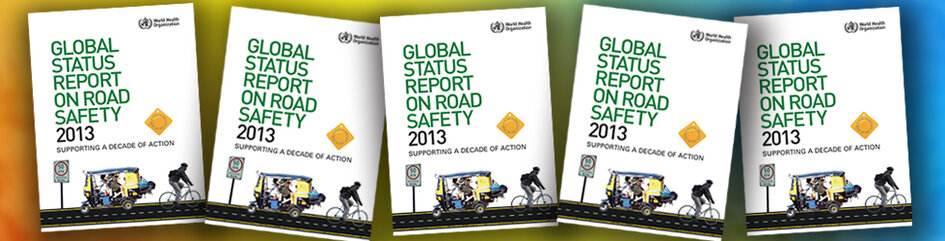
Global Status Report on Road Safety 2013 launched today

Global Status Report on Road Safety 2013 launched today

The Global Status Report on Road Safety is the most comprehensive report covering 182 countries around the world and accounting for almost 99% of the world population. Conducted by the World Health Organization, the report provides the low down on global statistics related to road safety alongside individual country profiles documenting mortality rates, road safety laws and other facets of road safety. The document will be used all across the world as a baseline of research and statistics relating to road safety, but what does it mean for young people?

Today (14th March 2013) global leaders in the field of road safety have gathered at the World Heatlh Organization HQ in Geneva, Switzerland to launch the The Global status report on road safety 2013.

The report presents information on road safety from 182 countries, accounting for almost 99% of the world’s population.

The report indicates that worldwide the total number of road traffic deaths remains unacceptably high at 1.24 million per year.

Only 28 countries, covering 7% of the world’s population, have comprehensive road safety laws on five key risk factors: drinking and driving, speeding, and failing to use motorcycle helmets, seat-belts, and child restraints. This report serves as a baseline for the Decade of Action for Road Safety 2011-2020, declared by the UN General Assembly. Made possible through funding from Bloomberg Philanthropies, this is the second in a series of Global status reports.

The report also presents data in an accessible and innovative infograpics which highlight its key findings and global trends in global road safety;

The report shows that road traffic crashes are still the biggest killer of young people globally and males are still most affected in road crashes.

These statistics show that youth and road safety action remains high on the agenda and more action is needed. It illustrates the vulnerable position of young people in traffic and that more efforts are necessary to involve young people in road safety, from advocacy to education to the implementation of robust road safety national plans covering road safety laws, enforcement, infrastructure, safer vehicles and awareness.

Road crashes remain disproportionately high in low and middle income countries even though middle income countries have a only half amount of the worlds vehicles. While high income countries have a great proportion of vehicles, crashes in high income countries are lower. 

So what does this mean? It suggests that high income countries, while have nearly half of all the world’s vehicles, have enacted road safety measures; systems, strategies policies, laws and so forth which reduced the amount of people killed in those countires. It suggests that the economy of a country is related to the amount of road crashes in that country. For low income and middle income countries, the amount of road crashes is unacceptably high. These countries are those in Africa, South America, South East Asia and Eastern Europe. More action is needed.

Launch of the Global Road Safety Report – World Health Organiazation HQ, Gevena, Switzerland
As you read this, global leaders have gathered at the World Health Organization headquarters in Switzerland to launch this report. The launch has been endorsed by world leaders who have said; 

dg tag 100px
This report is a milestone in the international road safety field. It gives us a full description of the situation around the world in almost every country at the start of this Decade of Action for Road Safety. The world is rapidly motorizing, and as this report shows, more concerted action is needed, and it is needed now. Without this, we can expect a rise in the number of deaths and injuries on our roads
.– Dr Margaret Chan, Director General, World Health Organization

bloomberg 100px
We all know what works: increasing seat-belt and helmet wearing; enforcing speed limits; reducing drinking and driving; shifting to sustainable transport modes such as bus rapid transit; creating pedestrian space and protected bike lanes. What’s needed is a global commitment by both the public and the private sectors to implement these strategies.
 Mr Micheal Bloomberg, Mayor of the City of New York (Bloomberg Philanthropies)

yeoh 100px
The Global status report on road safety 2013 will be such an important tool, as it will allow progress to be measured throughout the Decade. This progress is so desperately needed, in order to avert the tragedies and great sadness that come as a result of losing a loved one in a road traffic crash. It is my hope that the Decade will indeed achieve its goal of saving millions of lives. We all have a role in making the Decade a success. Ms Michelle Yeoh, Global Ambassador to Make Roads Safe and Internationally renowned actress (BAFTA Nominee)

On the panel of distinguished delegates to discuss the report is director of YOURS Mr Floor Lieshout. He joins a panel with Dr Kelly Henning, Director, International Health Programmes, Bloomberg Philanthropies, Mr David Ward, Director General, FIA Foundation for the Automobile and Society, Mr Pieter Venter, Chief Executive Officer, GRSP: Global Road Safety Partnership, Professor Adnan Hyder, Director, International Injury Research Unit, Johns Hopkins University Mr Jose Luis Irigoyen, Director, Transport, Water, Information and Communication Technologies.

Mr Lieshout said,

Road Traffic Injuries are still the leading killer of young people aged 15-29. It’s an unacceptable price to for youth to pay for mobility!

Download the report in the right banner and view video statements for the launch of the report in the links. We strive to use this report as evidence that youth need to be part of the solution of road safety, let’s work together & reduce leading cause of death in young people.

See the person behind the helmet – a UK campaign from THINK!

See the person behind the helmet – a UK campaign from THINK!

Person centered road safety campaigns have evoked some meaningful messages. These types of campaigns focus on the people in the road safety messages because after all, it is people’s lives that we are trying save. A new campaign launched in the UK focuses on ‘seeing the person behind the helmet’ and calls for drivers to take extra care for motorcyclists who are particularly vulnerable on the road.

The campaign includes an advert that promotes the message that drivers should see the people behind the helmet.

Drivers are being urged to “see the person behind the helmet” and take longer to look for motorcyclists in the latest THINK! motorcycle safety campaign, launched today (11 March) in the United Kingdom by Stephen Hammond, road safety minister for Great Britain.

The £1.3m campaign, timed to coincide with the time of year when motorcycling increases, the summer and it encourages drivers to take longer to look for bikers and to think about the biker; not just the bike as is the focus of seeing Dave the new dad (pictured above). The campaign will run from March to May with messages delivered through radio advertising and in petrol stations. Wider awareness will be generated through TV video on demand advertising, targeting younger drivers in particular.

Stephen Hammond said: “Motorcyclists account for just 1% of traffic but 19% of deaths on Britain’s roads, and 30 bikers are killed or injured in accidents at junctions every day. I am determined to reduce this terrible toll.

“That is why we are funding this THINK! campaign to remind drivers to look out for motorcyclists – particularly at junctions – and to see the person behind the helmet, not just a motorbike.”

The campaign was informed by statistics which show that motorists failing to look properly is a factor in half of all accidents where motorcyclists are killed or seriously injured at a junction; and wider research showing that drivers are more likely to notice motorcyclists on the roads if they know a biker themselves.

Neil Greig, from the Institue of Advanced Motorists in the UK director of policy and research, said: “There are far too many SMIDSY (sorry mate, I didn’t see you) accidents on our roads today, so we welcome the new THINK! awareness campaign for motorcyclist. “‘Failed to look’ is the top reason for serious crashes and research shows that drivers often miss smaller vehicles when they scan the road before a turn. A few extra moments spent checking for motorcyclists means everyone gets home safely.”

Globally, motorcyclists and other two wheel users are recognised as particularly vulnerable drivers. The injury rate in low and middle income countries are signficantly higher than high income countries. In developing nations, two wheel transport is much more prevalent and the lack of helmet use and the subsequent head injuries are a massive cause for deaths of rider in motorcycle crashes.

10 years of TeamAlert in the Netherlands – road safety pioneers!

10 years of TeamAlert in the Netherlands – road safety pioneers!

The leading, the biggest and the most active youth and road safety organization in The Netherlands, TeamAlert has reached its ten year anniversary this month! On 6th March 2013, the organization reached a decade of operations and we take this moment to congratulate their work and look back at some of their revolutionary, ground breaking and unique campaigns.

TeamAlert is one of the original organizations for youth and road safety in the world. They championed the cause thirteen years ago in 2000 and have being going strong ever since. Since 2003 TeamAlert became an independent youth-led organization for road safety and have ran a range of expertly reviewed campaigns in the The Netherlands. They continue to be an authority on youth and road safety issues in the country and beyond!

TeamAlert post about their work;

“TeamAlert is necessary because traffic crashes are still the number one killer among young peopleTeamAlert was formed as a project in 2000 on the initiative of the former Transport MinisterMs NetelenbosThe Minister gave 5 youngsters the task activities and campaigns to devise road safety under the attention of peers“.

The young people came up with the name TeamAlert” and in three years they formed the foundations of the organization, on the 6 March 2003 TeamAlert was foundedThe 10 years that followed countless young people have worked to convince their peers themselves of safe traffic behavior, a true peer-to-peer model.

One of TeamAlert’s many campaigns, the Witte Waas, promoted at festivals across The Netherlands. Translated as ‘White Blurb’ promotes awareness of an anti drug driving message amongst youth in traffic.

TeamAlert now employs more than 20 office staff and about 70 education and information staff. Many projects have been implemented in schoolsfestivals, nightclubs and on the street and the organization continues to reach many more young people. They said, ‘It works pretty well, because in 2012 we reached 117.000 people with our road safety messages and in this jubilee year we reach over 125.000 people‘.

YOURS Director Mr Floor Lieshout began his road safey journey in this organization, he said,

“I am so proud that TeamAlert has reached its ten year anniversary. Working with this organization is where my passion for road safety started and where it is rooted. You could say that YOURS is an indirect result of my work with TeamAlert and many of our focuses and principles are similar. I wish them many more successful years”.

Read more about TeamAlert at their Facebook page here and at their website here! You can also view their profile on the YOURS website here.

Brian’s Column: That moment of meeting an inspiring activist!

Brian’s Column: That moment of meeting an inspiring activist!

This month, our regular columnist Brian K Mwebaze shares an experience that inspired him to write this particular column. The experience revolves around meeting an inspiring activist. This activist was not giving a speech at a world conference, they were not on television or leading a march, they were a taxi driver and the inspiration came with just a few words. Read about it here.

Greetings to all of you road safety ambassadors in your respective titles that may have changed throughout the course of last month! I know that lots of things have changed about you, physically, mentally, socially and let me also say, maybe emotionally?

The Gambia initative turning a birthday into an event that gives to the community.

Lets begin with special recognition of the Gambian Youth Parliament for their initiative in advancing their road safety agenda within their country! They took positive advantage of their Programme Officer’s (Siaka K Dba) 25th Birth Day to raise more awareness on their core work, which includes road safety! How I wish everyday were some one’s birthday at the Gambian Youth Parliament, just imagine the impact! There is also the Long Short Walk Campaign which you shouldn’t by any mistake miss because its so easy to take part. Much respects!

So, this time, after spending 86 hours travelling in which I met Red Cross Road Safety ambassadors  from Rwanda and the VSO Team in Uganda, I hurled myself to East Africa’s Most Original city’s bus park  (Kampala, Uganda) on my way to Mbarara, Uganda where I am staying for 2 more days before I run into the Democratic Republic of Congo for the first time! Thrilled! I enjoy my work really. Yes…how it must feel to be back home again…play for me that song, by Chris Daughtry, ‘Home’ lol. But, you see, I am not interested in telling you how I slept like a sack of Irish potatoes and with a helmet on…no thanks, so here we go…

As you may well be aware, communiting in Africa can become a daily challenge.

On getting out of the bus, I found my way into a taxi whose driver was female! (please don’t ask me a lot of questions here, just listen). As it was at night, I adjusted my jacket head hood and comfortably chillaxed in the passenger’s seat.

The female taxi driver sat and before she started the engine, glanced at me over her shoulders and calmly said, ‘Your seatbelt sir or I wont start!’

Upon  hearing this, I asked for her name very fast! Never before had it ever occurred to me while in any developing country that I am being asked to buckle-up! (although it was the next thing I was about to do, being a road safety ambassador and all)  Usually, when I want to get some good information, I claim to be stupid…I think all the young men play this kind of game right? So, I asked her in a friendly tone, ‘What the hell do you mean miss? Do you want to convince me that your car runs on seatbelts? You see, I am not Ford but I know for sure that, cars run on petrol, What do you mean to tell me?’ You see, I was intrigued to find a road safety conscious taxi driver and so I wanted to check if she knew the plethora of road safety arguments behind seatbelt use! (I know, cheeky me!)

With a very serious face, the 29 year old (as I later found out) Miss Shallon Nsubuga looked at me for what seemed like 365 days, upon which she calmly and authoritatively asked me, ‘Are you married?’ ‘Do you have any family’ ‘What do you do for a living?’ ‘Do you have any real dreams like a young person’ and ‘How do you want to arrive home, vertical or horizontal?’ I have never met a character like this!

Usually, am given the usual answers of ‘Well, the government here, or the police will fine you heavily’. But this was a person-focused conviction…she passed me through her life and experience of how she lost her uncle to a road traffic crash! That uncle was the gentleman that was paying for her University tuition and for all other dependants. She has a job as a teller in one of the banks in town, but she says, she has to work harder to supplement her income….I was touched! Touched to my bone marrow! Wouldn’t you be? Everyday we hope to meet road safety aware youngsters and today, I was given a message that I pass on every time I sit in a vehicle.

When we finally parted, I spent what seemed like (to be honest, I don’t remember) but it was a long time in my house thinking, how road safety and seatbelts issues were being handled with a person-centred approach! Scarce as pregnant guinea fowls, such kind of young drivers are our superstars. They are our hope. They have a religion of safety and like all road safety ambassadors, we need to join and stay in this religion, in this movement and pass the message on from person to person, always.

Young people in developing countries are becoming more and more aware about the burden of avoidable road traffic crashes onto themselves, family and society! I thought about it and came to the conclusion that she has more than likely said this to all passengers in her taxi, to buckle up and stay safe. She is the change that wants to see and for that I salute her and say this, she impacted me that day.

Much respects to all of you who believe and practice the ‘Your seatbelt or I won’t start!’ rule. N.B Miss Shallon Nsubuga gave me her consent to use her real names in this article and I can tell her what you thought of her approach, just tweet me.

These unsung heroes of our road safety world are priceless and deserve to be sung about! Miss Nsubunga, keep the fire burning!

Spotlight On: Voice Trust, India – educational programs in rural spaces

Spotlight On: Voice Trust, India – educational programs in rural spaces

As you may now be aware, every so often, YOURS chooses a network member from our global youth network for road safety and puts their spotlight on the work for the world to see. When organizations submit detailed application forms with great information about their projects and work, we will spotlight them! This time, we put the spotlight on Voice Trust, India. Based in rural Tamil Nadu, this organization works to promote amongst other programs; road safety awareness and education, read about them here.

The mission of Voice Trust is to provide quality healthcare services and facilities for rural and indigenous communities, to promote wellness, to relieve suffering, to restore health, safety and provide a humanely consistent best service that they can give.

VOICE Trust has been targeting youths, parents, teachers and student communities in the Madurai disctrict and we intend to teach them about road safety, traffic sense, health issues and so forth. We intend to cover these groups to create awareness and recognition of the vulnerable position of young people in traffic in our contemporary society.

Girls wrote Bledge for Road Safety- Latha Madhvan Engineering College

The Voice Trust’s Objectives include:

  • To engage local communities in all social welfare programs for participatory development;
  • To conduct Road Safety Education Programmes in Madurai and rural areas.
  • To sensitize youths on contemprary challenges facing them and solutions to the challenges.
  • To empower youths for self sufficiency and for endogenous development.
  • To create awareness among youth on digital empowerment programs.
  • To provide the community life supporting skills base for self reliance

Road Safety Awareness Class- Latha Mahdhvan Matriculation School

An example of a recent project includes the Voice Trust’s Road Safety Education Program. The project was aimed at implementing at implementing a program aimed at the reduction of trauma on our road through the delivery of quality, evidence based road safety education programs among youth driving vehicles in Madurai City and students in educational institutions.

The Voice Trust intends to implement Road Safety Education Programs continuously for three months as an early intervention program that will set the scene for developing positive road safety attitudes and behaviour among youths and students in educational institutions.

They plan to involve local hospitals, Traffic Police Department personnel, teachers and women groups in the programs and make the activity a campaign against rash driving. The programs will open the eyes of youths and students on risk management and decision making traffic related situations and associated safety measures to be followed while driving.

Outcomes of the Activity:
District Police officials and reputed hospitals appreciated our programs. Schools also requested us to continue the program in view of the increase in accidents rates in Madurai City due to wrong depiction of youths riding bokes in advertisements, cinemas, televisions and media.

Have you signed up to our network? If not, apply by application form and we could spotlight you as well as offer your road safety organization a range of other opportunities. Apply here.